18/11/2026
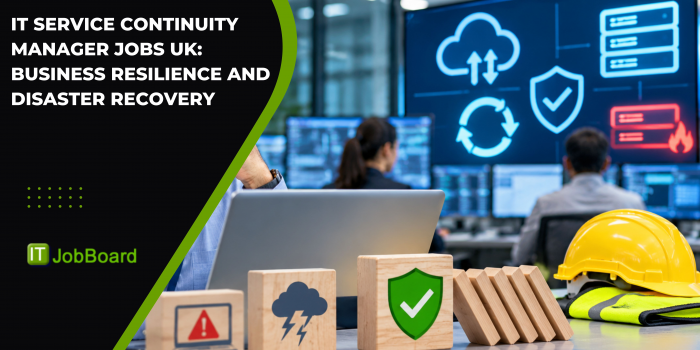
IT Service Continuity Manager Jobs UK: Business Resilience and Disaster Recovery Skills
What Are IT Service Continuity Manager Jobs in the UK?
IT Service Continuity Manager jobs in the UK focus on ensuring that essential technology services can continue operating, or be restored within acceptable timescales, when disruption occurs. These professionals help organisations prepare for system failures, cyber incidents, data loss, cloud outages, supplier problems and other events that affect IT operations.
The role combines IT service management, business continuity, disaster recovery, risk management and stakeholder coordination. Depending on the employer, similar positions may be advertised as IT Resilience Manager, Technology Continuity Manager, Disaster Recovery Manager or Business Continuity and IT Service Manager.
An IT Service Continuity Manager does not necessarily repair every technical issue personally. Instead, the role involves making sure that recovery responsibilities, procedures, resources and testing arrangements are in place before a disruption happens.
Why Is IT Service Continuity Important for UK Organisations?
Organisations rely on technology to deliver services, process transactions, store information and communicate with customers. An extended outage can affect business operations, customer confidence, revenue and regulatory obligations.
Consider a financial services company that loses access to a critical application. A healthcare organisation may experience disruption to an important digital system. An online retailer may be unable to process customer orders because of a cloud service outage.
In these situations, organisations need more than a technical repair. They need a coordinated approach to maintaining essential activities and restoring services.
The National Cyber Security Centre (NCSC), in its guidance on preparing for highly disruptive cyber incidents, identifies business continuity, people, technical recovery and decision-making as important areas of preparation.
This makes IT service continuity relevant to organisations that depend on digital infrastructure, including banks, government departments, healthcare providers, telecommunications companies and technology businesses.
What Does an IT Service Continuity Manager Do?
The responsibilities vary according to the size and complexity of the organisation. Common duties include the following.
1. Developing IT service continuity plans
The manager works with technology and business teams to document how essential services will be maintained during disruption.
Plans may cover system outages, cyber incidents, data centre failures, cloud service interruptions, network problems and supplier disruptions.
They should identify the people responsible for decisions, escalation procedures, communication arrangements and alternative ways of delivering important services.
2. Coordinating disaster recovery planning
Disaster recovery focuses on restoring technology infrastructure, applications, systems and data after a serious disruption.
An IT Service Continuity Manager may coordinate recovery plans with infrastructure teams, cloud engineers, cybersecurity specialists, application owners and external service providers.
The GDS Way disaster recovery guidance explains why digital services need plans for major incidents and why recovery arrangements should be tested.
3. Conducting business impact assessments
A business impact assessment helps an organisation understand how disruption to a particular service could affect its operations.
The manager may work with business departments to identify:
- Critical applications and technology services.
- Dependencies between systems and suppliers.
- The operational impact of service interruptions.
- Recovery priorities.
- Resources required to restore services.
This information helps organisations decide which systems need the highest level of recovery preparation.
4. Managing recovery testing and exercises
A documented recovery plan is useful only if the organisation understands whether it works.
Managers may organise tabletop exercises, technical recovery tests and scenario-based simulations. These activities help teams identify unclear responsibilities, missing resources and technical dependencies.
The NCSC recommends regularly testing and exercising business continuity and recovery arrangements. Its business continuity preparation guidance explains how exercises can reveal weaknesses before a real incident occurs.
5. Reporting risks and continuity performance
IT Service Continuity Managers may prepare reports for senior management, technology leadership, risk committees and service owners.
Reports can cover plan reviews, recovery test results, unresolved risks, service dependencies and improvement actions.
What Technical Skills Are Required for IT Service Continuity Manager Jobs?
The role requires an understanding of technology services and how organisations depend on them. The exact technical requirements differ between employers.
|
Skill area
|
Relevant knowledge
|
|
IT service management
|
ITIL concepts, incident and change management
|
|
Disaster recovery
|
System restoration, backup and recovery procedures
|
|
Business continuity
|
Business impact assessments and continuity plans
|
|
Cloud services
|
Cloud infrastructure and service dependencies
|
|
Cyber resilience
|
Incident response and secure recovery
|
|
Risk management
|
Risk assessment, controls and reporting
|
|
Communication
|
Stakeholder coordination and incident updates
|
|
Testing
|
Recovery exercises and plan validation
|
What Are RTO and RPO?
Two important concepts in disaster recovery are Recovery Time Objective (RTO) and Recovery Point Objective (RPO).
Recovery Time Objective (RTO) describes the target time within which a service should be restored after disruption.
Recovery Point Objective (RPO) describes the maximum acceptable amount of data loss measured in time.
For example, an organisation might set a four-hour RTO for a particular application and an RPO of one hour. These are illustrative targets, not universal standards. Each organisation determines its requirements based on business impact, technical capability and risk.
Candidates applying for continuity roles should understand how these measures influence backup frequency, recovery architecture and service priorities.
Which Qualifications and Certifications Can Help?
Employers may look for experience in IT service management, business continuity, risk management or technology operations.
Relevant qualifications and professional development may include:
- ITIL training for IT service management knowledge.
- ISO 22301-related business continuity training.
- Business continuity and organisational resilience qualifications.
- Cloud platform knowledge, depending on the employer's infrastructure.
- Cybersecurity and incident management training.
ISO 22301 is an internationally recognised standard for business continuity management systems. Candidates can explore the standard through the International Organization for Standardization.
A certification is not automatically required for every vacancy. Employers may place equal or greater importance on experience managing continuity plans, coordinating recovery exercises and working with technology teams.
Can IT Professionals Move into Service Continuity Management?
Yes. Several IT career paths can provide relevant experience.
Potential routes include:
- IT Service Manager
- IT Operations Manager
- Infrastructure Manager
- Disaster Recovery Specialist
- Business Continuity Analyst
- IT Risk Analyst
- Cybersecurity or Incident Response Specialist
For example, an IT operations professional may already understand service dependencies, system availability and incident escalation. Developing knowledge of business impact assessments, recovery objectives and continuity testing can help build the additional capabilities needed for a continuity management role.
People moving from business continuity or risk management may need to strengthen their understanding of IT infrastructure, cloud platforms, applications and technical recovery processes.
What Is the Difference Between an IT Service Continuity Manager and a Disaster Recovery Manager?
The roles are related, but their emphasis can differ.
|
IT Service Continuity Manager
|
Disaster Recovery Manager
|
|
Focuses on continuity of essential IT services
|
Focuses on restoring technology after disruption
|
|
Coordinates business and technology continuity arrangements
|
Coordinates technical recovery activities
|
|
Reviews business impact and service priorities
|
Works with infrastructure, applications and data recovery teams
|
|
Oversees continuity plans and exercises
|
Oversees disaster recovery procedures and testing
|
|
Works across business and IT stakeholders
|
Often works closely with technical teams
|
Some organisations combine both responsibilities into one position. Job titles and reporting structures are not standardised across every employer.
Which UK Industries Employ IT Service Continuity Managers?
Continuity expertise is relevant across sectors where technology availability is important.
Financial services: Banks, insurers and payment providers need plans for disruption to applications, transactions and customer services.
Healthcare: Healthcare organisations depend on digital records, infrastructure and operational systems that need appropriate continuity arrangements.
Government and public services: Departments and agencies need to maintain important digital services during incidents.
Telecommunications: Network and service providers need to prepare for infrastructure failures and service interruptions.
Technology and cloud services: Software companies and managed service providers need recovery arrangements for platforms, data and customer-facing services.
Retail and e-commerce: Businesses depend on payment systems, inventory platforms, websites and customer account services.
The UK Government's Organisational Resilience Guidance provides further context on preparing for disruption, responding effectively and recovering organisational capabilities.
How Should Candidates Prepare for IT Service Continuity Manager Interviews?
Candidates should be ready to explain how they would approach a disruption affecting a critical technology service.
Interview preparation can include:
- Explaining the difference between business continuity and disaster recovery.
- Describing how to conduct a business impact assessment.
- Explaining RTO and RPO using practical examples.
- Discussing how to organise a recovery exercise.
- Describing how to coordinate teams during a major IT incident.
- Explaining how supplier and cloud dependencies affect continuity planning.
- Giving examples of risks identified and improvements implemented.
Candidates should use genuine examples from their work experience. Where they have not managed a major incident, they can explain their approach to a realistic scenario without presenting hypothetical experience as actual work.
What Should Candidates Include in an IT Service Continuity Manager CV?
A relevant CV should demonstrate both technical understanding and the ability to coordinate business and IT stakeholders.
Useful areas to highlight include:
- IT service management experience.
- Business continuity and disaster recovery planning.
- Business impact assessments.
- RTO and RPO knowledge.
- Backup and recovery coordination.
- Cloud and infrastructure dependencies.
- Incident management and stakeholder communication.
- Recovery testing, exercises and improvement reporting.
Where possible, describe measurable outcomes that can be supported by evidence, such as the number of recovery exercises coordinated or the completion of a documented plan review programme.
What Is the Future of IT Service Continuity Management?
Technology environments are increasingly interconnected. Organisations may depend on cloud providers, software platforms, outsourced infrastructure, third-party data services and remote working systems.
This creates continuity challenges that extend beyond an organisation's own servers and networks. A disruption at a supplier can affect services even when internal systems remain operational.
Cyber incidents also make recovery planning more complex. The NCSC's guidance on preparing technical recovery capability highlights the importance of tested backups, restoration processes, infrastructure information and secure recovery arrangements.
For IT professionals, service continuity management offers a career direction combining technology operations, organisational resilience, risk management and leadership.
Key Takeaways
- IT Service Continuity Managers help organisations maintain or restore essential technology services during disruption.
- Business continuity and disaster recovery are connected but have different areas of focus.
- RTO, RPO, business impact assessments and recovery testing are important areas of knowledge.
- Experience in IT operations, service management, infrastructure, risk or business continuity can support entry into the role.
- UK employers across finance, healthcare, government, telecommunications and technology may need continuity expertise.
Frequently Asked Questions
1. What does an IT Service Continuity Manager do?
An IT Service Continuity Manager develops and coordinates plans to maintain or restore essential IT services during disruptions. Responsibilities may include business impact assessments, disaster recovery planning, recovery testing, risk reporting and stakeholder coordination.
2. What qualifications are useful for IT Service Continuity Manager jobs in the UK?
Relevant qualifications may include ITIL training, business continuity management training, ISO 22301-related learning and experience in IT operations or risk management. Requirements vary by employer and seniority.
3. What is the difference between business continuity and disaster recovery?
Business continuity focuses on maintaining essential business activities during disruption. Disaster recovery focuses on restoring technology systems, applications, infrastructure and data after an incident. Both activities should work together.
4. What do RTO and RPO mean in disaster recovery?
Recovery Time Objective (RTO) is the target time for restoring a service after disruption. Recovery Point Objective (RPO) is the maximum acceptable amount of data loss measured in time. Both help organisations define recovery requirements.
5. Can an IT operations professional become an IT Service Continuity Manager?
Yes. IT operations professionals can move into continuity management by developing experience in business impact assessments, recovery planning, risk management, continuity testing and coordination with business stakeholders.