06/11/2026
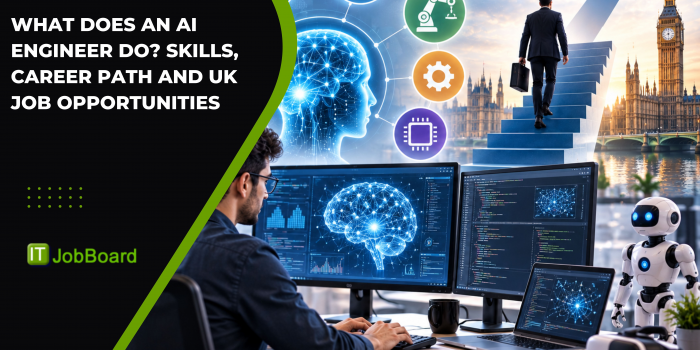
AI/ML Engineer Jobs UK: Skills, Responsibilities and Career Opportunities
What does an AI/ML Engineer do?
AI/ML Engineer jobs in the UK focus on designing, developing, testing and deploying artificial intelligence and machine learning systems. These professionals build software that allows computers to identify patterns, make predictions, process language, recognise images and support automated decision-making.
AI Engineers may work on generative AI applications, intelligent assistants, recommendation systems and automation tools. Machine Learning Engineers often concentrate on training models, evaluating their performance and deploying them into production environments.
The two job titles overlap, and employers do not always use them consistently. However, both require a combination of programming, mathematics, data handling, software engineering and knowledge of machine learning technologies.
As UK organisations introduce AI into their products and business processes, professionals with practical AI development skills are becoming relevant across technology, finance, healthcare, retail, manufacturing and consulting.
Why are AI/ML Engineer jobs growing in the UK?
Artificial intelligence is being adopted across a wide range of business activities. Organisations are exploring how AI can improve customer services, analyse information, automate repetitive work and support complex decisions.
Some examples include:
- Financial organisations using machine learning for fraud detection and risk analysis.
- Retail businesses using recommendation systems and demand forecasting.
- Healthcare organisations exploring AI-supported research and image analysis.
- Technology companies developing generative AI applications.
- Manufacturers using predictive analytics and intelligent automation.
- Professional services firms introducing AI assistants and document-processing systems.
The UK Government's AI sector research and AI skills publications provide evidence of the growing importance of AI-related capabilities across the UK economy.
However, demand differs between employers and locations. Some vacancies require advanced machine learning research experience, while others focus on integrating existing AI models into software products.
What are the main responsibilities of an AI/ML Engineer?
The responsibilities depend on the employer, product and level of seniority. Common areas of work include the following.
1. Developing machine learning models
AI/ML Engineers develop models that identify patterns in data and generate predictions or classifications.
They may work on supervised learning, unsupervised learning, classification, regression, recommendation systems or deep learning.
2. Preparing and analysing data
Machine learning systems depend on suitable training and evaluation data.
Engineers work with data scientists and data engineers to prepare datasets, identify missing information, handle inconsistent records and ensure that data is suitable for model development.
3. Training and evaluating models
Engineers train models using appropriate algorithms and frameworks. They evaluate performance using relevant metrics and compare different approaches.
The choice of evaluation method depends on the application. For example, a classification system may require precision, recall and F1-score analysis rather than relying only on accuracy.
4. Developing generative AI applications
Some AI engineering roles involve building applications that use large language models.
Responsibilities may include connecting models to business data, developing retrieval-augmented generation (RAG) workflows, integrating APIs and evaluating the quality of AI-generated responses.
5. Deploying AI systems
A model must be integrated into an application before users can benefit from it.
Engineers may build APIs, package models, deploy services and connect AI components to cloud platforms and existing software systems.
6. Monitoring and maintaining models
Model performance can change when incoming data or business conditions change.
AI/ML Engineers monitor deployed systems, investigate failures, assess model quality and update models when required. They may also work with MLOps teams to automate testing, deployment and monitoring.
Which technical skills do employers look for?
AI/ML Engineer vacancies typically combine programming, machine learning knowledge and software development experience.
|
Skill area
|
Relevant technologies or knowledge
|
|
Programming
|
Python, SQL, sometimes Java or C++
|
|
Machine learning
|
Scikit-learn, supervised and unsupervised learning
|
|
Deep learning
|
PyTorch, TensorFlow
|
|
Data processing
|
Pandas, NumPy, data preparation
|
|
Generative AI
|
Large language models, embeddings, RAG
|
|
Model deployment
|
APIs, Docker, Kubernetes
|
|
MLOps
|
MLflow, model monitoring, automated pipelines
|
|
Cloud platforms
|
AWS, Microsoft Azure, Google Cloud
|
|
Software development
|
Git, testing, CI/CD
|
|
Mathematics
|
Statistics, probability, linear algebra and optimisation
|
Not every role requires all these technologies. A research-focused position may prioritise deep learning and mathematical knowledge, while a product-focused AI Engineer role may place more emphasis on APIs, cloud services and software engineering.
Which programming languages are important for AI/ML Engineer jobs?
Python is one of the most widely used programming languages in machine learning because of its libraries, development tools and ecosystem.
Important Python libraries and frameworks include:
- Scikit-learn: Used for traditional machine learning algorithms and model evaluation.
- PyTorch: Used for deep learning and neural network development.
- TensorFlow: A framework for developing and training machine learning models.
- Pandas: Used for data manipulation and analysis.
- NumPy: Supports numerical computing and array operations.
SQL is also useful because engineers frequently work with structured data stored in databases.
Some employers may require Java, C++ or other languages when AI systems need to integrate with existing applications or meet particular performance requirements.
What is the difference between an AI Engineer and a Machine Learning Engineer?
The job titles overlap, but they can represent different areas of work.
|
Role
|
Main responsibility
|
|
AI Engineer
|
Builds AI-powered applications and integrates AI capabilities into software products
|
|
Machine Learning Engineer
|
Develops, trains, evaluates and deploys machine learning models
|
|
Data Scientist
|
Analyses data and develops statistical or machine learning approaches to answer business questions
|
|
AI Research Scientist
|
Investigates new AI methods, algorithms and model architectures
|
|
MLOps Engineer
|
Builds systems and processes for reliable model training, deployment and monitoring
|
|
AI Data Engineer
|
Develops data pipelines and platforms that supply information to AI systems
|
For example, an AI Engineer might build a business assistant using an existing language model. A Machine Learning Engineer might develop and optimise a model that powers a prediction service.
In smaller teams, one engineer may perform responsibilities from several of these roles.
Do you need a degree to become an AI/ML Engineer?
A degree in computer science, artificial intelligence, mathematics, statistics, data science or software engineering can provide a useful foundation.
Some research-intensive positions may require postgraduate qualifications or a PhD, particularly when the work involves developing new algorithms or conducting advanced research.
However, many applied engineering positions place significant importance on programming ability, software development experience and practical projects.
Useful subjects include:
- Programming and data structures.
- Linear algebra and calculus.
- Probability and statistics.
- Machine learning algorithms.
- Deep learning.
- Data engineering.
- Cloud computing.
- Software testing and deployment.
Certifications and online courses can help demonstrate learning, but practical experience is important when applying for engineering positions.
How can you build experience for AI/ML Engineer jobs?
Candidates from software development, data analysis, mathematics and IT backgrounds can work towards AI/ML engineering through structured learning.
Step 1: Learn Python. Develop confidence in writing scripts, working with libraries, handling data and building small applications.
Step 2: Strengthen mathematics and statistics. Understand probability, distributions, linear algebra, optimisation and model evaluation.
Step 3: Study machine learning fundamentals. Learn classification, regression, clustering, feature engineering and model validation.
Step 4: Explore deep learning. Practise using PyTorch or TensorFlow to build and train neural networks.
Step 5: Understand AI deployment. Learn how to package models, create APIs, use containers and deploy applications to cloud platforms.
Step 6: Explore generative AI. Study large language models, embeddings, prompt design, RAG and AI application evaluation.
Step 7: Build a portfolio. Create projects such as a recommendation system, document classification tool, forecasting model or AI-powered application. Explain the problem, dataset, methods, evaluation and limitations.
A portfolio should demonstrate more than a working demonstration. Employers benefit from seeing how candidates evaluate accuracy, handle errors and consider the reliability of an AI system.
What salary can AI/ML Engineers earn in the UK?
AI/ML Engineer salaries vary according to experience, technical specialisation, employer, location and the responsibilities of the role.
Junior positions may focus on supporting model development and data preparation. Experienced engineers may take responsibility for production systems, model architecture, optimisation, deployment and technical leadership.
Specialist positions involving deep learning, large language models, distributed training or production MLOps may have different salary levels from general software development roles.
When comparing vacancies, review:
- Advertised base salary and additional benefits.
- Required years of professional experience.
- Whether the position focuses on research or applied engineering.
- Programming and machine learning requirements.
- Cloud, deployment and MLOps responsibilities.
- Location and remote or hybrid working arrangements.
There is no single salary range that accurately represents every AI/ML Engineer position in the UK. Compare vacancies with similar responsibilities and seniority.
Which UK industries recruit AI/ML Engineers?
AI/ML Engineers can work across several sectors.
Technology and software: Develop AI products, intelligent applications, search systems and automation platforms.
Financial services: Build fraud detection, credit risk, forecasting and financial analytics systems.
Healthcare and life sciences: Support research, medical data analysis and AI-assisted applications, subject to appropriate regulatory and data protection requirements.
Retail and e-commerce: Develop recommendation engines, customer analytics and demand forecasting models.
Manufacturing: Build predictive maintenance, computer vision and production optimisation systems.
Consulting: Help businesses introduce machine learning and generative AI into existing operations.
London, Cambridge, Oxford, Bristol, Manchester and Edinburgh are among the UK's established technology and research locations. However, AI-related vacancies can also be found elsewhere, including remote and hybrid opportunities.
What should you include in your AI/ML Engineer CV?
A strong CV should demonstrate how you have applied AI and machine learning to practical problems.
Include:
- Python and SQL programming experience.
- Machine learning algorithms and frameworks.
- PyTorch, TensorFlow or Scikit-learn experience.
- Data preparation and model evaluation.
- Deep learning or generative AI projects.
- API development and model deployment.
- Cloud platforms and MLOps tools.
- Git, testing and software development practices.
- Examples of collaboration with data and engineering teams.
Describe the purpose of each project, the tools used, your individual contribution and the results.
Avoid making unsupported claims about model accuracy or production experience. Clearly distinguish academic projects, personal projects and professional responsibilities.
Key Takeaways
- AI/ML Engineers develop and deploy artificial intelligence and machine learning applications.
- Python, SQL, statistics and machine learning fundamentals are important skills.
- PyTorch, TensorFlow and Scikit-learn are widely used development frameworks.
- Generative AI, RAG and MLOps can provide additional areas of specialisation.
- Software developers, data analysts and data scientists can build towards AI engineering roles.
- Practical projects and production engineering experience can strengthen job applications.
Frequently Asked Questions
1. What does an AI/ML Engineer do?
An AI/ML Engineer develops, tests and deploys artificial intelligence and machine learning systems. Their work can include data preparation, model training, performance evaluation, application integration and production monitoring.
2. Which programming language is best for AI/ML engineering?
Python is a widely used choice because it supports machine learning frameworks and data science libraries. SQL is also valuable for accessing and preparing data. Some roles may require Java or C++.
3. Can a Software Developer become an AI/ML Engineer?
Yes. Software Developers can move towards AI/ML engineering by learning Python, statistics, machine learning algorithms, deep learning frameworks and model deployment. Building practical projects can help demonstrate the necessary skills.
4. Do AI/ML Engineers need a master's degree?
Not every AI/ML engineering position requires a master's degree. A relevant degree can be useful, and postgraduate qualifications may be preferred for research-intensive roles. Applied engineering employers may place greater emphasis on practical programming and machine learning experience.
5. What is the difference between AI Engineering and Machine Learning Engineering?
AI Engineering often focuses on building applications that use artificial intelligence technologies. Machine Learning Engineering focuses more directly on developing, training, evaluating and deploying machine learning models. The responsibilities can overlap depending on the employer.