02/11/2026
AI and Cloud Security Jobs in the UK: Skills Employers Want
AI and cloud security jobs in the UK combine artificial intelligence, cloud computing, software engineering and cybersecurity to help organisations build and operate secure digital systems. Employers may seek professionals with skills in Python, Microsoft Azure, Google Cloud Platform (GCP), automation, identity and access management, AI testing and secure software development.
A recently advertised AI, Machine Learning and Cloud Security position at GSK in London illustrates how these skills can come together in one role. The advertised responsibilities include configuring AI platform environments, maintaining CI/CD documentation, testing AI components and automating pipeline monitoring. However, requirements vary by employer, seniority and the type of security work involved.
For UK job seekers, this career area offers several possible entry points, including cloud security, AI engineering, platform engineering, security testing and machine learning operations.
What Are AI and Cloud Security Jobs?
AI and cloud security jobs involve protecting cloud-based infrastructure, AI applications, machine learning pipelines and the data used by digital systems.
Although these disciplines overlap, they are not identical.
Cloud security focuses on protecting cloud infrastructure, accounts, networks, applications, data and access permissions.
AI security focuses on risks associated with AI systems, including unauthorised tool access, prompt injection, insecure data handling, unsafe outputs and weaknesses in the way models interact with applications.
Some roles concentrate on one discipline, while others combine both.
For example, a cloud security engineer might configure access policies and monitor cloud environments. An AI security engineer might test a large language model application for vulnerabilities. An AI platform engineer could help maintain the infrastructure and automated pipelines on which AI services depend.
The exact responsibilities depend on the employer and job description.
Why Are Employers Seeking AI and Cloud Security Skills in the UK?
The adoption of cloud platforms, automated security tools and AI applications creates new technical and operational requirements for organisations.
The UK government's 2026 cyber security labour-market research reported that AI skills appeared in 9% of online postings for core cybersecurity roles in 2025, compared with 4% in the previous study. Automation skills were mentioned in 15% of these postings in 2025, up from 11% in 2024. These figures indicate changing skill requirements across cybersecurity recruitment, rather than a guarantee that every employer is hiring specifically for AI security.
Several factors help explain the relevance of this skill combination:
- Cloud adoption: Organisations need to protect workloads, identities, applications and data hosted in cloud environments.
- AI deployment: Businesses require reliable processes for testing, monitoring and maintaining AI applications.
- Security automation: Scripts and automated workflows can help teams identify failures and respond more consistently.
- Data protection: AI systems must handle sensitive information appropriately and maintain suitable access controls.
- Operational reliability: Production systems need monitoring, documentation, testing and clear procedures for investigating problems.
These requirements can create opportunities for candidates who understand both software delivery and security fundamentals.
Which Skills Do Employers Want for AI and Cloud Security Jobs?
The most suitable skills depend on whether the position focuses on cloud infrastructure, AI engineering, cybersecurity or platform operations.
1. Python and Automation
Python is useful for automating repetitive technical tasks, monitoring pipelines, processing data and integrating systems.
For example, an engineer might develop a script that checks whether a data ingestion process has failed or whether an API is responding unusually slowly.
Candidates should understand variables, functions, error handling, API interactions, logging and basic testing. More advanced positions may require experience building maintainable automation that operates reliably in production environments.
2. Microsoft Azure and Google Cloud Platform
Knowledge of cloud platforms can help candidates understand how applications and infrastructure are deployed and secured.
Relevant areas include:
- Identity and access management
- Cloud networking
- Permissions and access policies
- Logging and monitoring
- Data protection
- Secrets management
- Secure configuration
- Cloud resource management
Candidates do not necessarily need expert-level knowledge of every platform. The appropriate depth depends on the vacancy.
The GSK advertisement, for example, references Azure and GCP, with cloud fundamentals certifications listed among its preferred qualifications.
3. AI and Machine Learning Fundamentals
Candidates working directly with AI platforms may benefit from understanding large language models (LLMs), retrieval-augmented generation (RAG), embeddings, vector databases and model evaluation.
These concepts help explain how AI applications retrieve information, generate responses and interact with external systems.
For security-focused positions, it is also important to understand how an application controls the information and tools available to a model.
4. CI/CD and Software Delivery
Continuous integration and continuous delivery (CI/CD) processes help teams build, test and release software consistently.
Useful skills include Git, automated testing, pipeline configuration, release controls, version management and troubleshooting failed builds.
For AI platforms, these practices may also apply to data pipelines, model deployment and evaluation workflows.
5. AI Security Testing
AI applications can introduce risks that differ from those found in conventional software.
Examples include prompt injection, inadequate output validation, inappropriate tool permissions and unintended exposure of sensitive data.
Candidates should learn how to design tests, document findings and verify whether security controls work as intended. Understanding recognised guidance, such as the OWASP Top 10 for Large Language Model Applications, can provide a starting point for further learning.
6. Documentation and Communication
Technical documentation is important when several engineering teams, security specialists or external service providers work on the same system.
Candidates may need to document configurations, testing results, known issues, deployment steps and operational procedures.
Clear communication also helps engineers explain risks, report defects and escalate problems before they affect production services.
What Qualifications Do You Need for AI and Cloud Security Jobs?
There is no single qualification required for every AI and cloud security role.
Relevant academic backgrounds can include computer science, software engineering, information technology, cybersecurity, data science or a related technical discipline.
Some employers accept equivalent practical experience, while others specify a degree or particular professional background.
Certifications may help demonstrate knowledge in areas such as:
- Cloud fundamentals
- Cloud security
- Cybersecurity fundamentals
- AI and machine learning fundamentals
- Secure software development
- Platform engineering
For example, Azure or GCP fundamentals certifications may be relevant to early-stage cloud learning. More specialised security certifications may suit candidates pursuing advanced cloud security responsibilities.
Always check the requirements of the particular vacancy before paying for a certification. A qualification is most useful when it supports the skills and experience requested by employers.
How Can You Start a Career in AI and Cloud Security?
A practical route is to develop transferable skills before moving into more specialised work.
Step 1: Build technical foundations. Learn networking, operating systems, Python, Git and basic cybersecurity principles.
Step 2: Choose a cloud platform. Practise deploying a small application, configuring access permissions and reviewing logs in a cloud learning environment.
Step 3: Learn software delivery. Create a basic CI/CD pipeline and use automated tests to check whether changes work as expected.
Step 4: Build a security-focused project. For example, create a small application that uses an AI API, applies access controls, records relevant events and tests for unsafe inputs.
Step 5: Document your work. Explain the architecture, security decisions, test cases, limitations and improvements in a portfolio or project repository.
Step 6: Search for suitable job titles. Consider junior cloud engineer, security analyst, platform engineer, DevSecOps engineer, AI platform engineer and AI security engineer vacancies according to your existing skills.
Candidates should not assume that every AI security position is suitable for beginners. Some vacancies require substantial experience, while others offer opportunities to support senior engineers and develop specialised expertise.
Which UK Job Titles Should You Search For?
Employers may advertise similar responsibilities under different job titles. Searching for several related terms can help candidates discover relevant opportunities.
|
Job title
|
Typical area of responsibility
|
|
AI Security Engineer
|
Security controls and testing for AI applications
|
|
Cloud Security Engineer
|
Cloud infrastructure, access controls and monitoring
|
|
AI Platform Engineer
|
Infrastructure and environments supporting AI systems
|
|
Cloud Engineer
|
Cloud deployment, configuration and operations
|
|
DevSecOps Engineer
|
Integrating security into software delivery
|
|
Machine Learning Engineer
|
Building and deploying machine learning systems
|
|
Security Automation Engineer
|
Automating security processes and workflows
|
|
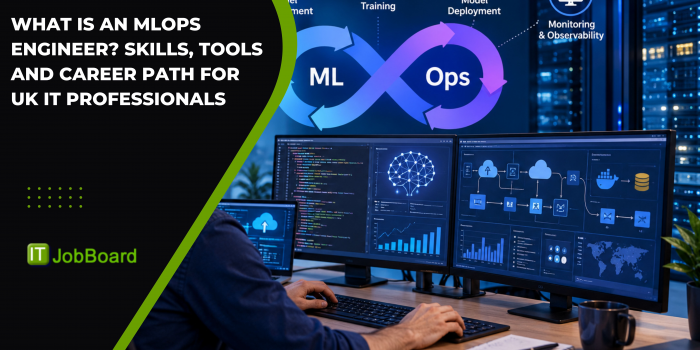
MLOps Engineer
|
Deploying, monitoring and maintaining machine learning systems
|
These titles are not interchangeable. Applicants should compare responsibilities, required skills, seniority and location rather than relying on the title alone.
For UK job searches, check whether a vacancy is based in London, another UK city or a remote or hybrid arrangement. Some positions may require regular office attendance, security clearance or eligibility to work on particular projects.
What Should You Include on Your CV?
A CV for AI and cloud security jobs should demonstrate relevant skills through evidence rather than listing technologies without context.
Where accurate, candidates can highlight:
- Python scripts or automation projects they have developed.
- Experience with Azure, GCP or another cloud platform.
- CI/CD pipelines, testing and version control.
- Cloud security configurations and access controls.
- AI application testing or model deployment projects.
- Troubleshooting, monitoring and technical documentation.
- Certifications that match the advertised requirements.
Describe the problem, your contribution, the tools used and the outcome. If a project was academic or personal rather than professional, identify it honestly.
Avoid claiming production experience, certifications or security responsibilities that you do not have.
Key Takeaways
- AI and cloud security jobs combine skills from cloud computing, cybersecurity, automation and AI engineering.
- Python, cloud fundamentals, CI/CD and security testing are useful areas to develop.
- UK government research indicates that AI and automation skills are becoming more visible in cybersecurity job postings.
- Job titles and qualification requirements vary significantly between employers.
- Practical projects can help candidates demonstrate their abilities, particularly when professional experience is limited.
- Candidates should verify each vacancy's location, eligibility criteria, experience requirements and closing date before applying.
Frequently Asked Questions
1. What are AI and cloud security jobs?
AI and cloud security jobs involve protecting cloud infrastructure, AI applications, data pipelines and related digital systems. Responsibilities can include security testing, access management, automation, monitoring and secure deployment.
2. Which skills are required for AI and cloud security jobs in the UK?
Commonly relevant skills include Python, cloud platforms such as Azure or GCP, identity and access management, CI/CD, security monitoring and AI application testing. Requirements vary by role and seniority.
3. Can beginners apply for AI and cloud security jobs?
Yes, some junior engineering, cloud and security positions may suit candidates with foundational skills and practical projects. However, specialised AI security vacancies may require previous experience in software engineering, cybersecurity or cloud technologies.
4. Do I need a certification to work in AI and cloud security?
Not always. Some employers request particular certifications, while others prioritise practical experience, technical knowledge or academic qualifications. Review the specific job description before choosing a certification.
5. Where can I find AI and cloud security jobs in the UK?
Search IT job boards and employer career websites using terms such as AI security engineer, cloud security engineer, AI platform engineer and DevSecOps engineer. Compare the responsibilities, location, working arrangement and application deadline for each vacancy.