31/08/2026
What Is a Threat Hunter?
The Threat Hunter career path UK is designed for cybersecurity professionals who proactively search for signs of malicious activity inside an organisation's IT environment. Unlike traditional security monitoring, where analysts often respond to alerts generated by security tools, threat hunting involves actively looking for suspicious behaviour that may not have triggered an alert.
Threat Hunters investigate questions such as:
- Is an attacker already inside the network?
- Are compromised credentials being used?
- Are unusual processes running?
- Is malware attempting to establish persistence?
- Are users behaving differently from normal?
- Are endpoints communicating with suspicious infrastructure?
- Are attackers using legitimate tools for malicious purposes?
Threat hunting combines cybersecurity knowledge, data analysis, threat intelligence and investigative thinking.
The role is particularly relevant to professionals who enjoy finding hidden patterns rather than simply responding to automated alerts.
Why Is Threat Hunting Important?
Modern security environments generate enormous amounts of information.
Security teams may collect data from:
- Endpoints
- Servers
- Firewalls
- Cloud platforms
- Identity systems
- Applications
- Network devices
- Email systems
Security tools can automatically identify many known threats, but attackers may use techniques designed to avoid straightforward detection.
Threat hunting provides another layer of defence.
Instead of asking:
"What alerts did our tools generate?"
a Threat Hunter may ask:
"What suspicious behaviour could be happening that our tools have not detected yet?"
This proactive approach can help organisations identify threats earlier.
The UK's cyber skills research identifies cyber threat intelligence as an established cybersecurity specialism and reports ongoing skills gaps across the sector.
What Does a Threat Hunter Do?
A Threat Hunter's daily responsibilities can vary significantly.
Common activities include:
- Developing threat hypotheses
- Searching security data
- Investigating suspicious behaviour
- Analysing endpoint activity
- Reviewing network traffic
- Using threat intelligence
- Investigating indicators of compromise
- Creating detection rules
- Working with SOC teams
- Supporting incident response
- Documenting investigations
- Improving security monitoring
Threat Hunters may also work closely with:
- SOC Analysts
- Incident Responders
- Security Engineers
- Detection Engineers
- Threat Intelligence Analysts
- Cloud Security Engineers
Threat Hunting vs SOC Analyst
These roles overlap, but their primary approaches are different.
|
Area
|
SOC Analyst
|
Threat Hunter
|
|
Security monitoring
|
Core
|
Supporting
|
|
Alert investigation
|
Core
|
Sometimes
|
|
Proactive investigation
|
Limited to moderate
|
Core
|
|
Threat hypotheses
|
Less common
|
Core
|
|
SIEM
|
Core
|
Core
|
|
Threat intelligence
|
Important
|
Very important
|
|
Detection engineering
|
Sometimes
|
Often
|
|
Incident response
|
Supporting
|
Supporting
|
|
Data analysis
|
Important
|
Core
|
A SOC Analyst may receive an alert and investigate it.
A Threat Hunter may begin with a hypothesis and search the environment for evidence.
For example:
SOC approach:
"An endpoint generated an alert. What happened?"
Threat hunting approach:
"Could attackers be using PowerShell to move laterally across our environment?"
Both roles are valuable, but threat hunting is generally more proactive.
What Skills Does a Threat Hunter Need?
1. Networking
Strong networking knowledge is essential.
Learn:
- TCP/IP
- DNS
- HTTP/HTTPS
- Ports
- Routing
- Firewalls
- VPNs
- Proxies
- Network traffic analysis
Understanding normal traffic makes abnormal traffic easier to identify.
2. Windows Security
Windows knowledge is highly valuable because many organisations operate Microsoft environments.
Learn:
- Windows Event Logs
- Active Directory
- PowerShell
- Processes
- Services
- Authentication
- Group Policy
- Windows Registry
Understanding how Windows normally operates helps you identify suspicious behaviour.
3. Linux
Linux is also important, especially in cloud and technology environments.
Learn:
- Processes
- Permissions
- Services
- Shell commands
- Authentication logs
- File systems
- Network connections
4. SIEM
Threat Hunters frequently use SIEM platforms to search large volumes of security data.
Common platforms include:
- Microsoft Sentinel
- Splunk
- Elastic Security
- IBM QRadar
The important skill is not simply knowing the interface.
You need to know how to formulate useful searches.
5. Query Languages
Threat hunting involves working with large datasets.
Depending on the technology environment, useful query languages can include:
- Kusto Query Language
- SPL
- SQL
- Lucene-based query syntax
Being able to construct efficient queries can significantly improve investigation speed.
What Is a Threat Hunting Hypothesis?
A threat hunting hypothesis is a statement about potentially suspicious activity that you want to investigate.
For example:
"An attacker may be using compromised administrator credentials to access systems outside normal working patterns."
The hunter then determines what evidence could support or disprove that hypothesis.
Possible evidence could include:
- Authentication logs
- Geographic login information
- Privilege changes
- Endpoint activity
- Network connections
- Access patterns
This creates a structured investigation rather than randomly searching security data.
What Is Threat Intelligence?
Threat intelligence provides information that helps security teams understand potential threats.
It can include:
- Malicious IP addresses
- Domains
- File hashes
- Malware families
- Attack techniques
- Threat actor behaviour
- Indicators of compromise
Threat Hunters can use intelligence to develop hunting hypotheses.
For example, if intelligence indicates that a particular threat actor commonly uses a specific technique, a Threat Hunter may search the organisation's environment for evidence of that behaviour.
What Is MITRE ATT&CK?
MITRE ATT&CK is a widely used knowledge base describing adversary tactics and techniques.
Threat Hunters can use ATT&CK to understand how attackers may:
- Gain initial access
- Establish persistence
- Escalate privileges
- Move laterally
- Collect information
- Exfiltrate data
- Avoid detection
It can also help security teams structure threat hunting activities.
Instead of simply searching for "malware", analysts can investigate specific attacker behaviours.
What Tools Should a Threat Hunter Learn?
There is no single toolset used by every organisation.
However, useful technologies include:
SIEM
For searching and correlating security logs.
EDR
For investigating endpoint activity.
Network Monitoring
For analysing network connections and traffic.
Threat Intelligence Platforms
For researching indicators and attacker behaviour.
Vulnerability Management Tools
For understanding weaknesses that attackers could exploit.
Cloud Security Tools
For investigating activity within AWS, Azure or Google Cloud environments.
The underlying investigation skills are more important than memorising a specific vendor's product.
Is Python Useful for Threat Hunting?
Yes.
Python can help automate repetitive tasks such as:
- Processing logs
- Analysing indicators
- Querying APIs
- Enriching IP addresses
- Extracting data
- Generating reports
You do not need to become an advanced software developer.
A working knowledge of Python can be enough to improve your efficiency.
What About PowerShell?
PowerShell is particularly useful for Windows-focused threat hunting.
Threat Hunters may use PowerShell to investigate:
- Processes
- Services
- User accounts
- Network connections
- Event logs
- System configuration
PowerShell can also be abused by attackers, making it important for defenders to understand legitimate and suspicious usage.
Threat Hunting and Cloud Security
Threat hunting is no longer limited to traditional corporate networks.
Organisations increasingly operate cloud environments containing:
- Cloud identities
- Virtual machines
- Containers
- APIs
- Storage
- Serverless workloads
- Applications
Threat Hunters therefore need to understand cloud activity.
Examples of cloud hunting questions include:
- Was an administrator account used unexpectedly?
- Was a new access key created?
- Did a user access resources from an unusual location?
- Was a security policy modified?
- Was a large amount of data downloaded?
- Was a new privileged role assigned?
Cloud security knowledge can therefore significantly strengthen a Threat Hunter's profile.
How Can a SOC Analyst Become a Threat Hunter?
SOC Analysts are often well positioned to move into threat hunting.
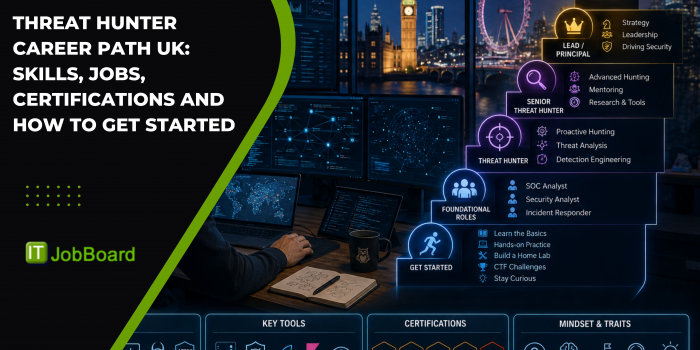
A possible career progression is:
Junior SOC Analyst
↓
SOC Analyst
↓
Senior SOC Analyst
↓
Threat Hunter
Alternatively:
SOC Analyst → Detection Engineer → Threat Hunter
SOC experience provides valuable knowledge of:
- Security alerts
- SIEM
- EDR
- Incident triage
- Log analysis
- Security monitoring
To progress, focus on:
- Threat intelligence
- Advanced query development
- MITRE ATT&CK
- Detection engineering
- Malware behaviour
- Network analysis
- Proactive investigation
Can an Incident Response Analyst Become a Threat Hunter?
Yes.
Incident Response Analysts already investigate real security incidents.
That experience can help them understand:
- Attacker behaviour
- Persistence
- Lateral movement
- Credential compromise
- Malware
- Indicators of compromise
The next step is learning how to proactively search for similar behaviours before an incident becomes obvious.
A possible path is:
Incident Response Analyst → Threat Hunter → Senior Threat Hunter
Can You Become a Threat Hunter Without a Degree?
A degree can be useful, but practical cybersecurity experience is highly valuable.
Candidates can build relevant experience through:
- SOC roles
- IT support
- Network administration
- Security engineering
- Incident response
- Cybersecurity certifications
- Home labs
- Capture-the-Flag challenges
A practical portfolio can demonstrate your ability to investigate security data.
For example, create a project where you:
- Establish a threat hypothesis
- Collect relevant logs
- Write queries
- Identify suspicious activity
- Investigate the evidence
- Map behaviour to MITRE ATT&CK
- Create a detection rule
- Document the investigation
This demonstrates far more than simply stating "interested in threat hunting."
Which Certifications Are Useful for Threat Hunting?
There is no single mandatory certification.
Potential options include:
CompTIA Security+
Useful for building cybersecurity fundamentals.
CompTIA CySA+
Can help develop knowledge around security analytics, detection and incident response.
GIAC Certifications
Specialist GIAC qualifications can be relevant to professionals pursuing advanced security operations, threat hunting and incident response skills.
Cloud Certifications
AWS, Azure or Google Cloud certifications can be useful for professionals working in cloud-heavy environments.
The right certification depends on your experience and target vacancy.
What Soft Skills Does a Threat Hunter Need?
Technical skills are only part of the job.
Curiosity
Threat Hunters need to ask questions that other people may not have considered.
Analytical Thinking
Large amounts of data need to be reduced into meaningful findings.
Persistence
Some investigations may produce no obvious answer initially.
Communication
Findings need to be explained to SOC teams, security leaders and sometimes business stakeholders.
Documentation
A good hunt should be repeatable and understandable by other analysts.
How AI Is Changing Threat Hunting
AI is becoming increasingly relevant to cybersecurity operations.
The UK's 2025 cyber labour-market research found that 53% of cyber security businesses reported using AI in their day-to-day operations, while 65% expected demand for AI skills to increase over the following 12 months.
For Threat Hunters, AI may help with:
- Searching large datasets
- Identifying unusual behaviour
- Summarising investigations
- Generating queries
- Correlating security events
- Enriching indicators
- Prioritising suspicious activity
However, AI does not eliminate the need for human investigation.
Threat Hunters still need to determine whether an apparent pattern represents genuine malicious behaviour or normal business activity.
How to Build a Threat Hunting Home Lab
A practical lab can help you develop job-ready skills.
You could build:
- Windows virtual machine
- Linux virtual machine
- Active Directory environment
- SIEM
- Endpoint monitoring
- Network monitoring
- Sample security logs
Then create hunting scenarios.
Example Hunt 1: Suspicious PowerShell
Search for unusual PowerShell execution and investigate:
- User
- Parent process
- Command line
- Network activity
- Endpoint
Example Hunt 2: Credential Abuse
Search for:
- Unusual login times
- Failed authentication
- Privileged access
- New authentication locations
Example Hunt 3: Lateral Movement
Investigate:
- Remote connections
- Administrative activity
- Unusual authentication
- Internal network traffic
Document each hunt and explain your reasoning.
How to Put Threat Hunting on Your CV
Avoid simply writing:
Threat Hunting
Instead, demonstrate what you actually did.
For example:
Developed SIEM hunting queries to identify suspicious PowerShell execution and mapped findings to MITRE ATT&CK techniques.
Another example:
Conducted a simulated threat hunt using endpoint and authentication logs to identify unusual administrator activity and documented investigation findings.
Specific evidence is more useful to recruiters than generic skill lists.
How to Find Threat Hunter Jobs in the UK
Search for several related titles.
Useful searches include:
- Threat Hunter
- Threat Hunting Analyst
- Cyber Threat Hunter
- Threat Detection Analyst
- Threat Intelligence Analyst
- Detection Engineer
- Security Detection Engineer
- Senior SOC Analyst
- Cybersecurity Analyst
- Threat Researcher
- Security Operations Analyst
Also search for technology combinations such as:
- Threat Hunting Splunk
- Threat Hunting Sentinel
- Threat Hunting EDR
- MITRE ATT&CK Analyst
- Threat Detection Engineer
- Cyber Threat Intelligence
Some employers may include threat hunting responsibilities inside broader Security Analyst or SOC roles.
Threat Hunter Career Progression
A possible career path is:
SOC Analyst
↓
Senior SOC Analyst
↓
Threat Hunter
↓
Senior Threat Hunter
↓
Threat Hunting Lead
↓
Detection Engineering / Threat Intelligence / Security Architecture
There is no single progression route.
Your experience can lead into several specialist areas.
Threat Hunting vs Incident Response
These roles are closely related but have different primary objectives.
Threat Hunting:
"Could an attacker already be present without being detected?"
Incident Response:
"We believe an incident has occurred. What happened and how do we contain it?"
Threat Hunters are proactive.
Incident Responders are generally reactive to identified or suspected incidents.
Professionals who understand both can be particularly effective because they understand both attacker behaviour and incident investigation.
Is Threat Hunting a Good Cybersecurity Career?
Threat hunting can be a strong career direction for professionals who enjoy investigation, data analysis and understanding attacker behaviour.
It combines:
- Security operations
- Threat intelligence
- Network analysis
- Endpoint security
- Cloud security
- Detection engineering
- Incident response
However, it is usually not the easiest cybersecurity role to enter directly.
Many professionals first gain experience in:
- SOC operations
- Security analysis
- Incident response
- Network security
This gives them the technical foundation required for effective threat hunting.
Common Mistakes When Starting Threat Hunting
Only Searching for Known Indicators
Threat hunting should also focus on attacker behaviour.
Ignoring Normal Activity
Understanding normal behaviour is essential for identifying anomalies.
Learning Only One SIEM
Focus on query and investigation principles.
Ignoring Cloud
Modern threat hunting increasingly includes cloud identities and workloads.
Treating AI Results as Fact
AI-generated findings still require human validation.
Not Documenting Hunts
Document your hypotheses, queries, findings and conclusions.
Final Thoughts
The Threat Hunter career path UK offers an advanced cybersecurity direction for professionals who enjoy proactive investigation and understanding how attackers operate.
The role combines SIEM analysis, endpoint security, networking, threat intelligence, cloud security and detection engineering. Strong analytical thinking is just as important as technical knowledge.
For beginners, moving directly into threat hunting may be difficult. A more realistic route is often:
IT / Networking → SOC Analyst → Senior SOC Analyst → Threat Hunter
or:
Cybersecurity Analyst → Incident Response → Threat Hunting
Build practical skills alongside certifications. Learn how to search security data, investigate suspicious behaviour, use MITRE ATT&CK and document repeatable threat hunts.
UK cyber hiring remains skills-focused, with government research showing that employers continue to report technical skills gaps while mid-level and experienced candidates account for a large share of demand.
For candidates searching for Threat Hunter jobs UK, practical evidence can therefore be extremely valuable. A well-documented threat hunting project can demonstrate your ability to think like a defender rather than simply list cybersecurity tools on a CV.
The strongest approach is:
Build cybersecurity fundamentals → gain SOC/security experience → learn threat intelligence → develop advanced queries → practise threat hunting → specialise.
Frequently Asked Questions
1. What does a Threat Hunter do?
A Threat Hunter proactively searches an organisation's systems and security data for signs of malicious activity that automated security controls may have missed.
2. How do I become a Threat Hunter in the UK?
A common route is to start in a SOC or cybersecurity analyst role, develop strong SIEM, networking and endpoint skills, then progress into proactive threat hunting.
3. Do Threat Hunters need programming skills?
Advanced programming is not always required, but Python, PowerShell and scripting skills can help automate investigations and analyse security data.
4. Is Threat Hunting the same as a SOC Analyst?
No. SOC Analysts generally monitor and investigate alerts, while Threat Hunters proactively search for suspicious behaviour and potential threats.
5. Can an Incident Response Analyst become a Threat Hunter?
Yes. Incident Response Analysts already understand attacker behaviour and investigation techniques. Developing proactive hunting and detection skills can help them transition into threat hunting.
6. What tools should a Threat Hunter learn?
Useful technologies include SIEM platforms, EDR tools, network monitoring systems, threat intelligence platforms and cloud security tools.
7. Is MITRE ATT&CK important for Threat Hunters?
Yes. MITRE ATT&CK provides a structured way to understand adversary tactics and techniques and can help Threat Hunters develop investigation hypotheses.
8. Do I need a degree to become a Threat Hunter?
Not necessarily. Practical cybersecurity experience, certifications, technical projects and hands-on security skills can also help candidates progress towards threat hunting roles.
9. Which certifications are useful for Threat Hunting?
Security+, CySA+, specialist GIAC certifications and relevant cloud certifications can be useful depending on your experience and target role.
10. Is Threat Hunting a good cybersecurity career?
Threat hunting can be a strong career direction for professionals who enjoy cybersecurity investigation, threat intelligence, data analysis and understanding attacker behaviour.