28/10/2026
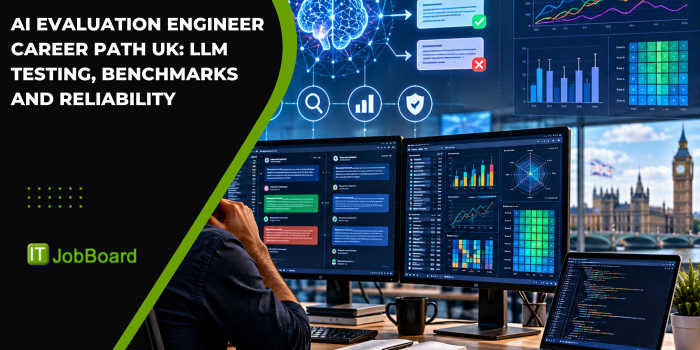
AI Evaluation Engineer Career Path UK: LLM Testing, Benchmarks and Reliability
An AI Evaluation Engineer in the UK tests and measures the performance, reliability, accuracy and safety of artificial intelligence systems. The role involves designing evaluation datasets, creating benchmarks, testing large language models (LLMs), analysing incorrect responses and building automated processes that help teams understand whether an AI system meets its requirements.
As organisations introduce AI into software products, customer services, business workflows and internal tools, they need ways to measure whether these systems perform as expected. UK research on AI skills and labour-market developments highlights the growing importance of specialist technical capabilities alongside practical AI implementation. Evaluation is one area where software testing, data analysis and AI engineering skills can come together.
For IT professionals interested in Python, software quality, data analysis or machine learning, the AI Evaluation Engineer career path offers an opportunity to work on AI quality without necessarily becoming a machine-learning researcher.
What Does an AI Evaluation Engineer Do?
An AI Evaluation Engineer develops methods to determine whether an AI system produces useful, accurate, consistent and safe results.
Typical responsibilities include:
- Designing test cases for AI applications and language models.
- Creating datasets and benchmarks for evaluating model performance.
- Measuring factual accuracy, relevance and response quality.
- Identifying hallucinations, inconsistent answers and failure patterns.
- Building automated evaluation pipelines using Python and relevant tools.
- Comparing model versions, prompts and system configurations.
- Testing how AI systems respond to unusual or adversarial inputs.
- Analysing evaluation results and communicating findings to developers.
- Tracking quality changes when models or applications are updated.
For example, a business may use an AI assistant to answer questions about its product documentation. An evaluation engineer could create a test dataset containing realistic customer questions and verified answers.
The engineer would then assess whether the assistant provides correct information, uses appropriate sources, admits when it lacks information and avoids inventing product details. Repeating these tests after changes helps the team identify regressions before releasing an updated system.
The precise responsibilities depend on the employer. Some roles concentrate on automated testing and software integration, while others involve statistical analysis, model behaviour, safety evaluations or research.
Why Is AI Evaluation Becoming Important?
Traditional software can often be tested against clearly defined expected outputs. Generative AI introduces additional challenges because responses can vary, contain plausible but incorrect information or behave differently depending on the prompt and context.
An AI application may produce a convincing answer that is factually wrong. It may perform well on common questions but fail on less familiar examples. It may also give different answers to similar questions.
Evaluation helps organisations identify these issues before they affect users.
Three developments make this work relevant:
AI moving into production: Businesses need evidence that AI features perform reliably under real-world conditions.
Frequent model changes: Updating a model, prompt or retrieval system can improve some tasks while making others worse.
Reliability and safety requirements: Organisations need to assess factuality, privacy, harmful outputs, bias and other risks appropriate to the application.
AI evaluation does not guarantee that a system will never fail. It provides structured evidence about performance, helps identify weaknesses and supports informed release decisions.
Which Skills Do You Need for AI Evaluation Engineer Jobs in the UK?
1. Python Programming
Python is useful for writing evaluation scripts, processing datasets, automating tests and analysing results.
Candidates should understand functions, data structures, file handling, APIs, JSON and error handling. Experience with libraries such as pandas and testing frameworks such as pytest can also be useful.
A practical exercise is to create a script that compares an AI assistant's responses with reference answers and produces a report showing failed test cases.
2. Large Language Model Fundamentals
You should understand how LLM-based applications work, including prompts, context windows, token limits, model outputs and retrieval-augmented generation (RAG).
RAG systems retrieve relevant information from documents or databases before generating a response. Evaluating these systems may involve checking both the relevance of retrieved information and the accuracy of the final answer.
You do not need to train a foundation model to begin learning evaluation, but understanding how the application works makes it easier to design meaningful tests.
3. Test Design and Quality Assurance
Software testing skills are highly transferable to AI evaluation.
Learn how to write test cases, define expected behaviour, organise test datasets, reproduce defects and report issues clearly. Understand regression testing, boundary testing and negative testing.
AI testing requires additional care because an acceptable response may have multiple valid forms. Some evaluations therefore use scoring rubrics, semantic similarity, structured checks or human review rather than exact text matching alone.
4. Data Analysis and Statistics
Evaluation engineers need to interpret results rather than simply count successful tests.
Useful skills include calculating success rates, comparing performance across datasets, understanding sample sizes and identifying patterns in failures. More advanced roles may require statistical testing, confidence intervals, experiment design or analysis of model performance across different user groups.
5. Evaluation Frameworks and Tools
Explore tools and frameworks used to measure LLM application quality. Depending on the project, these may include:
- OpenAI Evals for organising evaluations.
- DeepEval for testing LLM applications.
- Ragas for evaluating aspects of retrieval-augmented generation.
- LangSmith for tracing and evaluating applications built with supported workflows.
- pytest for integrating repeatable checks into software testing.
Tools evolve quickly, and not every employer uses the same stack. Understanding evaluation principles is more valuable than memorising a long list of product names.
6. Clear Reporting and Critical Thinking
Evaluation results need to inform engineering and product decisions.
Candidates should be able to explain what was tested, which failures occurred, how serious those failures are and what limitations apply to the results. Critical thinking is important because an evaluation score can be misleading if the dataset is too small, the rubric is poorly defined or the test does not reflect real user behaviour.
How Is an AI Evaluation Engineer Different From an AI Tester?
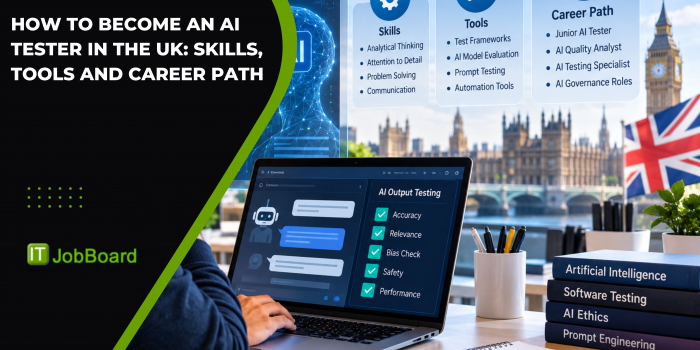
An AI Tester generally focuses on testing an AI-powered application to check whether it behaves according to functional, performance, security and usability requirements.
An AI Evaluation Engineer often places greater emphasis on measuring model or system quality through datasets, benchmarks, evaluation metrics and repeatable experiments.
For example, an AI Tester might verify that a chatbot loads correctly, handles errors and displays responses as expected. An AI Evaluation Engineer might measure whether the chatbot answers 500 representative questions accurately, follows a scoring rubric and maintains performance after a model update.
The distinction is not absolute. Some organisations use the titles interchangeably, while others separate application testing, model evaluation and AI safety evaluation into different teams.
When comparing vacancies, examine the responsibilities rather than relying only on the job title.
How Can You Become an AI Evaluation Engineer in the UK?
A structured learning path can help you build the required combination of programming, testing and AI knowledge.
Step 1: Learn Python and software testing. Practise writing scripts, testing functions, processing data and reporting defects.
Step 2: Understand LLM applications. Experiment with an AI assistant, prompts and a simple RAG application. Learn how the application retrieves information and generates responses.
Step 3: Build an evaluation dataset. Create a collection of representative questions, reference answers and scoring criteria. Use public or synthetic data that you have permission to use.
Step 4: Automate the evaluation. Write a script that runs test cases, records outputs and calculates relevant metrics. Include clear checks for failures and missing results.
Step 5: Analyse weaknesses. Categorise errors such as factual inaccuracies, incomplete answers, irrelevant responses and unsupported claims. Compare results after changing a prompt or application configuration.
Step 6: Document your project. Explain your test methodology, dataset limitations, scoring rules, results and recommendations in a portfolio or Git repository.
Step 7: Search for relevant vacancies. Look for AI Evaluation Engineer, LLM Evaluation Engineer, AI Quality Engineer, AI Test Engineer, AI Engineer and Machine Learning Engineer positions that include evaluation responsibilities.
This pathway is suitable for software testers, QA engineers, Python developers, data analysts and AI practitioners who want to specialise in evaluating AI systems.
Which Qualifications Can Help?
There is no single qualification required for every AI evaluation position.
A computer science, software engineering, data science or related degree may be relevant to technical roles. However, some employers also consider practical experience, professional training and demonstrable project work.
Useful learning areas include:
- Python programming and automated testing.
- Machine-learning fundamentals.
- Data analysis and statistics.
- Software quality assurance.
- LLM application development.
- AI safety, responsible AI and evaluation methods.
More research-oriented positions may expect deeper knowledge of machine learning, experimental design or statistical methods. Application-focused positions may prioritise Python, APIs, test automation and experience integrating AI services into software products.
Choose training according to the actual requirements of the vacancies you want to pursue.
What Career Opportunities Are Available in the UK?
AI evaluation skills may be used by AI product companies, software developers, consultancies, research organisations and businesses deploying generative AI applications.
Related job titles include:
- AI Evaluation Engineer
- LLM Evaluation Engineer
- AI Quality Engineer
- AI Test Engineer
- Machine Learning Engineer
- AI Engineer
- AI Safety Evaluation Specialist
- Software Development Engineer in Test
Not every employer advertises a dedicated AI Evaluation Engineer position. Evaluation responsibilities may instead appear within AI engineering, quality assurance, software testing or AI research vacancies. Recent industry analysis also suggests that evaluation skills can be requested within broader AI roles rather than appearing in the job title itself.
Career progression may lead towards senior AI engineering, evaluation platform development, AI quality leadership or specialist AI safety work, depending on your skills and the organisation.
How Can You Find Relevant AI Jobs on IT Job Board UK?
When searching for opportunities, use several related job titles rather than relying on one exact phrase. Review vacancies for Python, software testing, software engineering, data analysis and AI development where the responsibilities match your experience.
Suggested internal links for IT Job Board UK include:
- Testing Jobs — link to the relevant Testing category.
- Python Jobs — link to the Python category.
- Software Engineer Jobs — link to the Software Engineer category.
- Software Development Jobs — link to the Software Development category.
- Data Scientist Jobs — link to the Data Scientist category.
- Information Technology Jobs — link to the Information Technology category.
Use the live category URLs available on the website. These links can help readers explore related vacancies and discover adjacent career paths.
Key Takeaways
- AI Evaluation Engineers measure the quality, reliability and safety of AI applications and language models.
- Important skills include Python, LLM fundamentals, test design, data analysis and evaluation frameworks.
- Evaluation involves more than checking whether an application runs; it measures whether outputs meet defined quality criteria.
- Software testers, QA engineers, developers and data professionals may have transferable skills.
- A portfolio project with a documented dataset, evaluation method and results can demonstrate practical ability.
- Related skills may be requested under AI engineering, software testing and AI quality job titles.
Frequently Asked Questions
1. What is an AI Evaluation Engineer?
An AI Evaluation Engineer designs and runs tests to measure the accuracy, reliability, consistency and safety of AI systems. The role often involves creating datasets, defining metrics, automating evaluations and analysing model failures.
2. What skills are required for AI Evaluation Engineer jobs in the UK?
Commonly relevant skills include Python, software testing, large language model fundamentals, data analysis, evaluation metrics and experience with LLM evaluation frameworks. Requirements vary by employer and seniority.
3. Do AI Evaluation Engineers need to know Python?
Python is useful for automating tests, processing evaluation datasets, integrating APIs and analysing results. Some roles may also require SQL, other programming languages or experience with particular AI development tools.
4. What is the difference between AI evaluation and AI testing?
AI testing often checks whether an AI application meets functional, performance and reliability requirements. AI evaluation more specifically measures the quality of model or system outputs using datasets, benchmarks, scoring criteria and repeatable experiments. The responsibilities can overlap.
5. How can I start a career in AI evaluation?
Start by learning Python, software testing and LLM fundamentals. Build a small evaluation project using representative questions, reference answers, scoring criteria and an automated results report. Then apply for relevant AI evaluation, AI quality, software testing or AI engineering positions.