17/08/2026
AI Engineer vs Machine Learning Engineer: What’s the Difference and Which Career Is Better in the UK?
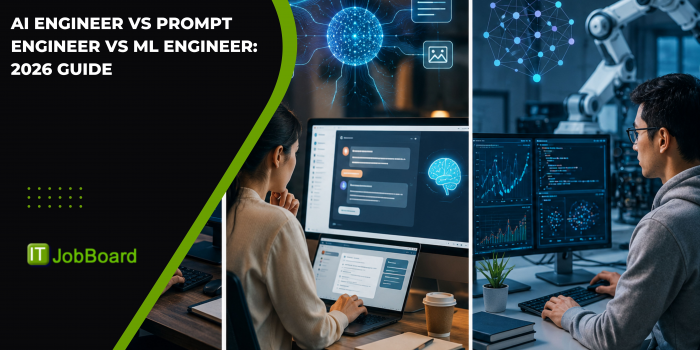
If you're comparing AI Engineer vs Machine Learning Engineer, the distinction can be confusing because both careers involve artificial intelligence, programming, data and machine-learning technologies. The biggest difference is usually the scope of the work. Machine Learning Engineers focus heavily on building, training, deploying and maintaining machine-learning models, while AI Engineers often work across a broader range of AI technologies, including machine learning, generative AI, large language models and AI-powered applications.
As organisations increasingly integrate AI into products, services and internal processes, both career paths are becoming relevant to the UK technology job market. Understanding how the roles differ can help job seekers decide which skills to develop and which career path best matches their interests.
What Is an AI Engineer?
An AI Engineer develops and implements applications that use artificial intelligence.
Depending on the organisation, an AI Engineer may work with:
- Machine learning
- Generative AI
- Large language models
- Natural language processing
- Computer vision
- Recommendation systems
- AI APIs
- AI agents
- Retrieval-augmented generation
- Model deployment
The role is often application-focused.
For example, an AI Engineer might build a customer-support application that uses a large language model to answer questions based on a company's internal documentation.
The engineer may need to integrate the model, build the application, connect databases, implement security controls and monitor the system.
What Is a Machine Learning Engineer?
A Machine Learning Engineer focuses more heavily on developing and operating machine-learning systems.
Typical responsibilities include:
- Preparing training data
- Developing models
- Training models
- Evaluating model performance
- Deploying models
- Monitoring models
- Optimising inference
- Automating machine-learning workflows
Machine Learning Engineers often work closely with Data Scientists.
A Data Scientist may develop an experimental model, while the Machine Learning Engineer helps turn that model into a reliable production system.
AI Engineer vs Machine Learning Engineer: The Main Difference
The simplest distinction is:
AI Engineer: builds applications and systems using AI technologies.
Machine Learning Engineer: focuses more heavily on developing and operationalising machine-learning models.
There is considerable overlap.
An AI Engineer may work with machine learning.
A Machine Learning Engineer may work with generative AI.
The exact responsibilities depend heavily on the organisation.
What Does an AI Engineer Do?
An AI Engineer may:
- Integrate AI models into applications
- Build AI-powered features
- Work with LLM APIs
- Develop AI agents
- Build RAG systems
- Implement prompt workflows
- Connect AI models to databases
- Monitor AI applications
- Improve application performance
- Work with software engineering teams
This makes software development an important part of the role.
What Does a Machine Learning Engineer Do?
Machine Learning Engineers may:
- Prepare training pipelines
- Train models
- Deploy models
- Optimise models
- Build inference systems
- Monitor model performance
- Automate ML workflows
- Manage model versions
- Improve scalability
The role can therefore involve both machine learning and software engineering.
AI Engineer vs Machine Learning Engineer Skills
|
Skill
|
AI Engineer
|
Machine Learning Engineer
|
|
Python
|
Essential
|
Essential
|
|
Machine Learning
|
Important
|
Core skill
|
|
Generative AI
|
Very important
|
Increasingly important
|
|
LLMs
|
Very important
|
Important
|
|
Software Engineering
|
Core skill
|
Very important
|
|
Statistics
|
Useful
|
Very important
|
|
Data Engineering
|
Important
|
Important
|
|
MLOps
|
Important
|
Core skill
|
|
Cloud
|
Very important
|
Very important
|
|
APIs
|
Very important
|
Important
|
|
Deep Learning
|
Useful
|
Very important
|
|
Prompt Engineering
|
Useful
|
Useful
|
|
System Design
|
Very important
|
Important
|
How Much Python Do AI Engineers Need?
Python is one of the most useful programming languages for AI work.
AI Engineers may use Python to:
- Connect to AI models
- Build APIs
- Process data
- Automate workflows
- Create AI applications
- Integrate machine-learning libraries
Python can therefore be a valuable foundation for professionals interested in AI Jobs UK.
However, AI Engineers should also understand software engineering principles rather than focusing only on Python syntax.
How Much Mathematics Does a Machine Learning Engineer Need?
Machine Learning Engineers generally benefit from stronger mathematical knowledge than many AI application developers.
Important areas include:
- Probability
- Statistics
- Linear algebra
- Calculus
- Optimisation
You don't necessarily need to be a mathematician to start learning machine learning.
However, understanding the underlying concepts can help you understand:
- How models learn
- Why models fail
- How algorithms are evaluated
- How optimisation works
AI Engineering and Generative AI
Generative AI has expanded the scope of AI engineering.
AI Engineers may now work with:
- Large language models
- Text generation
- Image generation
- Speech models
- AI assistants
- AI agents
- Retrieval-augmented generation
Instead of training a model from scratch, many organisations use existing foundation models and build applications around them.
This has created new technical requirements.
AI Engineers may need to understand:
- APIs
- Prompt design
- Vector databases
- Embeddings
- RAG
- Model evaluation
- AI application security
What Is RAG?
RAG stands for Retrieval-Augmented Generation.
A RAG system allows an AI application to retrieve relevant information from an external knowledge source before generating an answer.
A simplified process looks like:
User Question
↓
Search Knowledge Base
↓
Retrieve Relevant Information
↓
Send Context to AI Model
↓
Generate Response
RAG can be useful when businesses want AI applications to answer questions using their own documents or knowledge bases.
Machine Learning and MLOps
Machine Learning Engineers frequently work with MLOps.
MLOps combines:
Machine Learning + Software Engineering + Operations
It helps teams manage machine-learning systems throughout their lifecycle.
This can include:
- Data pipelines
- Model training
- Model deployment
- Model monitoring
- Version control
- Infrastructure
- Automation
MLOps skills can therefore be valuable for professionals targeting Machine Learning Engineer Jobs UK.
AI Engineer vs Machine Learning Engineer Salary in the UK
Salary depends on experience, location, industry and technical specialisation.
Broad indicative ranges include:
|
Experience
|
AI Engineer
|
Machine Learning Engineer
|
|
Junior
|
£40,000–£55,000
|
£40,000–£55,000
|
|
Mid-level
|
£55,000–£80,000
|
£55,000–£85,000
|
|
Senior
|
£80,000–£110,000+
|
£80,000–£110,000+
|
|
Specialist/Lead
|
£100,000+
|
£100,000+
|
These are broad market indications rather than guaranteed salaries.
Professionals with expertise in generative AI, large-scale machine learning, cloud infrastructure and production AI systems may command particularly competitive compensation.
AI Engineer vs Data Scientist
These roles also overlap.
A Data Scientist may focus on:
- Data analysis
- Statistical modelling
- Experiments
- Predictive models
- Business insights
An AI Engineer may focus more on:
- Building AI applications
- Integrating models
- Deploying AI systems
- Software engineering
- AI infrastructure
This creates a potential career pathway:
Data Scientist → AI Engineer
for professionals who develop stronger software engineering and deployment skills.
AI Engineer vs Data Engineer
Data Engineers build the infrastructure that makes data available.
AI Engineers use data and AI models to build intelligent applications.
For example:
Data Engineer
→ builds data pipelines
↓
AI Engineer
→ uses the data to power an AI application
↓
End User
→ interacts with the AI-powered product
This means Data Engineering and AI Engineering can work closely together.
Why Cloud Skills Matter
Modern AI applications increasingly rely on cloud infrastructure.
AI Engineers may need to understand:
- Cloud compute
- Storage
- Networking
- APIs
- Containers
- Kubernetes
- Security
- Model deployment
Cloud platforms can also provide specialised machine-learning services.
This makes Cloud Computing a useful supporting skill for AI professionals.
AI and Cybersecurity
AI applications introduce new security considerations.
AI Engineers may need to consider:
- Data privacy
- Access controls
- Model security
- Prompt injection
- Data leakage
- Authentication
- API security
This creates opportunities for professionals who combine AI with Cyber Security knowledge.
AI security is likely to become increasingly important as organisations deploy AI systems into business-critical environments.
AI Engineer Career Path
A possible pathway is:
Junior AI Engineer
↓
AI Engineer
↓
Senior AI Engineer
↓
Lead AI Engineer
↓
AI Architect
↓
Principal AI Engineer
Alternative directions include:
- Machine Learning Engineer
- MLOps Engineer
- AI Solutions Architect
- Generative AI Engineer
- AI Product Engineer
Machine Learning Engineer Career Path
A possible pathway is:
Junior Machine Learning Engineer
↓
Machine Learning Engineer
↓
Senior Machine Learning Engineer
↓
Staff/Lead ML Engineer
↓
Principal Machine Learning Engineer
Possible specialisations include:
- Computer Vision
- Natural Language Processing
- Recommendation Systems
- MLOps
- Generative AI
- Machine Learning Infrastructure
Which Career Is Better for Software Developers?
Software Developers may find AI Engineering a relatively natural transition.
Existing development skills can transfer to:
- APIs
- Application architecture
- Testing
- Version control
- Backend development
- Cloud deployment
The main additional skills are likely to involve:
- AI models
- Machine learning fundamentals
- LLMs
- RAG
- AI evaluation
Machine Learning Engineering is also possible, but may require deeper mathematics and ML knowledge.
Which Career Is Better for Data Scientists?
Data Scientists may find Machine Learning Engineering a natural progression.
They already understand:
- Data
- Statistics
- Machine learning
- Model evaluation
The missing skills may include:
- Software engineering
- Cloud
- APIs
- Containers
- CI/CD
- Infrastructure
- MLOps
Alternatively, Data Scientists interested in generative AI applications could transition toward AI Engineering.
Is Generative AI Creating New Jobs?
Generative AI is contributing to the emergence and evolution of technology roles.
Job titles may include:
- Generative AI Engineer
- AI Engineer
- LLM Engineer
- AI Solutions Engineer
- MLOps Engineer
- AI Product Engineer
Not every employer will use these exact titles.
The underlying skills are often more important than the title.
Which Career Is More Future-Proof?
Both careers have strong potential, but AI technology is evolving rapidly.
AI Engineers who understand:
- Software engineering
- Cloud
- LLMs
- RAG
- AI agents
- Security
- Data
can adapt as AI tools evolve.
Machine Learning Engineers who understand:
- Model development
- MLOps
- Cloud
- Distributed systems
- Model deployment
- Generative AI
can also adapt to changing technology.
The strongest strategy is therefore to build transferable technical foundations rather than learning one AI tool.
How to Start an AI Engineering Career
Step 1: Learn Python
Build strong programming fundamentals.
Step 2: Learn Software Engineering
Understand:
- Git
- APIs
- Testing
- Databases
- Application architecture
Step 3: Learn AI Fundamentals
Understand:
- Machine learning
- Neural networks
- Generative AI
- LLMs
Step 4: Build AI Projects
Examples:
- AI chatbot
- Document assistant
- Recommendation system
- RAG application
Step 5: Learn Cloud
Deploy your applications using a cloud platform.
Step 6: Learn AI Security
Understand data protection and AI-specific security risks.
How to Start a Machine Learning Engineering Career
Step 1: Learn Python
Step 2: Learn SQL
Step 3: Study Statistics
Step 4: Learn Machine Learning
Understand:
- Regression
- Classification
- Clustering
- Model evaluation
Step 5: Learn Deep Learning
Study neural networks and modern deep-learning frameworks.
Step 6: Learn MLOps
Understand model deployment and monitoring.
Step 7: Build Production Projects
Don't only build models in notebooks.
Learn how to turn models into reliable applications.
Internal Link Suggestions
This article gives you strong opportunities to connect to existing IT Job Board categories.
|
Anchor Text
|
Suggested Section
|
|
AI Jobs
|
Introduction / AI career section
|
|
Machine Learning Jobs
|
Machine Learning section
|
|
Python Jobs
|
Python section
|
|
Data Scientist Jobs
|
Data Scientist comparison
|
|
Data Engineer Jobs
|
Data Engineering section
|
|
Software Engineer Jobs
|
Software developer pathway
|
|
Developer Jobs
|
Career transition
|
|
Cloud Computing Jobs
|
Cloud section
|
|
Cyber Security Jobs
|
AI security
|
|
DevOps Jobs
|
MLOps section
|
|
Data Analyst Jobs
|
Data career pathway
|
|
SQL Jobs
|
ML engineering pathway
|
|
IT Jobs
|
Introduction
|
|
Graduate IT Jobs
|
Entry-level pathway
|
Natural Internal-Link Examples
Professionals moving from Software Engineer Jobs into AI can build on their existing programming and application-development experience.
Those interested in analytics may first explore Data Analyst Jobs before progressing toward Data Science or Machine Learning.
Strong Python Jobs experience can provide a useful foundation for both AI Engineering and Machine Learning Engineering.
Professionals interested in production AI systems should also understand Cloud Computing Jobs and modern cloud infrastructure.
AI security is another emerging area connecting Cyber Security Jobs with artificial intelligence.
AI Engineer vs Machine Learning Engineer: Which Should You Choose?
Choose AI Engineering if you enjoy:
- Software development
- AI applications
- Generative AI
- LLMs
- APIs
- AI agents
- Product development
Choose Machine Learning Engineering if you enjoy:
- Machine learning
- Statistics
- Model development
- Data
- MLOps
- Model optimisation
- Production ML systems
There is no universally better option.
Your existing background should influence your decision.
Software Developer → AI Engineer can be a natural transition.
Data Scientist → Machine Learning Engineer can also be a natural transition.
Data Engineer → MLOps / ML Engineering is another increasingly relevant pathway.
Conclusion
The AI Engineer vs Machine Learning Engineer distinction is becoming increasingly important as organisations expand their use of artificial intelligence.
AI Engineers often focus on building applications powered by AI technologies, including generative AI and large language models. Machine Learning Engineers focus more heavily on developing, deploying and maintaining machine-learning models and systems.
Both careers require strong programming skills, and both benefit from knowledge of cloud computing and modern data infrastructure.
The best career choice depends on your interests.
If you enjoy building applications and experimenting with generative AI, AI Engineering may be the better fit. If you prefer machine-learning models, statistics and production ML systems, Machine Learning Engineering may be more suitable.
For either path, focus on durable skills such as Python, software engineering, cloud computing, data, machine learning and automation. AI tools will continue to change, but those foundations can remain valuable across different technologies and job titles.
FAQs
1. What is the difference between an AI Engineer and a Machine Learning Engineer?
AI Engineers generally build applications and systems using a broad range of AI technologies, while Machine Learning Engineers focus more specifically on developing, deploying and maintaining machine-learning models.
2. Is AI Engineering a good career in the UK?
Yes. AI Engineering combines software development with artificial intelligence and can lead to opportunities across technology, finance, retail, healthcare and other industries.
3. Is Machine Learning Engineering difficult to learn?
It can require a strong combination of programming, mathematics, statistics, machine learning and software engineering. However, a structured learning path can make the transition manageable.
4. Does an AI Engineer need Python?
Python is one of the most useful programming languages for AI Engineering, particularly for working with AI models, data and machine-learning libraries.
5. Does a Machine Learning Engineer need mathematics?
A solid understanding of statistics, probability, linear algebra and optimisation can be valuable for Machine Learning Engineers.
6. Can a Software Engineer become an AI Engineer?
Yes. Software engineering provides a strong foundation for AI Engineering. Additional knowledge of machine learning, LLMs, AI APIs and AI application architecture can help with the transition.
7. Can a Data Scientist become a Machine Learning Engineer?
Yes. Data Scientists already have relevant knowledge of statistics, data and machine learning. Developing software engineering, cloud and MLOps skills can support the transition.
8. Are Generative AI jobs growing?
Generative AI is creating and reshaping technology roles, including AI Engineering, LLM development, AI application development and MLOps. The exact job titles vary between employers.
9. Which pays more, AI Engineer or Machine Learning Engineer?
Both can offer strong salaries. Compensation depends on experience, location, industry and technical specialisation. Professionals working on advanced AI and machine-learning systems can command competitive salaries.