13/07/2026
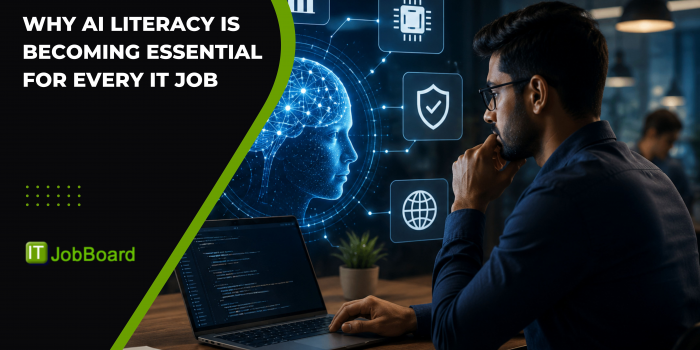
Why AI Literacy Is Becoming Essential for Every IT Job
Artificial intelligence is no longer limited to specialist machine learning teams. Today, AI Literacy in IT Jobs has become an essential skill for software developers, cloud engineers, cybersecurity professionals, data analysts, system administrators, and many other technology roles. Employers are increasingly looking for candidates who understand how AI works, where it can be applied, and how to use AI-powered tools responsibly to improve productivity and solve business problems. Rather than replacing IT professionals, artificial intelligence is changing the way they work, making AI literacy one of the most valuable skills for long-term career success.
Across the UK technology sector, organisations are investing heavily in AI-powered solutions to automate repetitive tasks, improve customer experiences, strengthen cybersecurity, and analyse business data more efficiently. As a result, hiring managers now expect IT professionals to possess at least a foundational understanding of AI, even if their primary role does not involve developing machine learning models.
What Is AI Literacy?
AI literacy refers to the ability to understand the fundamentals of artificial intelligence, recognise its practical applications, evaluate its limitations, and use AI tools effectively and responsibly.
Being AI literate does not mean you need to become a data scientist or AI researcher. Instead, it means understanding concepts such as:
- Machine Learning
- Generative AI
- Large Language Models (LLMs)
- Prompt Engineering
- AI Ethics
- Automation
- AI-powered productivity tools
- Data privacy and security
Professionals who understand these concepts can adapt more quickly as AI becomes integrated into everyday business operations.
Why Employers Value AI Literacy
Businesses are adopting AI because it helps teams work faster, reduce costs, and improve decision-making. Employers therefore want candidates who can collaborate with AI tools rather than avoid them.
IT professionals with AI knowledge often contribute by:
- Automating repetitive development tasks
- Improving software testing
- Analysing large datasets
- Enhancing cybersecurity monitoring
- Optimising cloud infrastructure
- Supporting intelligent business applications
Instead of viewing AI as a replacement for employees, most organisations see it as a productivity enhancer that enables teams to focus on more strategic work.
AI Literacy Benefits Every IT Role
One of the biggest misconceptions is that AI knowledge is only useful for AI Engineers. In reality, almost every IT role is evolving because of artificial intelligence.
Software Developers
Developers increasingly use AI-powered coding assistants to:
- Generate code suggestions
- Detect bugs
- Write documentation
- Create unit tests
- Improve code quality
Understanding how these tools work allows developers to become more productive without sacrificing quality.
Internal Anchor Text: Developer Jobs
Cloud Engineers
Cloud platforms now provide integrated AI services that organisations use for automation, analytics, and application development.
Cloud Engineers who understand AI can:
- Deploy AI services
- Manage AI infrastructure
- Optimise cloud resources
- Support AI-enabled applications
This combination of cloud and AI expertise is becoming highly attractive to employers.
Cyber Security Professionals
Artificial intelligence is transforming cyber security by helping organisations detect threats faster and respond to attacks more effectively.
Security professionals benefit from AI by:
- Identifying suspicious behaviour
- Detecting malware
- Analysing security logs
- Automating incident response
- Reducing false positives
However, they must also understand how cybercriminals use AI, making AI literacy increasingly important for defensive strategies.
Data Analysts
Modern analytics platforms increasingly use AI to identify trends, generate reports, and provide predictive insights.
AI-literate Data Analysts can:
- Prepare higher-quality data
- Use AI-assisted analytics
- Interpret AI-generated insights
- Support better business decisions
Rather than replacing analysts, AI helps them focus on strategic analysis instead of repetitive reporting.
AI Literacy Goes Beyond Technical Skills
Employers are not only interested in technical knowledge. They also value professionals who can apply AI responsibly within business environments.
Important skills include:
- Critical thinking
- Problem-solving
- Communication
- Ethical decision-making
- Understanding AI limitations
- Verifying AI-generated outputs
These abilities help organisations use AI effectively while reducing potential risks.
AI-Powered Productivity Tools Are Becoming Standard
Many IT teams now use AI-powered tools in their daily workflows, including:
- AI coding assistants
- Intelligent documentation tools
- Automated testing platforms
- AI-powered monitoring solutions
- Chat-based knowledge assistants
- Code review assistants
Professionals who understand how to use these tools efficiently often complete tasks faster while maintaining high standards of quality.
Continuous Learning Is Essential
Artificial intelligence continues to evolve rapidly, making continuous learning one of the most valuable habits for IT professionals. Employers increasingly appreciate candidates who stay informed about emerging technologies, experiment with new AI tools, and invest in professional development.
Developing AI literacy does not require mastering every AI framework or programming language. Instead, it involves building a solid understanding of how AI supports different business functions and learning how to apply it responsibly within your role.
How to Build AI Literacy for Your IT Career
Developing AI Literacy in IT Jobs does not require an advanced degree in artificial intelligence. Most IT professionals can gradually build their knowledge through practical learning and hands-on experience. The goal is to understand how AI fits into your role and how it can improve your productivity.
Here are some practical ways to strengthen your AI literacy:
- Learn the fundamentals of machine learning and generative AI.
- Explore AI-powered tools relevant to your profession.
- Practice writing effective prompts for AI assistants.
- Stay updated with AI trends and industry developments.
- Understand AI ethics, security, and responsible use.
- Work on small AI-assisted projects to gain practical experience.
Continuous learning is one of the biggest advantages in today's technology job market. Even dedicating a few hours each week to AI learning can help you stay ahead of changing employer expectations.
IT Career Advice
AI Literacy Is Becoming a Competitive Advantage
As AI adoption continues to grow, employers are beginning to view AI literacy as a core professional skill rather than a specialist qualification. Candidates who understand how to use AI responsibly often demonstrate greater adaptability, stronger problem-solving abilities, and a willingness to embrace innovation.
This competitive advantage applies across a wide range of IT careers, including:
- Software Engineers
- Cloud Engineers
- DevOps Engineers
- Cyber Security Analysts
- Data Analysts
- Business Analysts
- QA Testers
- System Administrators
- Network Engineers
Whether you're applying for your first IT role or aiming for a senior leadership position, AI literacy can help you stand out during recruitment and improve your long-term career prospects.
The Future of AI Literacy in IT Jobs
Artificial intelligence will continue to reshape the technology industry, but success will depend on how professionals adapt. The future belongs to individuals who combine technical expertise with the ability to collaborate effectively with AI tools.
Instead of fearing automation, IT professionals should focus on developing complementary skills such as critical thinking, creativity, communication, ethical decision-making, and continuous learning. These human strengths, combined with AI literacy, will remain highly valuable as technology evolves.
For job seekers, investing in AI literacy today is an investment in long-term career resilience. Employers are increasingly seeking professionals who can leverage AI to improve efficiency, solve complex problems, and drive innovation across their organisations.
Conclusion
Artificial intelligence is no longer a niche technology reserved for specialist teams—it is becoming part of everyday work across the IT industry. As organisations continue to integrate AI into software development, cloud computing, cybersecurity, data analysis, and IT operations, AI Literacy in IT Jobs is quickly becoming an essential skill for professionals at every career stage.
Developing AI literacy does not mean replacing your existing technical expertise. Instead, it means learning how to use AI responsibly, understand its capabilities and limitations, and apply it to improve productivity and decision-making. Professionals who embrace continuous learning and combine strong technical skills with AI knowledge will be better positioned to secure rewarding career opportunities in an increasingly competitive technology job market.
If you're planning your next career move, now is the ideal time to strengthen your AI skills and explore the latest Software Engineer Jobs, AI Engineer Jobs, Cloud Engineer Jobs, and other exciting opportunities across the IT sector.
Frequently Asked Questions (FAQs)
1. What is AI literacy in IT jobs?
AI literacy in IT jobs refers to understanding the fundamentals of artificial intelligence, knowing how AI tools work, and applying them responsibly to improve productivity and solve business problems.
2. Do I need programming experience to become AI literate?
No. While programming knowledge can be helpful, AI literacy focuses on understanding AI concepts, using AI-powered tools effectively, and recognising their strengths and limitations.
3. Which IT roles benefit most from AI literacy?
Almost every IT role can benefit, including Software Developers, Cloud Engineers, Cyber Security Analysts, Data Analysts, DevOps Engineers, Business Analysts, QA Testers, and IT Support professionals.
4. How can I improve my AI literacy?
You can improve your AI literacy by learning AI fundamentals, exploring AI-powered productivity tools, practising prompt engineering, understanding AI ethics, and staying updated with emerging technologies.
5. Will AI literacy improve my career opportunities?
Yes. Employers increasingly value professionals who can work alongside AI technologies, making AI literacy a valuable skill that can enhance employability, career progression, and long-term job security.