06/10/2026
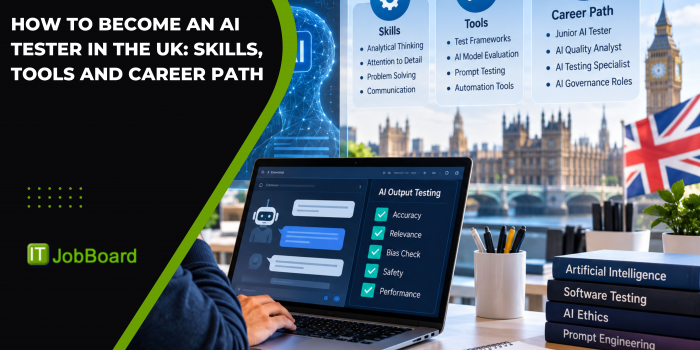
How to Become an AI Tester in the UK: Skills, Tools and Career Path
Direct Answer
An AI Tester evaluates artificial intelligence systems to determine whether they produce reliable, accurate, secure and appropriate results under different conditions.
AI testing extends traditional software testing by examining areas such as model outputs, data quality, hallucinations, robustness, bias, prompt behaviour, security and AI system reliability.
A software tester does not necessarily need to become a machine-learning engineer to move into AI testing. However, knowledge of software quality assurance, automation, data and AI fundamentals can provide a useful foundation.
As AI becomes more integrated into software development and business processes, testing and verification are also evolving. Skills England's 2026 assessment highlights the increasing importance of AI literacy, verification, assurance and oversight within digital and technology work.
What Is AI Testing?
AI testing is the process of evaluating an artificial intelligence system to determine whether it behaves as intended.
Traditional software normally follows predefined rules.
AI systems can produce outputs based on models, data, prompts, context and other variables.
For example, an AI chatbot may provide a different response when the wording of a question changes.
An AI Tester therefore needs to evaluate not only whether the application works, but also how consistently and safely the AI behaves across different scenarios.
What Does an AI Tester Do?
The responsibilities depend on the organisation and AI technology being tested.
Typical activities can include:
- Creating AI test cases
- Testing model outputs
- Testing edge cases
- Evaluating accuracy
- Checking response consistency
- Testing AI integrations
- Validating data
- Testing APIs
- Testing prompts and instructions
- Identifying unexpected behaviour
- Testing security controls
- Recording defects
- Automating repetitive tests
- Retesting fixes
- Reporting findings to developers and product teams
An AI Tester may work closely with software developers, data scientists, machine-learning engineers, product managers and cybersecurity professionals.
How Is AI Testing Different from Traditional Software Testing?
There is significant overlap between the two disciplines.
Traditional software testing commonly examines whether predefined inputs produce expected outputs.
AI testing can involve additional questions:
- Is the generated answer factually reliable?
- Does the model behave consistently?
- What happens with unusual inputs?
- Can the system be manipulated?
- Does the system expose sensitive information?
- Does performance change with different data?
- Does the model produce inappropriate or biased outputs?
- What happens when the model is integrated with another application?
This makes AI testing a multidisciplinary area.
What Skills Does an AI Tester Need?
1. Software Testing
A strong understanding of software testing remains important.
Useful areas include:
- Functional testing
- Regression testing
- Integration testing
- System testing
- Test planning
- Defect management
- Test case design
2. Automation Testing
Automation can help testers run large numbers of repeatable tests.
Experience with automation frameworks and scripting can therefore be valuable.
3. AI Fundamentals
AI Testers should understand basic concepts such as:
- Machine learning
- Generative AI
- Large language models
- Training data
- Inference
- Model evaluation
- AI agents
The level of knowledge required depends on the role.
4. Data Skills
AI systems depend heavily on data.
Useful knowledge includes:
- Data quality
- Data validation
- Data preparation
- Data analysis
- Data formats
- Data pipelines
5. Python
Python can be particularly useful for AI testing because it is widely used for automation, data processing and machine-learning workflows.
However, Python is not necessarily mandatory for every AI testing position.
6. Analytical Thinking
AI testing frequently involves investigating unusual outputs.
The tester needs to identify patterns, reproduce issues and determine why an AI system behaves differently under specific conditions.
What Types of AI Testing Are There?
AI testing can involve several areas.
Functional AI Testing
This checks whether the AI application performs the intended task.
Model Performance Testing
This evaluates metrics appropriate to the specific model or application.
Robustness Testing
The tester examines how the system behaves when inputs change or become unusual.
Security Testing
Security testing can examine whether an AI application can be manipulated or whether information can be exposed.
Data Testing
This examines whether data used by the AI system meets the required quality and validation criteria.
Output Evaluation
For generative AI, testers may evaluate whether responses meet defined quality criteria.
Regression Testing
When a model, prompt, application or supporting component changes, regression testing can help identify unexpected changes in behaviour.
What Tools Can AI Testers Use?
The technology stack varies between employers.
Potential tools and technologies include:
- Python
- API testing tools
- Automated testing frameworks
- Cloud platforms
- Data validation tools
- Model evaluation frameworks
- Version-control systems
- Logging platforms
- Monitoring systems
- AI evaluation tools
A job description should therefore be checked carefully rather than assuming that every AI Tester role uses the same tools.
How Can a Software Tester Become an AI Tester?
An existing QA professional can gradually add AI skills.
A possible learning sequence is:
Software Testing → Test Automation → Python → Data Fundamentals → AI Fundamentals → AI Evaluation
For example, someone who already understands regression testing and API testing could learn how to evaluate AI-generated outputs and test AI-specific failure scenarios.
This approach builds on existing testing experience rather than starting from zero.
Can a Data Analyst Become an AI Tester?
Yes, depending on the role.
A Data Analyst already has experience working with data, identifying patterns and analysing results.
They may need to develop additional knowledge in:
- Software testing
- Test case design
- Automation
- APIs
- AI systems
- Quality assurance
The combination of data analysis and testing can be useful for roles involving AI evaluation and data validation.
Can a Developer Become an AI Tester?
Developers can also transition into AI testing.
Programming experience can help with:
- Automated testing
- API testing
- Test frameworks
- Debugging
- AI integrations
- Data processing
A developer moving into AI testing would typically need to strengthen their knowledge of testing methodologies and AI evaluation.
Do AI Testers Need a Degree?
There is no single educational requirement that applies to every AI Tester position.
Relevant educational backgrounds can include:
- Computer science
- Information technology
- Software engineering
- Data science
- Artificial intelligence
- Mathematics
Employers can also consider professional experience, certifications, apprenticeships and demonstrable technical skills.
Skills England's assessment of the UK digital and technology sector recognises multiple routes into digital careers, including higher education, apprenticeships and other skills pathways.
What Certifications Can Help?
The most appropriate certification depends on the individual's existing experience and target role.
Potentially relevant areas include:
- Software testing
- Test automation
- Cloud
- Data
- Cybersecurity
- Artificial intelligence
A certification should support practical knowledge rather than replace it.
For AI testing specifically, employers may place greater emphasis on the ability to demonstrate practical testing and evaluation skills.
What Is the Career Path for an AI Tester?
A possible career progression is:
QA Tester → Software Test Engineer → Automation Test Engineer → AI Test Engineer → AI Quality Engineer → AI Testing Lead
Another route could be:
Data Analyst → AI Evaluation Specialist → AI Quality Specialist
Job titles vary between employers, particularly because AI testing is still an evolving specialism.
What Industries Could Hire AI Testing Professionals?
AI testing skills can be relevant wherever organisations develop or deploy AI applications.
Potential sectors include:
- Financial services
- Technology
- Telecommunications
- Retail
- Manufacturing
- Professional services
- Healthcare
- Automotive
- Government
- Insurance
The testing requirements will depend on the type of AI system and how it is used.
What Should You Put on an AI Testing CV?
An AI testing CV can highlight practical skills such as:
- Software testing
- Test automation
- Python
- API testing
- Data analysis
- AI/ML fundamentals
- Model evaluation
- Generative AI
- Defect management
- Regression testing
- Security testing
Where possible, describe what was tested and what outcome was achieved rather than simply listing technologies.
For example, instead of writing:
“AI testing experience.”
A stronger skills description could explain the type of AI application tested, testing methodology used and how defects or quality issues were identified.
What Is the Future of AI Testing?
AI testing is likely to continue evolving as organisations use AI in more applications.
The role may increasingly involve a combination of:
QA + automation + data + AI evaluation + security + assurance.
Skills England's 2026 digital and technology assessment identifies verification, assurance and oversight as increasingly relevant capabilities as AI changes technology workflows.
This means traditional testing experience can remain relevant while professionals add new AI-specific capabilities.
Key Takeaways
- AI Testers evaluate AI systems for quality, reliability, security and expected behaviour.
- AI testing builds on traditional software testing but introduces additional AI-specific challenges.
- Python, automation, data and AI fundamentals can strengthen an AI Tester profile.
- QA professionals can transition into AI testing by adding AI and data skills.
- Developers and Data Analysts can also move toward AI testing with additional QA knowledge.
- There is no single qualification required for every AI Tester role.
- AI testing combines software quality assurance with AI evaluation and verification.
Frequently Asked Questions
What is an AI Tester?
An AI Tester evaluates artificial intelligence systems to determine whether they produce reliable, accurate, secure and appropriate results.
What skills do AI Testers need?
AI Testers can benefit from software testing, automation, Python, data analysis, AI fundamentals, API testing and analytical skills.
Can a software tester become an AI Tester?
Yes. A software tester can build on existing QA and automation experience by learning AI fundamentals, data concepts and AI evaluation techniques.
Does an AI Tester need Python?
Python is useful for automation, data processing and AI-related testing, but it is not mandatory for every AI testing position.
Is AI testing the same as machine-learning engineering?
No. Machine-learning engineers generally develop and maintain machine-learning systems, while AI Testers focus on evaluating their quality, reliability, behaviour and performance.