05/10/2026
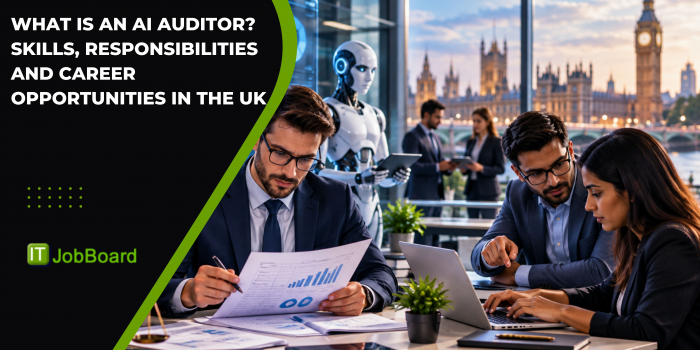
What Is an AI Auditor? Skills, Responsibilities and Career Opportunities in the UK
Direct Answer
An AI Auditor reviews how artificial intelligence systems are designed, developed, deployed and governed. The role examines areas such as AI risk, data, security, transparency, documentation, controls, accountability and compliance.
AI Auditing combines knowledge from IT audit, cybersecurity, data governance, risk management, artificial intelligence and responsible technology. An AI Auditor does not necessarily build AI models; instead, they assess whether AI systems are being developed and used with appropriate controls and oversight.
As organisations increasingly integrate AI into business processes, AI assurance and governance are becoming important areas of digital and technology work. UK government skills research highlights AI, governance, risk management and assurance as relevant capabilities within the changing digital and cyber security skills landscape.
What Does an AI Auditor Do?
An AI Auditor examines an organisation's AI systems, processes and controls.
Depending on the employer, responsibilities may include:
- Reviewing AI governance policies
- Assessing AI-related risks
- Reviewing data sources and data management processes
- Checking model documentation
- Examining security and access controls
- Reviewing AI testing procedures
- Assessing monitoring processes
- Examining audit trails and documentation
- Reviewing human oversight arrangements
- Identifying gaps in governance controls
- Preparing audit reports
- Communicating findings to technical and business teams
- Following up on remediation activities
The exact responsibilities depend on the organisation, industry and type of AI systems being audited.
Why Is AI Auditing Becoming Important?
AI systems can influence business operations, customer interactions, internal processes and decision-making.
This creates questions that organisations need to answer.
For example:
What data does an AI system use?
Who is responsible for the system?
How is its performance monitored?
What happens when the system produces an incorrect result?
How are security and privacy risks managed?
Is there sufficient human oversight?
An AI Auditor can help organisations examine these areas systematically.
The UK's 2026 digital and technology skills assessment identifies the growing importance of AI-related capabilities including oversight, verification, assurance and responsible use of AI.
What Skills Does an AI Auditor Need?
AI auditing requires a combination of technical and governance skills.
1. AI Literacy
An AI Auditor should understand the basic principles behind:
- Machine learning
- Generative AI
- Large language models
- AI applications
- Model training and inference
- AI agents
- Automated decision systems
The auditor does not necessarily need to be a machine-learning engineer, but they need enough technical understanding to evaluate risks and controls.
2. IT Audit Skills
Traditional IT audit knowledge remains valuable.
This can include:
- IT controls
- Access management
- Change management
- System documentation
- Risk assessment
- Control testing
- Evidence collection
- Audit reporting
3. Cybersecurity Knowledge
AI systems can interact with applications, APIs, databases and cloud platforms.
Understanding cybersecurity can therefore help an AI Auditor assess:
- Authentication
- Authorisation
- Data security
- Vulnerability management
- Security monitoring
- Third-party risks
- Incident management
UK cyber skills research also identifies AI-related skills alongside governance, risk management and security capabilities.
4. Data Governance
AI systems depend heavily on data.
Useful knowledge includes:
- Data quality
- Data lineage
- Data access
- Data classification
- Data protection
- Data retention
- Data management
5. Risk Management
AI Auditors need to identify potential risks and determine whether appropriate controls exist.
This means understanding concepts such as:
- Risk identification
- Risk assessment
- Risk treatment
- Control design
- Control effectiveness
- Risk monitoring
6. Communication
An AI Auditor may need to communicate findings to developers, security professionals, executives, compliance teams and business managers.
The ability to explain technical risks in straightforward language is therefore important.
AI Auditor vs IT Auditor: What Is the Difference?
An IT Auditor generally examines technology systems and IT controls.
An AI Auditor may examine those areas as well but adds AI-specific considerations.
|
IT Auditor
|
AI Auditor
|
|
IT controls
|
AI and IT controls
|
|
Access management
|
AI access and model controls
|
|
Infrastructure
|
AI infrastructure and applications
|
|
Cybersecurity
|
AI security and AI-specific risks
|
|
System changes
|
Model and system changes
|
|
IT governance
|
AI governance
|
|
General technology risk
|
AI-related technology and operational risk
|
|
IT documentation
|
AI/model documentation
|
There is considerable overlap between the two roles.
An experienced IT Auditor can therefore build AI knowledge without necessarily starting their career again from the beginning.
AI Auditor vs AI Tester
These roles can also overlap, but they have different primary objectives.
An AI Tester generally evaluates whether an AI system behaves as expected.
Testing may examine:
- Accuracy
- Reliability
- Performance
- Robustness
- Model outputs
- Edge cases
- Safety
An AI Auditor can examine the wider environment around the AI system, including:
- Governance
- Policies
- Controls
- Documentation
- Risk management
- Accountability
- Monitoring
- Evidence
In some organisations, these responsibilities may be performed by different teams.
How Can You Become an AI Auditor in the UK?
There is no single route into AI auditing.
Professionals can potentially move into the field from several technology and governance backgrounds.
Route 1: IT Audit
An existing IT Auditor can add:
AI fundamentals + AI governance + data knowledge + responsible AI
Route 2: Cybersecurity
A cybersecurity professional can develop:
AI fundamentals + governance + risk assessment + audit skills
Route 3: Data
A data professional can develop:
Data governance + AI fundamentals + risk + audit methodology
Route 4: AI/Technology
An AI or software professional can develop:
Governance + risk management + control assessment + audit reporting
The most useful combination depends on the role and employer.
Do AI Auditors Need to Know How to Code?
Not necessarily.
An AI Auditor does not usually need the same level of programming expertise as an AI Engineer or Machine Learning Engineer.
However, technical knowledge can be valuable.
Understanding Python, APIs, databases, cloud environments and AI architectures can help an auditor understand the systems they are reviewing.
The requirement will vary significantly between employers.
What Qualifications Can Help?
There is no single qualification specifically required for every AI Auditor role.
Relevant backgrounds can include:
- Computer science
- Information technology
- Cybersecurity
- Information systems
- Data science
- Risk management
- Internal audit
- IT audit
- Compliance
Professional certifications in IT audit, cybersecurity, risk or related areas may also be relevant depending on the position.
Practical experience can be equally important because AI auditing requires an understanding of how technology systems operate in real organisations.
What Is the Career Path for an AI Auditor?
A potential career progression could look like:
IT Auditor → Technology Risk Analyst → AI Governance Analyst → AI Risk Specialist → AI Auditor → AI Assurance Specialist
Another route could be:
Cybersecurity Analyst → Security Auditor → AI Security/Governance → AI Auditor
There is no standard career ladder because organisations use different job titles for AI governance and assurance work.
Where Can AI Auditors Work?
AI auditing skills can potentially be relevant across industries using artificial intelligence.
Examples include:
- Financial services
- Technology
- Professional services
- Retail
- Telecommunications
- Manufacturing
- Healthcare
- Government
- Insurance
The specific audit requirements will depend on how AI is being used and the risks associated with those applications.
What Is the Future of AI Auditing?
AI auditing is likely to develop alongside the wider adoption of artificial intelligence.
As AI systems become embedded in software, business processes and decision workflows, organisations may need stronger methods for documenting, monitoring and assessing AI-related risks.
Skills England's digital and technology assessment highlights the growing importance of AI literacy, assurance, verification and responsible AI capabilities as AI changes how technology work is performed.
This means AI auditing is not simply a technical AI career. It sits at the intersection of technology, governance, risk, security and business operations.
Key Takeaways
- An AI Auditor evaluates AI systems, controls, governance and associated risks.
- AI auditing combines technology, risk and governance skills.
- IT audit, cybersecurity and data professionals can develop relevant skills for AI auditing.
- Coding is useful but is not necessarily required for every AI Auditor position.
- AI Auditors may assess documentation, security, data, governance, monitoring and accountability.
- AI Auditor job titles and responsibilities can vary between organisations.
- AI auditing is an emerging specialism within the wider technology risk and assurance landscape.
Frequently Asked Questions
What is an AI Auditor?
An AI Auditor reviews artificial intelligence systems, processes and controls to identify risks and assess whether appropriate governance and oversight are in place.
What skills does an AI Auditor need?
Important skills can include AI literacy, IT audit, risk management, cybersecurity, data governance, control assessment and communication.
Does an AI Auditor need programming skills?
Programming is not always required, but technical knowledge of AI systems, APIs, databases or cloud platforms can be useful.
Can an IT Auditor become an AI Auditor?
Yes. IT audit provides a relevant foundation, and professionals can build additional knowledge in AI, governance, data and responsible technology.
Is AI auditing the same as AI testing?
No. AI testing generally focuses on evaluating system or model behaviour, while AI auditing can examine governance, controls, documentation, risk and accountability.