23/09/2026
What Does an AI Engineer Do? Skills, Career Path and UK Job Opportunities
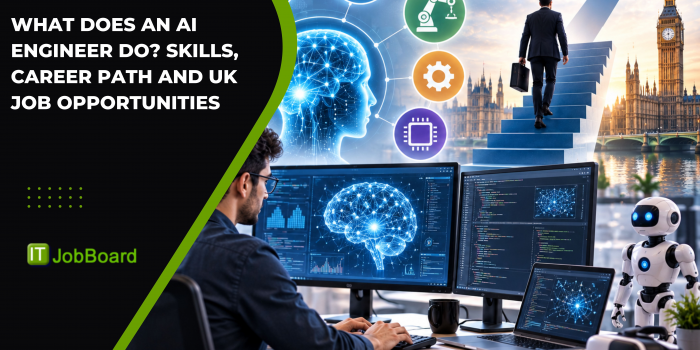
Artificial intelligence is increasingly being integrated into software products, business applications and digital services. An AI Engineer helps design, develop, integrate and maintain AI-powered systems, combining software engineering with artificial intelligence, data and machine learning technologies.
Direct answer: An AI Engineer develops and integrates AI capabilities into real-world applications. Depending on the role, this can include working with machine learning models, generative AI, large language models, APIs, data pipelines, evaluation systems and production software. The role often sits between traditional software engineering and specialist AI or machine learning work.
What does an AI Engineer do?
An AI Engineer turns AI techniques and models into usable technology.
Instead of focusing only on theoretical research, AI Engineers often work on how AI systems function inside real applications.
Their work may involve:
- Developing AI-powered applications
- Integrating AI models into software
- Working with machine learning models
- Building generative AI features
- Developing AI APIs
- Preparing and processing data
- Evaluating model performance
- Improving AI application reliability
- Deploying AI systems
- Monitoring AI applications
The exact responsibilities vary significantly between employers.
An AI Engineer working on an enterprise chatbot may have a very different day-to-day role from an engineer building computer-vision systems for industrial applications.
What are the main responsibilities of an AI Engineer?
AI engineering can cover several stages of developing an AI-powered application.
Developing AI applications
AI Engineers may build applications that use AI to perform tasks such as:
- Text classification
- Document processing
- Recommendation
- Search
- Prediction
- Image analysis
- Speech processing
- Conversational assistance
- Content generation
The engineer needs to connect the AI capability with the wider software application.
Working with AI models
Depending on the position, an AI Engineer may work with:
- Machine learning models
- Natural language processing models
- Computer vision models
- Generative AI models
- Large language models
- Speech models
- Recommendation models
Some engineers build models themselves, while others integrate existing models through APIs or machine learning platforms.
Integrating AI into software
A model on its own does not necessarily constitute a complete product.
AI Engineers may connect models to:
- Web applications
- Mobile applications
- Databases
- APIs
- Cloud platforms
- Enterprise systems
- Data pipelines
This is where conventional software engineering skills become particularly important.
Testing and evaluating AI systems
AI applications need to be evaluated to understand whether they are producing useful and reliable results.
Depending on the system, engineers may measure:
- Accuracy
- Relevance
- Latency
- Reliability
- Error rates
- Model performance
- User feedback
- Cost
Generative AI systems may require additional evaluation because their outputs can vary between requests.
Deploying and monitoring AI systems
An AI application needs to operate effectively after development.
AI Engineers may work on:
- Cloud deployment
- Model serving
- APIs
- Monitoring
- Logging
- Performance optimisation
- Scaling
- Version management
This creates overlap with cloud engineering, DevOps and machine learning engineering.
What skills does an AI Engineer need?
AI Engineer jobs typically combine programming, AI knowledge and software engineering.
Programming skills
Python is widely used in AI and machine learning.
Depending on the job, engineers may also encounter:
Python is particularly common because of its extensive AI and data ecosystem.
Machine learning knowledge
AI Engineers may need to understand concepts such as:
- Supervised learning
- Unsupervised learning
- Model training
- Model evaluation
- Feature engineering
- Neural networks
- Deep learning
- Model inference
The required depth depends on whether the role involves developing models or primarily integrating existing AI capabilities.
Generative AI knowledge
Modern AI Engineer roles may include technologies such as:
- Large language models
- Retrieval-augmented generation
- Embeddings
- Vector databases
- Prompt engineering
- AI agents
- Model evaluation
- AI APIs
However, not every AI Engineer role is focused on generative AI.
Software engineering
Strong software development practices are important because AI systems usually form part of larger applications.
Useful skills include:
- Version control
- APIs
- Testing
- System design
- Databases
- Cloud computing
- CI/CD
- Application development
Does an AI Engineer need Python?
Python is one of the most useful programming languages for AI engineering, particularly for machine learning, data processing and AI application development.
Common Python technologies in AI work can include machine-learning and data libraries, model frameworks and API tooling.
However, knowing Python alone is not enough for most AI engineering positions.
Employers may also look for:
- Software engineering
- Machine learning
- Data handling
- Cloud
- APIs
- Deployment
- Testing
Candidates should therefore read the complete job description rather than treating Python as the only requirement.
What is the difference between an AI Engineer and a Machine Learning Engineer?
The roles overlap considerably.
An AI Engineer may have a broader focus on integrating artificial intelligence into applications and products.
A Machine Learning Engineer often has a stronger focus on developing, deploying and maintaining machine learning models and associated pipelines.
For example:
AI Engineer:
“How can we integrate an AI capability into this product?”
Machine Learning Engineer:
“How should this machine learning model be developed, deployed and maintained?”
In practice, employers sometimes use the titles interchangeably, so the actual responsibilities in the job description are important.
How does an AI Engineer work with large language models?
AI Engineers working with generative AI may build applications around large language models rather than training a foundation model from scratch.
Their work can include:
- Connecting applications to model APIs
- Designing retrieval systems
- Working with embeddings
- Building RAG applications
- Creating evaluation processes
- Managing prompts
- Adding guardrails
- Monitoring model responses
- Connecting models to business data
For example, an organisation could build an internal knowledge assistant that retrieves relevant company information and provides it to an LLM before generating a response.
The engineering challenge involves much more than simply sending a prompt to a model.
What is Retrieval-Augmented Generation?
Retrieval-Augmented Generation (RAG) is an approach in which relevant information is retrieved from a knowledge source and provided to a generative AI model as context.
An AI Engineer working on a RAG application may need to understand:
- Data ingestion
- Document processing
- Chunking
- Embeddings
- Vector search
- Retrieval
- Prompt construction
- Model responses
- Evaluation
RAG is one example of the type of applied AI engineering work that can connect software engineering, data and generative AI.
How can you become an AI Engineer?
There are several routes into AI engineering.
Professionals may come from:
- Software engineering
- Data science
- Machine learning
- Data engineering
- Backend development
- Cloud engineering
- Research
- Computer science
A degree in computer science, artificial intelligence, mathematics, statistics, data science or a related subject can provide relevant foundations.
However, practical experience is also important.
Candidates can develop experience through:
- AI projects
- Machine learning projects
- Software applications using AI APIs
- Data projects
- Open-source contributions
- Internships
- Graduate roles
What qualifications are useful for AI Engineer jobs?
Requirements vary significantly.
Potentially relevant educational backgrounds include:
- Computer science
- Artificial intelligence
- Data science
- Mathematics
- Statistics
- Software engineering
- Engineering
Employers may also value cloud, machine learning or AI-specific certifications.
For research-heavy roles, postgraduate education may be more common than in application-focused AI engineering.
For practical AI application development, software engineering experience and demonstrable technical projects can also be important.
What is the career path for an AI Engineer?
A possible career progression is:
Junior AI Engineer → AI Engineer → Senior AI Engineer → Lead AI Engineer → AI Engineering Manager
Other directions can include:
- Machine Learning Engineer
- ML Platform Engineer
- AI Architect
- AI Solutions Architect
- Data Scientist
- AI Product Engineer
- Research Engineer
- AI Technical Lead
The exact progression depends on the organisation and technical specialisation.
Which industries hire AI Engineers?
AI engineering skills can be relevant across many industries.
Potential sectors include:
- Financial services
- Technology
- Healthcare
- Retail
- Telecommunications
- Manufacturing
- Automotive
- Professional services
- Cybersecurity
- Media
- E-commerce
- Public sector
The type of AI work can vary significantly between industries.
For example, a financial organisation may use AI for document processing or fraud detection, while a technology company may develop AI-enabled software products.
What should you look for in an AI Engineer job description?
When searching for AI Engineer jobs UK, consider related job titles such as:
- AI Engineer
- Artificial Intelligence Engineer
- AI Software Engineer
- AI Developer
- Machine Learning Engineer
- Generative AI Engineer
- LLM Engineer
- Applied AI Engineer
- AI Solutions Engineer
- Machine Learning Software Engineer
Look for technical keywords including:
- Python
- Machine learning
- Deep learning
- Generative AI
- LLMs
- RAG
- APIs
- SQL
- Cloud
- Docker
- Kubernetes
- MLOps
- Data pipelines
- Model evaluation
The combination of requirements can indicate whether the role is focused on application development, machine learning, generative AI or AI infrastructure.
Is AI Engineering an IT career?
Yes. AI Engineering is a technology career that combines software engineering, artificial intelligence and data-related technologies.
It can suit professionals who enjoy programming and software development but want to work on AI-powered applications.
The role is also broad enough to support several specialisations, including generative AI, machine learning, computer vision, natural language processing and AI infrastructure.
Frequently Asked Questions
1. What does an AI Engineer do?
An AI Engineer develops and integrates artificial intelligence capabilities into software and digital products. Responsibilities can include AI application development, model integration, data processing, evaluation, deployment and monitoring.
2. Does an AI Engineer need Python?
Python is widely used in AI engineering and is an important skill for many roles. However, employers may also require software engineering, machine learning, APIs, databases and cloud skills.
3. What is the difference between an AI Engineer and a Machine Learning Engineer?
AI Engineers can have a broader focus on applying artificial intelligence within software products, while Machine Learning Engineers often focus more heavily on developing, deploying and maintaining machine learning models. The titles overlap between employers.
4. Do AI Engineers work with ChatGPT or large language models?
Some AI Engineers work with large language models and generative AI systems. Their responsibilities can include APIs, RAG, embeddings, evaluation, prompt design, integrations and AI application development.
5. Is a degree required to become an AI Engineer?
Requirements vary by employer. Degrees in computer science, AI, mathematics, statistics, data science and related subjects can be useful, while practical software and AI engineering experience can also be important.
6. What programming languages do AI Engineers use?
Python is particularly common. Depending on the role, AI Engineers may also use SQL, Java, JavaScript, C++ or other programming languages.
7. What can an AI Engineer become?
Career progression can include Senior AI Engineer, Lead AI Engineer and AI Engineering Manager. Other pathways include Machine Learning Engineer, AI Architect, AI Solutions Architect, Research Engineer and AI technical leadership.
Key Takeaway
An AI Engineer combines artificial intelligence with practical software engineering. The role can involve building AI-powered applications, integrating models, working with generative AI and LLMs, managing data, evaluating outputs and deploying AI systems. While Python and machine learning knowledge are common requirements, successful AI engineering also involves software development, APIs, cloud technologies and production engineering.