25/08/2026
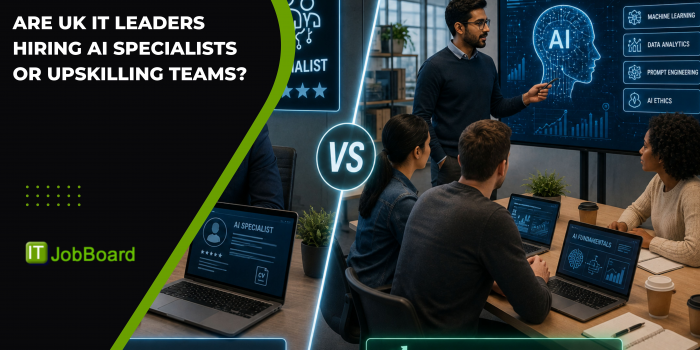
Are UK IT Leaders Hiring AI Specialists or Upskilling Existing IT Teams?
Artificial intelligence is creating a difficult workforce decision for UK IT leaders. As organisations introduce AI into software development, cybersecurity, data, cloud computing and business operations, CIOs and CTOs must decide how to build the skills they need. Should they hire specialist AI professionals, or should they train existing IT employees to work with AI?
There is no single answer. For many organisations, the most practical approach is likely to combine external hiring with internal upskilling.
The decision depends on the organisation's AI maturity, existing workforce, technology strategy, budget and the type of AI capability required.
For IT professionals, this shift is equally important. AI is not only creating new job opportunities. It is also changing the skills expected from people already working in technology.
The result is a UK IT jobs market where specialist AI expertise and AI-enabled traditional IT skills are developing alongside each other.
Why are UK IT leaders facing a build-or-buy decision for AI skills?
AI adoption creates new technical requirements, but organisations do not always need to build every capability from scratch.
A company introducing an AI-powered customer service system might need AI integration expertise, data engineering, cybersecurity and cloud skills.
The organisation could recruit specialists with these capabilities.
Alternatively, it could train existing developers, data professionals and cloud engineers to support the project.
This creates two broad strategies:
Hiring: Bring new AI expertise into the organisation.
Upskilling: Develop AI capabilities within the existing workforce.
Many businesses may ultimately use both approaches.
Are UK companies hiring more AI specialists?
Demand for specialist AI skills has increased significantly.
PwC's 2026 AI Jobs Barometer reported that UK job postings requiring specialist AI skills increased from around 112,000 in 2024 to approximately 180,000 in 2025. The report also found that AI-user roles were growing faster than AI-developer roles.
This distinction is important.
AI adoption is creating demand for specialists who develop and implement AI systems, but it is also creating demand for professionals who use AI within existing occupations.
Therefore, the AI workforce is becoming broader than traditional machine-learning roles.
Why can't companies simply hire AI specialists?
Hiring specialists can solve specific skills gaps, but it does not automatically create an AI-ready organisation.
A newly hired AI specialist still needs to understand:
- Existing technology
- Business processes
- Internal data
- Security requirements
- Organisational culture
- Customer needs
- Existing software architecture
If an organisation hires one AI expert but the rest of the technology team does not understand how to work with AI, the organisation may struggle to scale the capability.
AI transformation therefore requires more than individual specialists.
It requires wider organisational capability.
Why are IT leaders considering internal upskilling?
Existing employees already understand how the organisation operates.
A software engineer may know the company's applications.
A data engineer may understand internal databases.
A cybersecurity analyst may understand the organisation's security environment.
A cloud engineer may already manage the company's infrastructure.
Teaching these professionals AI skills can therefore create a powerful combination of existing knowledge and new capability.
This is one reason internal upskilling can be attractive.
What does UK research say about AI skills gaps?
The UK's AI Labour Market Survey found that 97% of surveyed organisations identified at least one AI skills gap. It also found that 57% reported technical skills gaps.
The research highlights a broader challenge.
Organisations are not simply struggling to recruit people with advanced AI qualifications.
They also need employees who can apply AI effectively within existing business and technology environments.
This makes workforce development an important part of AI strategy.
Which is better: hiring AI specialists or training existing employees?
Neither strategy is automatically better.
The right choice depends on the organisation's requirements.
Hiring can be useful when a company needs expertise that does not currently exist internally.
Upskilling can be more effective when the organisation already has strong technical employees who understand the business.
A simple way to think about the decision is:
Hire for new capability.
Upskill for broader adoption.
If an organisation needs to build a sophisticated AI platform, specialist hiring may be necessary.
If it wants hundreds of employees to use AI safely and productively, workforce training may be more appropriate.
When should a company hire an AI specialist?
Hiring may make sense when an organisation needs expertise in areas such as:
- Machine learning engineering
- AI architecture
- AI platform engineering
- Large language model development
- AI security
- AI governance
- Advanced data science
- AI research
These capabilities may require specialist experience that is difficult to develop quickly.
External recruitment can bring that expertise into the organisation faster.
However, specialist hiring should still be connected to a broader workforce strategy.
When should a company upskill existing IT employees?
Upskilling can make sense when employees already have strong technical foundations.
For example, an organisation may have experienced:
- Software developers
- Data analysts
- Cloud engineers
- Cybersecurity analysts
- IT support professionals
- Business analysts
These professionals may not need to become AI specialists.
Instead, they can learn how AI applies to their existing roles.
A developer can learn AI-assisted development.
A cybersecurity analyst can learn AI-powered security analysis.
A data analyst can learn AI-assisted analytics.
A cloud engineer can learn AI infrastructure.
This creates AI-enabled professionals without completely changing their career paths.
Why is AI upskilling becoming important for IT departments?
AI is increasingly becoming part of everyday technology work.
Developers may use AI coding assistants.
Security teams may use AI for threat analysis.
IT support teams may use AI-powered service management.
Data teams may use AI for analysis.
Cloud teams may support AI workloads.
If only a small group of employees understands AI, the organisation may struggle to integrate it across departments.
Upskilling can therefore create broader AI literacy.
Can existing IT professionals become AI specialists?
Some can.
Professionals with strong technical backgrounds may transition into deeper AI roles through additional education and practical experience.
For example, a software engineer with strong Python and mathematics skills could move towards machine learning engineering.
A data engineer could move towards AI data infrastructure.
A cloud engineer could specialise in AI platform engineering.
A cybersecurity professional could develop expertise in AI security.
However, not every employee needs to make this transition.
The bigger opportunity may be creating AI-enabled specialists.
What is an AI-enabled IT professional?
An AI-enabled IT professional combines an existing technical speciality with practical AI capability.
For example:
Software Engineer + AI-assisted development
Cybersecurity Analyst + AI security
Data Analyst + AI-assisted analytics
Cloud Engineer + AI infrastructure
IT Support Specialist + AI automation
This model allows organisations to introduce AI across existing departments.
It also gives employees a way to future-proof their careers without abandoning their core expertise.
Why might upskilling be better for employee retention?
Employees who see opportunities to learn emerging technologies may be more likely to view their organisation as a place where they can build their careers.
AI training can provide:
- Career development
- New responsibilities
- Greater productivity
- Internal mobility
- Technical growth
For employers, this can be valuable because replacing experienced employees can be expensive.
An organisation may already have people who understand its systems better than an external hire.
Giving those employees opportunities to develop AI skills can preserve that institutional knowledge.
Does hiring AI specialists create problems for existing IT teams?
It can if the organisation does not manage the transition carefully.
Suppose a company hires several AI specialists but does not involve its existing technology teams.
Employees may struggle to understand:
- Why the new roles were created
- How their responsibilities are changing
- Which skills they should learn
- How AI affects their careers
This can create uncertainty.
A stronger approach is to combine specialist hiring with internal education.
New AI specialists can help existing teams develop their capabilities.
This turns recruitment into a knowledge-sharing opportunity.
Why is knowledge transfer important when hiring AI specialists?
AI specialists can bring valuable expertise into an organisation.
But their impact can be much greater when they transfer that knowledge to other employees.
For example, an AI engineer could work with software developers to establish:
- AI development standards
- Testing processes
- Security controls
- Prompting practices
- AI integration patterns
The specialist becomes not only an individual contributor but also a capability multiplier.
This can make specialist recruitment more valuable.
Why might hiring be necessary when AI skills are urgently needed?
Upskilling takes time.
If an organisation needs advanced AI capability immediately, training existing employees may not be fast enough.
External hiring can provide access to people who already have:
- Production AI experience
- Industry knowledge
- Advanced technical skills
- Architecture experience
- AI implementation expertise
This can accelerate an organisation's AI programme.
However, hiring remains competitive because many organisations are seeking similar talent.
Is the AI skills shortage making recruitment harder?
Yes.
The UK's AI Labour Market Survey found that 35% of surveyed organisations struggled to fill AI roles. Lack of work experience and insufficient technical skills were among the key barriers. Senior positions were particularly difficult to fill.
This creates a strong argument for developing talent internally.
If every organisation attempts to recruit experienced AI professionals, competition for a limited pool of candidates increases.
Upskilling can help companies develop capability from within.
Why are apprenticeships relevant to the AI skills shortage?
Early-career talent can provide another route into AI capability.
UK government research found that apprenticeships accounted for 19% of AI hires in 2025, compared with 3% in 2020.
This suggests that organisations are increasingly considering structured development routes rather than relying exclusively on experienced external hires.
For young people entering IT, this could create opportunities to develop AI skills while gaining practical experience.
What is the role of managers in AI upskilling?
AI training should not simply mean giving employees access to an online course.
Managers need to connect training to real work.
For example, a manager could ask a developer to identify one repetitive task that AI might improve.
A cybersecurity manager could identify an investigation process suitable for AI assistance.
An IT support manager could identify repetitive ticket categories that could be automated.
This creates practical learning.
Employees can learn AI by applying it to real problems.
Should every IT employee receive the same AI training?
No.
Different employees need different levels of AI capability.
A useful model could have three levels.
Level 1: AI literacy
For most employees.
Focus on safe and responsible AI use.
Level 2: Role-specific AI skills
For developers, analysts, support professionals and other technology specialists.
Focus on applying AI within the role.
Level 3: AI specialist capability
For AI engineers, architects, data scientists and specialist security professionals.
Focus on advanced implementation and engineering.
This avoids wasting training resources while ensuring the right people develop deeper skills.
How should IT leaders decide what to hire?
A useful starting point is identifying the organisation's AI capability gap.
Ask:
What can our current workforce already do?
What AI capabilities are missing?
Can the missing skills be developed internally?
How quickly do we need them?
How specialised are they?
Will the capability be needed permanently?
These questions can help determine whether recruitment or upskilling makes more sense.
What should IT leaders consider before investing in AI training?
Training should be connected to measurable outcomes.
Before launching an AI programme, leaders should consider:
- Which tasks should improve?
- What productivity gain is expected?
- What risks need to be controlled?
- Which employees need training?
- How will AI use be measured?
- What happens if AI output is incorrect?
- How will employees receive ongoing support?
Training without a clear business purpose can become another technology initiative with limited impact.
How can IT leaders combine hiring and upskilling?
A hybrid strategy may be the most practical approach.
For example, an organisation could:
Hire a small number of AI specialists
to provide advanced expertise.
Then:
Upskill existing IT teams
to apply AI across departments.
Then:
Create internal AI communities
where employees share knowledge and best practices.
Finally:
Develop career pathways
so employees can move into more advanced AI responsibilities.
This approach creates both specialist depth and broader organisational capability.
What does this mean for software developers?
Software developers should not assume that AI hiring means fewer opportunities.
Instead, the skill requirements are changing.
Developers who can combine:
- Programming
- System design
- AI-assisted development
- Testing
- Security
- APIs
may be well positioned for AI-enabled development environments.
The most important skill is not simply knowing a particular AI coding tool.
It is understanding how to use AI while maintaining software quality.
What does this mean for cybersecurity professionals?
Cybersecurity professionals have an opportunity to combine security expertise with AI.
Relevant areas include:
- AI threat detection
- AI security
- Security automation
- Incident response
- Threat intelligence
- AI governance
As organisations deploy more AI systems, protecting those systems can become another cybersecurity responsibility.
This creates potential demand for professionals who understand both domains.
What does this mean for data professionals?
Data professionals may become central to AI adoption because AI systems depend on reliable data.
Skills such as:
- SQL
- Data engineering
- Data governance
- Data quality
- Cloud data platforms
- Analytics
remain important.
Adding AI knowledge can make these capabilities more valuable.
A data professional who understands how to prepare data for AI systems may have opportunities beyond traditional reporting and analytics.
What does this mean for IT support professionals?
IT support is another area where upskilling can change career progression.
AI may automate simple support requests.
This could allow support professionals to spend more time on:
- Complex troubleshooting
- Infrastructure
- Security
- Automation
- Cloud
- System administration
Learning how AI-powered service management works could therefore help support professionals move towards more advanced responsibilities.
Will AI upskilling reduce the need for external hiring?
Not completely.
Some capabilities will always require specialist recruitment.
However, upskilling can reduce an organisation's dependence on external hiring for every new technology trend.
A mature technology workforce should ideally be able to learn.
This creates resilience.
Instead of asking:
“Can we hire someone who knows the next technology?”
organisations can increasingly ask:
“Can we develop our existing workforce to learn it?”
What is the best strategy for UK IT employers?
For most organisations, the answer is unlikely to be hire only or upskill only.
A more sustainable strategy is:
Hire specialist expertise where the capability is genuinely scarce.
Upskill existing employees where strong foundations already exist.
Create opportunities for employees to apply what they learn.
Build internal AI knowledge over time.
This creates a workforce that can adapt as technology changes.
What does the future of AI hiring look like in the UK?
The UK IT jobs market is likely to contain several overlapping categories.
There will be:
AI specialists
who build and manage advanced AI systems.
AI-enabled IT professionals
who apply AI within existing technology roles.
Traditional IT professionals
whose roles may change gradually as AI adoption increases.
The boundaries between these groups may become less clear over time.
A software engineer may become an AI application engineer.
A data analyst may become an AI-enabled analytics specialist.
A cybersecurity analyst may specialise in AI security.
A cloud engineer may work on AI infrastructure.
The future is therefore unlikely to be simply about creating more AI job titles.
It is about changing the skills inside existing jobs.
What should IT professionals do now?
IT professionals should not wait for employers to completely redefine their jobs.
A practical approach is to start with the skills they already have.
Choose your core area.
Then identify how AI is changing that profession.
Learn the tools.
Build a small practical project.
Document the results.
Develop the ability to explain where AI helped and where human judgement was necessary.
This creates evidence of AI capability rather than simply claiming AI knowledge.
What should IT leaders remember when building AI teams?
The most important lesson is that AI transformation is a workforce transformation.
Hiring specialists can bring new expertise.
Upskilling can spread that expertise.
Neither approach works particularly well in isolation.
An organisation that hires AI specialists without developing the wider workforce may struggle to scale adoption.
An organisation that only trains existing employees may struggle when it needs advanced specialist expertise.
The strongest approach is likely to combine both.
For UK IT professionals, this creates an important career opportunity.
The future does not necessarily belong only to people with “AI” in their job title.
It may increasingly belong to professionals who can combine deep IT expertise with practical AI capability.
That is why the most important question for both employers and candidates is no longer simply:
“Who knows AI?”
It is:
“Who knows how to use AI to create better technology, better processes and better business outcomes?”
Frequently Asked Questions
Are UK IT leaders hiring AI specialists or upskilling existing employees?
UK IT leaders are using both approaches. Specialist hiring can provide advanced expertise, while upskilling helps existing employees apply AI within their current roles.
Why are companies hiring AI specialists?
Companies may hire AI specialists when they need advanced capabilities such as machine learning engineering, AI architecture, AI security, AI governance or AI platform development.
Why are companies upskilling existing IT employees?
Existing employees already understand the organisation's technology, systems and business processes. Upskilling can therefore add AI capability without losing existing knowledge.
Is AI upskilling important for IT professionals?
Yes. AI is increasingly becoming part of software development, cybersecurity, data, cloud and IT support, making role-specific AI knowledge increasingly useful.
Will AI specialists replace traditional IT professionals?
Not necessarily. Many organisations need AI specialists alongside existing IT professionals who can apply AI within their own technical disciplines.
What is an AI-enabled IT professional?
An AI-enabled IT professional combines an existing IT speciality with practical AI capability, such as a software engineer using AI-assisted development or a cybersecurity analyst using AI for threat analysis.
Should every IT employee learn AI?
Every employee may benefit from basic AI literacy, but advanced AI training should be tailored to the employee's role and responsibilities.
Are apprenticeships becoming important for AI hiring?
UK government research found that apprenticeships represented 19% of AI hires in 2025, up from 3% in 2020, indicating that early-career development is becoming an important route into AI-related work.
Is the UK facing an AI skills shortage?
Yes. UK government research found that 97% of surveyed organisations identified at least one AI skills gap, while 35% reported difficulty filling AI roles.
What should IT leaders consider before hiring AI specialists?
They should identify the specific capability they need, determine whether the skill can be developed internally, consider how quickly it is required and assess whether the capability needs to remain in-house.
What should IT professionals do to prepare for AI-driven changes?
Professionals should strengthen their core IT expertise, learn how AI applies to their discipline, build practical experience and demonstrate how they can use AI responsibly to solve real problems.
Is hiring or upskilling better for AI adoption?
Neither is universally better. Hiring is useful for scarce specialist expertise, while upskilling is useful for expanding AI capability across an existing workforce. A combination of both can provide a balanced approach.