25/08/2026
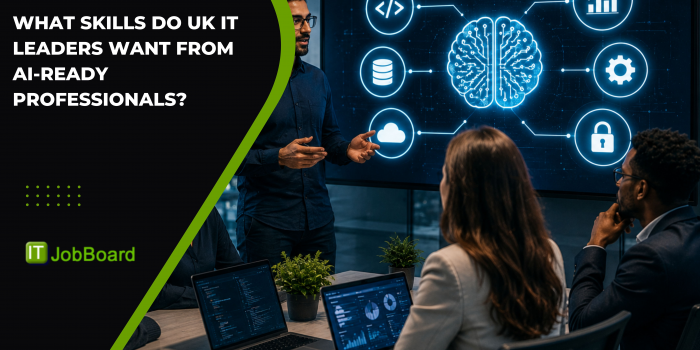
What Skills Do UK IT Leaders Want From AI-Ready IT Professionals?
Artificial intelligence is changing what employers expect from technology professionals. For UK IT leaders, hiring is no longer only about finding people who can work with established technologies such as Python, Java, SQL, cloud platforms or cybersecurity tools. Increasingly, employers want professionals who can combine strong technical foundations with practical AI capability, critical thinking and business judgement.
The change is becoming visible in the UK labour market. PwC's 2026 AI Jobs Barometer reported that UK job postings requiring specialist AI skills reached around 180,000 in 2025, up from 112,000 in 2024. It also found that AI-user roles were growing faster than AI-developer roles, suggesting that organisations increasingly need people who can apply AI within existing areas of expertise.
This creates an important opportunity for IT professionals.
You do not necessarily need to become a machine-learning researcher to become an AI-ready candidate. In many cases, the more valuable combination is IT expertise + AI literacy + problem-solving + human judgement.
Why are UK IT employers looking for AI-ready professionals?
AI adoption is moving from experimentation towards practical business use.
UK government research published in 2026 found that organisations continue to face significant AI skills gaps. The AI Labour Market Survey reported that 97% of surveyed organisations identified at least one AI skills gap, while 57% reported technical skills gaps.
At the same time, Skills England reported that around 44% of workplaces were using AI every day, although adoption and impact remained uneven.
This creates a recruitment challenge.
Employers may have access to AI tools, but they still need people who know how to use those tools effectively.
That is why AI readiness is increasingly becoming a workforce capability rather than simply a specialist job title.
What does being an AI-ready IT professional actually mean?
Being AI-ready does not mean knowing every new AI application.
An AI-ready IT professional should be able to understand:
- Where AI can improve a workflow
- Where AI should not be used
- How to evaluate AI-generated outputs
- How to protect sensitive information
- How to integrate AI into existing technology
- How to automate repetitive work
- When human judgement is required
For a developer, this could mean using AI-assisted coding responsibly.
For a cybersecurity analyst, it could mean understanding AI-assisted threat detection.
For a data analyst, it could mean using AI to accelerate analysis while validating the results.
The exact skill changes by profession.
Which technical skills remain important in an AI-driven IT job market?
AI does not remove the importance of core technology skills.
In many cases, it makes them more valuable because professionals need enough technical understanding to evaluate AI-generated work.
Important foundations can include:
- Programming
- Databases
- Cloud computing
- Networking
- Cybersecurity
- Data engineering
- Software architecture
- Operating systems
- APIs
- Automation
The key change is that these skills increasingly need to work alongside AI.
A Python developer who understands AI-assisted development may have a broader capability than a developer who only knows traditional development workflows.
Why is AI literacy becoming a core workplace skill?
AI literacy sits between basic digital skills and advanced AI engineering.
Someone with AI literacy should understand how to use common AI tools safely and effectively.
Skills England has published an AI foundation skills benchmark covering technical, non-technical, responsible and ethical capabilities needed to use simple AI tools at work.
For IT professionals, AI literacy can include:
Understanding: knowing what AI systems are capable of.
Application: knowing how AI can support your job.
Evaluation: checking whether AI-generated results are accurate.
Security: understanding data and privacy risks.
Responsible use: recognising when human oversight is necessary.
These capabilities can become relevant even when AI is not the primary responsibility of the job.
Are UK IT leaders looking for AI specialists or AI users?
Both, but the distinction matters.
AI specialists may build, train, deploy or manage advanced AI systems.
AI users apply AI within another professional discipline.
Recent UK labour-market evidence suggests the second category is growing particularly quickly. PwC reported that UK AI-user roles increased by around 65.8% in 2025, while AI-developer roles grew by 21.6%.
This indicates a potentially important direction for IT careers.
The future may not require every IT professional to become an AI developer.
Instead, many professionals may become AI-enabled specialists.
What AI skills should software developers learn?
Software developers should start with their existing programming knowledge and add AI-assisted development capabilities.
Useful areas include:
- AI coding assistants
- Prompting for development tasks
- Automated testing
- Code review with AI
- Debugging assistance
- API integration
- AI application development
- Secure AI coding practices
However, developers should not rely blindly on generated code.
AI can produce code that appears correct but contains bugs, security weaknesses or architectural problems.
A strong AI-ready developer should therefore be able to ask:
Does this code work?
Is it secure?
Is it maintainable?
Does it fit the existing architecture?
That judgement remains human.
What AI skills should cybersecurity professionals develop?
Cybersecurity is particularly interesting because AI can support both attackers and defenders.
Security professionals can use AI for:
- Alert analysis
- Threat intelligence
- Log investigation
- Incident response
- Security automation
- Pattern recognition
- Vulnerability analysis
At the same time, organisations need professionals who understand AI-specific risks.
This makes a combination of cybersecurity + AI security + automation increasingly relevant.
A cybersecurity candidate who can explain how AI changes an organisation's threat model may have an advantage over someone who only lists generic AI knowledge.
What AI skills should data professionals learn?
Data professionals are likely to remain essential because AI depends heavily on data quality.
Useful skills include:
- Data engineering
- SQL
- Data modelling
- Data governance
- Data quality
- Machine learning fundamentals
- AI-assisted analytics
- Data visualisation
- Statistical reasoning
AI can generate analysis quickly, but a data professional needs to determine whether the underlying information is reliable.
This makes data quality and governance particularly important.
Why are AI and cloud skills becoming connected?
Many AI applications depend on cloud infrastructure.
IT professionals working with AI may need to understand:
- Cloud-based AI services
- APIs
- Data storage
- Compute requirements
- Security
- Identity and access management
- Monitoring
- Cost management
This is creating opportunities for cloud professionals to expand their expertise without completely changing careers.
A cloud engineer does not necessarily need to become a machine-learning scientist.
Understanding how AI workloads operate in cloud environments can itself be valuable.
Why are automation skills important for AI-ready IT professionals?
AI becomes more useful when it is connected to workflows.
For example, an organisation might combine:
AI + APIs + automation + business applications
to reduce repetitive manual work.
This means IT professionals who understand automation can potentially create more value from AI.
Useful areas include:
- Python scripting
- APIs
- Workflow automation
- Integration platforms
- PowerShell
- Cloud automation
- Process mapping
The valuable skill is not simply knowing how to use an AI chatbot.
It is knowing how to connect technology to a real business process.
Are communication skills becoming more important because of AI?
Yes.
This may seem surprising, but AI can increase the importance of human communication.
When AI makes it easier to generate technical information, professionals need to explain:
- What the technology is doing
- Why a decision was made
- What risks exist
- What the business should do next
IT professionals increasingly work across technical and non-technical teams.
A developer may need to explain an AI application to a product manager.
A cybersecurity analyst may need to explain an AI-related risk to senior management.
A data engineer may need to explain data-quality issues to business stakeholders.
Technical knowledge alone may not be enough.
Why is critical thinking becoming a priority?
AI can produce convincing answers even when those answers are wrong.
This makes critical thinking essential.
An AI-ready professional should question outputs rather than automatically accepting them.
For example:
Does the information make sense?
What evidence supports it?
Could the AI have misunderstood the context?
What happens if this recommendation is wrong?
This is particularly important in cybersecurity, finance, healthcare, infrastructure and other high-impact environments.
AI can accelerate decision-making, but it does not eliminate the need for judgement.
Are IT leaders looking for creativity as well as technical skills?
Increasingly, yes.
PwC's 2026 analysis found that roles exposed to AI are adding human-intensive skills such as judgement, empathy and creativity at a faster rate than less AI-exposed roles.
This suggests an important shift.
As AI handles more routine work, employers may place greater value on employees who can:
- Generate new ideas
- Design solutions
- Understand customers
- Challenge assumptions
- Solve unusual problems
- Make decisions under uncertainty
This is why AI readiness should not be defined purely in technical terms.
Does AI make business knowledge more important for IT professionals?
Yes.
An IT professional who understands the business problem behind a technical request can often use AI more effectively.
For example, suppose an organisation wants to automate customer support.
A technically focused employee might immediately select an AI chatbot.
A business-aware professional might first ask:
- What customer problems are we solving?
- Which requests are repetitive?
- What data does the system need?
- Which issues require humans?
- What security requirements apply?
- How will success be measured?
The second approach is more likely to produce useful technology.
Why is adaptability becoming a key IT hiring skill?
AI technology is changing rapidly.
Specific tools can become popular and then be replaced within a short period.
Employers therefore need people who can learn continuously.
Adaptability can be demonstrated through:
- New certifications
- Personal projects
- Open-source work
- Cross-functional projects
- AI experiments
- Learning new programming frameworks
- Automation projects
The strongest candidates can show evidence that they have already adapted to technological change.
What AI skills should junior IT professionals focus on?
Junior professionals should avoid trying to learn everything.
A better approach is:
Choose one IT career → build strong fundamentals → add AI capability.
For example:
Graduate Developer: programming + Git + databases + AI-assisted development
Junior Cybersecurity Analyst: networking + security fundamentals + AI-assisted investigation
Junior Data Analyst: SQL + statistics + visualisation + AI-assisted analysis
IT Support Technician: troubleshooting + networking + cloud fundamentals + AI-enabled service management
This creates a clear career path instead of an unfocused collection of AI certificates.
Are AI certifications enough to get an IT job?
Not necessarily.
A certification can demonstrate learning, but employers still need evidence of practical capability.
A candidate who has completed an AI course but cannot explain how AI could improve a real business process may struggle to demonstrate value.
Practical projects can be more useful.
For example:
- Build an AI-powered application
- Automate a repetitive task
- Create a chatbot using an API
- Analyse a dataset using AI
- Develop an AI-assisted security workflow
- Document how you evaluated AI outputs
The goal should be to demonstrate what you can do, not simply what courses you have completed.
Why are employers struggling to find AI-ready talent?
The UK AI Labour Market Survey found that 35% of surveyed organisations struggled to fill AI roles, with lack of work experience and insufficient technical skills among the leading barriers. Senior roles were particularly difficult to fill.
This creates a problem for employers.
They need people with AI skills.
But they also need practical experience.
This is one reason apprenticeships, internal training and alternative routes into technology careers are becoming more important.
The same government research found that apprenticeships accounted for 19% of AI hires in 2025, up from 3% in 2020.
Are IT employers likely to train existing employees in AI?
Yes, and this could become an important part of workforce strategy.
Skills England's 2026 research specifically focuses on evidence-based approaches to AI upskilling and highlights the need for organisations to build workforce capability rather than simply provide access to AI tools.
Training can help employees understand:
- AI fundamentals
- Practical use cases
- Security
- Responsible use
- Automation
- Evaluation
- Role-specific applications
This can be more effective than expecting employees to learn everything independently.
What is the difference between AI literacy and AI expertise?
This distinction is important for job seekers.
AI literacy means understanding and using AI tools effectively.
AI implementation skills mean integrating AI into workflows and systems.
AI specialist skills involve developing or engineering advanced AI systems.
Not every IT job requires the third level.
A helpdesk professional may need AI literacy.
A software engineer may need AI implementation skills.
An AI engineer may require specialist expertise.
Understanding this difference can help candidates avoid learning skills that are unnecessary for their target role.
What should UK IT job seekers put on their CVs?
Candidates should show AI skills in context.
Instead of writing:
“AI knowledge.”
Use evidence such as:
“Used AI-assisted development tools to accelerate testing and documentation while manually validating generated code.”
Instead of:
“Knowledge of automation.”
Use:
“Built an automated workflow that reduced repetitive data-processing tasks.”
Specific evidence gives employers a clearer understanding of capability.
What will AI-ready IT professionals look like in the future?
The strongest professionals are unlikely to be defined by AI alone.
They will combine:
Technical expertise
AI literacy
Automation
Critical thinking
Business understanding
Communication
This combination creates professionals who can use AI without becoming dependent on it.
That distinction is important.
The goal is not to become someone who asks AI to do everything.
The goal is to become someone who knows what AI should do, how it should do it, and when a human should take over.
What should UK IT leaders look for when hiring AI-ready professionals?
A practical hiring framework can focus on five areas:
- Technical foundation
Does the candidate genuinely understand their IT discipline?
- AI capability
Can they apply AI to relevant tasks?
- Evaluation skills
Can they identify inaccurate or unsafe AI output?
- Adaptability
Can they learn new technology as the market changes?
- Human judgement
Can they communicate, collaborate and make decisions?
This approach is likely to produce better results than simply adding “AI experience” to every job description.
What does the growth of AI skills mean for UK IT jobs?
The UK IT jobs market is not simply moving towards a future where every vacancy becomes an “AI job”.
A more realistic transformation is the development of AI-enabled IT jobs.
Software engineers will use AI.
Cybersecurity professionals will use AI.
Data specialists will use AI.
Cloud engineers will support AI.
IT support teams will automate more work.
Business analysts will design AI-enabled processes.
As this happens, the competitive advantage may belong to professionals who combine technology expertise with the ability to use AI responsibly.
For job seekers, the message is clear:
Do not replace your IT speciality with AI. Add AI to your speciality.
For employers, the lesson is equally important:
Do not hire for AI keywords alone. Hire people who can turn AI capability into measurable business and technical value.
That is what an AI-ready IT workforce increasingly means in the UK.
Frequently Asked Questions
What skills do UK IT employers want from AI-ready professionals?
UK IT employers increasingly value a combination of core technical skills, AI literacy, automation, critical thinking, adaptability, communication and business understanding.
Do IT professionals need to become AI experts?
No. The required level of AI expertise depends on the role. Many IT professionals can benefit from practical AI literacy without becoming AI engineers or researchers.
Which AI skills are useful for software developers?
AI-assisted coding, automated testing, debugging, code review, API integration, AI application development and secure use of AI coding tools can be valuable.
Which AI skills are useful for cybersecurity professionals?
AI-assisted threat detection, security automation, incident investigation, AI security and understanding how attackers can use AI are increasingly relevant.
Are AI certifications enough for IT jobs?
Certifications can demonstrate learning, but employers also value practical experience. Projects that show how AI was applied to real technical problems can strengthen a candidate's profile.
Is AI literacy becoming important for IT jobs?
Yes. AI literacy is becoming increasingly relevant because professionals across IT functions may need to use AI tools safely and effectively.
What is the difference between AI literacy and AI expertise?
AI literacy involves understanding and using AI tools effectively. AI implementation involves integrating AI into systems and workflows, while AI expertise involves developing or engineering advanced AI systems.
Are communication skills important for AI-related IT careers?
Yes. As AI generates more technical information, professionals still need to communicate decisions, explain risks and work effectively with technical and non-technical stakeholders.
How can junior IT professionals become AI-ready?
Junior professionals should first develop strong fundamentals in their chosen IT discipline and then add practical AI skills relevant to that career.
Will AI replace traditional IT skills?
AI is more likely to change how traditional IT skills are used than eliminate them. Programming, cybersecurity, cloud, networking and data skills remain important foundations.
Why are employers struggling to find AI-ready professionals?
UK research identifies shortages in both technical and non-technical AI capabilities, while employers also report difficulties finding candidates with practical experience.
What is the best combination of skills for future IT jobs?
A strong combination is technical expertise, AI capability, automation, critical thinking, adaptability, communication and business understanding.