09/10/2026
What Is a FinOps Engineer? Cloud Cost Management Skills and Careers in the UK
Direct Answer
A FinOps Engineer helps organisations understand, manage and optimise the financial impact of their technology usage, particularly cloud infrastructure and other consumption-based services.
The role combines cloud engineering, financial analysis, data, automation and business decision-making. A FinOps Engineer may analyse cloud usage, identify unusual spending, improve resource efficiency, build cost dashboards, support forecasting and work with engineering and finance teams on technology investment decisions.
FinOps is no longer limited to simply reducing cloud bills. The FinOps Foundation defines it as an operational framework and cultural practice focused on maximising the business value of technology through collaboration between engineering, finance and business teams.
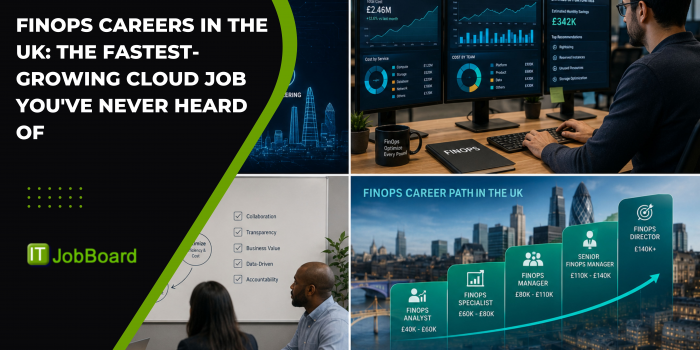
For UK IT professionals, FinOps can therefore provide a career path connecting cloud computing, DevOps, data analytics and technology management.
What Does a FinOps Engineer Do?
A FinOps Engineer works at the intersection of technology and financial management.
Typical responsibilities can include:
- Monitoring cloud usage and spending
- Analysing technology cost data
- Creating cost dashboards
- Identifying unusual spending
- Supporting cloud budgets
- Forecasting future technology costs
- Improving resource utilisation
- Analysing cloud pricing models
- Supporting engineering teams with cost information
- Automating cost-management processes
- Implementing tagging and allocation strategies
- Supporting governance policies
- Measuring technology unit economics
- Communicating cost insights to technical and non-technical teams
The exact responsibilities vary between organisations.
Some companies may use titles such as:
- FinOps Engineer
- FinOps Practitioner
- FinOps Analyst
- Cloud FinOps Engineer
- Cloud Cost Engineer
- Cloud Cost Analyst
- FinOps Specialist
- Cloud Financial Management Analyst
The responsibilities may also sit within cloud engineering, DevOps, platform engineering, IT finance or technology operations teams.
What Is FinOps?
The term FinOps combines "Finance" and "DevOps."
It originated around managing variable cloud costs, but the discipline has expanded.
The FinOps Foundation's current definition focuses on maximising the business value of technology, using timely data-driven decisions and creating financial accountability across engineering, finance and business teams.
The 2026 FinOps Framework also reflects an expansion beyond traditional public-cloud spending, with greater attention to technology categories and executive strategy alignment.
This means modern FinOps can involve:
- Public cloud
- SaaS
- Software licensing
- Data platforms
- Private cloud
- Data centres
- AI workloads
- Other technology consumption
Why Does FinOps Matter for Cloud Careers?
Cloud platforms provide flexibility, scalability and consumption-based pricing.
However, the same flexibility can make technology spending difficult to understand.
For example, a business might have:
- Hundreds of cloud workloads
- Multiple environments
- Multiple teams
- Different pricing models
- Storage costs
- Database costs
- Network costs
- AI workloads
- SaaS subscriptions
A FinOps team helps connect this usage information with business decisions.
Instead of asking only:
"How can we reduce the cloud bill?"
FinOps can also ask:
"What business value are we receiving from this technology spend?"
That distinction is important because reducing technology usage without considering business impact can produce unintended consequences.
What Skills Does a FinOps Engineer Need?
1. Cloud Computing
A strong cloud foundation is important.
A FinOps Engineer should understand concepts such as:
- Compute
- Storage
- Databases
- Networking
- Containers
- Serverless computing
- Kubernetes
- Cloud regions
- Availability
- Scalability
- Reserved and usage-based pricing
Knowledge of major cloud platforms can also be useful.
These may include:
- AWS
- Microsoft Azure
- Google Cloud
The goal is to understand how technical architecture affects usage and cost.
2. Cloud Cost Management
FinOps professionals need to understand how cloud costs are generated.
This includes:
- Usage measurement
- Pricing models
- Discounts
- Commitments
- Resource allocation
- Cost allocation
- Budgets
- Forecasting
- Chargeback
- Showback
Understanding the relationship between architecture and cost is particularly important for technical FinOps roles.
3. Data Analysis
FinOps depends heavily on data.
Useful skills include:
- SQL
- Excel
- Python
- Data visualisation
- Statistical analysis
- Dashboard creation
A FinOps Engineer may analyse large volumes of usage data to identify trends or anomalies.
4. Financial Awareness
You do not necessarily need to become an accountant.
However, understanding basic financial concepts can be valuable.
Useful areas include:
- Budgeting
- Forecasting
- Variance analysis
- Cost allocation
- Return on investment
- Unit economics
- Business cases
The FinOps Framework includes planning, estimating, forecasting, budgeting, benchmarking and unit economics as capabilities for understanding business value. (FinOps Foundation)
5. Automation
Manual cloud-cost analysis can become difficult at scale.
Automation skills can help with:
- Cost reports
- Resource tagging
- Budget alerts
- Anomaly detection
- Rightsizing analysis
- Scheduled reports
- Policy enforcement
Useful technical skills include:
- Python
- PowerShell
- Bash
- APIs
- Infrastructure as Code
- CI/CD
6. Communication
FinOps is highly cross-functional.
A FinOps Engineer may need to explain technical spending to:
- Software Engineers
- DevOps Engineers
- Cloud Architects
- Product Managers
- Finance teams
- Procurement teams
- Senior management
This makes communication an important part of the role.
What Is Cloud Cost Optimisation?
Cloud cost optimisation involves improving the relationship between technology usage, cost and business value.
Examples may include:
- Removing unused resources
- Selecting appropriate instance sizes
- Improving storage policies
- Reviewing idle workloads
- Evaluating pricing commitments
- Improving resource tagging
- Scheduling non-production environments
- Reviewing architecture
- Monitoring unexpected usage
However, optimisation should not automatically mean using the cheapest possible infrastructure.
A lower-cost architecture may not meet performance, availability or security requirements.
FinOps therefore involves balancing factors such as:
Cost + Performance + Reliability + Security + Business Value
What Is the Difference Between a FinOps Engineer and a Cloud Engineer?
The roles overlap but generally have different primary responsibilities.
|
FinOps Engineer
|
Cloud Engineer
|
|
Focuses on technology value and cost
|
Focuses on cloud infrastructure
|
|
Analyses usage and spending
|
Builds and operates cloud systems
|
|
Creates cost insights
|
Designs technical architecture
|
|
Supports forecasting
|
Deploys cloud services
|
|
Identifies optimisation opportunities
|
Maintains infrastructure
|
|
Works closely with finance
|
Works closely with engineering
|
|
Measures technology economics
|
Measures technical performance
|
A Cloud Engineer may therefore use FinOps principles as part of their work, while a FinOps Engineer focuses more heavily on financial visibility, cost allocation and technology value.
Skills England's current DevOps Engineer standard includes FinOps, cloud economics, cost and budget management within its technical knowledge requirements, showing that these concepts are increasingly relevant to cloud engineering roles too. (Skills England)
What Is the Difference Between FinOps and Cloud Cost Cutting?
FinOps is broader than cost cutting.
A company could reduce cloud spending by removing resources that appear expensive.
But if those resources support an important customer-facing application, the reduction could negatively affect the business.
FinOps instead focuses on informed technology decisions.
The FinOps Foundation describes the practice as maximising business value rather than treating cost reduction as the sole objective. (FinOps Foundation)
This makes value measurement an important concept for modern FinOps professionals.
What Tools Are Used by FinOps Engineers?
The exact toolset depends on the organisation.
FinOps professionals may work with:
- Cloud-provider cost-management platforms
- Cloud billing systems
- Cost dashboards
- Data warehouses
- Business intelligence platforms
- Spreadsheets
- FinOps management platforms
- Infrastructure monitoring systems
- Automation tools
- APIs
Cloud-provider knowledge is often important because cost data originates from cloud services.
Data tools are also useful because FinOps teams frequently need to transform and analyse usage information.
What Is FinOps Unit Economics?
Unit economics connects technology costs to a meaningful business unit.
For example, a company could examine:
- Cloud cost per customer
- Infrastructure cost per transaction
- Cost per API request
- Cost per application user
- AI cost per generated response
This provides more context than looking at the total cloud bill.
The FinOps Foundation identifies unit economics as an important concept because it can create a common language between engineering and business teams. (FinOps Foundation)
For an IT professional, learning unit economics can therefore add a business dimension to technical cloud skills.
How Is AI Changing FinOps?
AI introduces new technology-cost considerations.
AI applications may generate costs from:
- Model inference
- API usage
- Compute
- GPUs
- Data processing
- Storage
- Model training
- Vector databases
- AI platforms
The FinOps Foundation's 2026 materials now explicitly cover AI-related technology value and AI cost management. (FinOps Foundation)
This has also created concepts such as AI FinOps and AI token economics, where teams analyse the cost and value associated with AI usage.
For IT professionals, this creates an intersection between:
Cloud + AI + Data + Financial Management
How Can You Become a FinOps Engineer in the UK?
There are several possible routes.
Route 1: Cloud Engineer to FinOps
A Cloud Engineer can build financial and analytical skills alongside existing cloud knowledge.
Cloud Engineer → Cloud Cost Management → FinOps Engineer
Route 2: DevOps to FinOps
DevOps professionals already understand infrastructure, automation and deployment.
A possible progression is:
DevOps Engineer → Cloud Economics → FinOps → FinOps Engineer
Route 3: Data Analyst to FinOps
Data professionals can develop cloud and financial knowledge.
Data Analyst → Technology Cost Analytics → FinOps Analyst → FinOps Engineer
Route 4: IT Finance to FinOps
Technology finance professionals can build technical cloud knowledge.
IT Finance → Cloud Financial Management → FinOps Practitioner
The route depends on your existing technical and business experience.
Do You Need a Degree to Become a FinOps Engineer?
There is no single degree specifically required for FinOps.
Relevant backgrounds can include:
- Computer Science
- Information Technology
- Cloud Computing
- Finance
- Accounting
- Economics
- Data Science
- Business
- Engineering
Practical cloud experience can be particularly valuable for engineering-focused FinOps positions.
Professional FinOps training and certifications are also available. The FinOps Foundation currently offers training and certification programmes including FinOps Certified Practitioner and FinOps Certified Professional. (FinOps Foundation)
What Should You Learn First?
If you are starting from an IT background, a practical learning sequence could be:
- Cloud fundamentals
- AWS, Azure or Google Cloud
- Cloud pricing concepts
- Cost allocation
- Resource tagging
- SQL and data analysis
- Cloud billing data
- Dashboards and reporting
- Automation
- Forecasting
- Unit economics
- FinOps principles
- AI and technology cost management
You do not need to master everything at once.
A combination of cloud knowledge + data skills + financial awareness provides a useful foundation.
What Should You Put on a FinOps Engineer CV?
A FinOps CV can highlight experience with:
- Cloud cost analysis
- AWS/Azure/Google Cloud
- Cloud billing
- Cost allocation
- Budgeting
- Forecasting
- Resource optimisation
- Cost dashboards
- SQL
- Python
- Automation
- Infrastructure as Code
- FinOps frameworks
- Unit economics
- Anomaly detection
- Stakeholder management
Whenever possible, describe the business or technical problem you worked on rather than simply listing tools.
For example:
Cloud cost analysis → identified usage anomaly → investigated workload → worked with engineering team → implemented monitoring
This gives recruiters more context about your actual FinOps capability.
What Could a FinOps Portfolio Project Include?
A portfolio project could analyse cloud usage data and produce a technology-cost dashboard.
The project could include:
- Cloud usage data
- Cost categories
- Team allocation
- Monthly trends
- Budget tracking
- Anomaly detection
- Forecasting
- Resource-utilisation analysis
- Cost-per-unit calculations
You could then explain which optimisation opportunities you identified and what trade-offs they involved.
This demonstrates both technical and analytical thinking.
What Is the Future of FinOps Careers?
FinOps is expanding beyond traditional cloud-cost management.
The FinOps Foundation's 2025 framework introduced broader "Cloud+" scopes covering areas such as SaaS, licensing, data centres and other technology spending. (FinOps Foundation)
Its 2026 framework further expands the discipline's strategic focus and adds greater attention to executive strategy alignment. (FinOps Foundation)
For IT professionals, this means FinOps can increasingly intersect with:
- Cloud engineering
- DevOps
- AI
- Data platforms
- IT asset management
- Sustainability
- Procurement
- Technology strategy
The role is therefore becoming less about reading a cloud invoice and more about connecting technology usage, cost, performance and business value.
Key Takeaways
- A FinOps Engineer connects cloud technology, financial data and business decisions.
- FinOps is broader than simply reducing cloud bills.
- Cloud computing, data analysis, financial awareness and automation are useful skills.
- SQL and Python can support FinOps reporting and automation.
- Unit economics helps connect technology spending with business outcomes.
- Cloud Engineers and DevOps Engineers can develop FinOps expertise.
- AI is creating additional technology-cost considerations around models, compute and usage.
- Modern FinOps increasingly covers SaaS, licensing, data platforms and other technology categories.
- Professional FinOps training and certifications are available through the FinOps Foundation. (FinOps Foundation)
FAQs
1. What is a FinOps Engineer?
A FinOps Engineer helps organisations understand, manage and optimise technology usage and costs, particularly cloud infrastructure, by combining cloud engineering, data analysis and financial management.
2. What skills does a FinOps Engineer need?
Important skills include cloud computing, cost analysis, SQL, data visualisation, financial concepts, automation, forecasting, cloud pricing and stakeholder communication.
3. Is FinOps the same as cloud cost optimisation?
Not exactly. Cloud cost optimisation is one part of FinOps. FinOps also covers financial accountability, forecasting, cost allocation, business value, unit economics and collaboration between engineering, finance and business teams.
4. Can a DevOps Engineer become a FinOps Engineer?
Yes. DevOps experience provides knowledge of cloud infrastructure, automation and deployment. Additional skills in cloud economics, financial analysis and cost management can support a transition into FinOps.
5. Do I need a certification to work in FinOps?
A certification is not universally required. However, FinOps training and certifications can help demonstrate knowledge of FinOps principles and practices. The FinOps Foundation provides practitioner and professional certification programmes. (FinOps Foundation)