06/10/2026
What Is an LLMOps Engineer? Skills, Tools and Career Path in the UK
Direct Answer
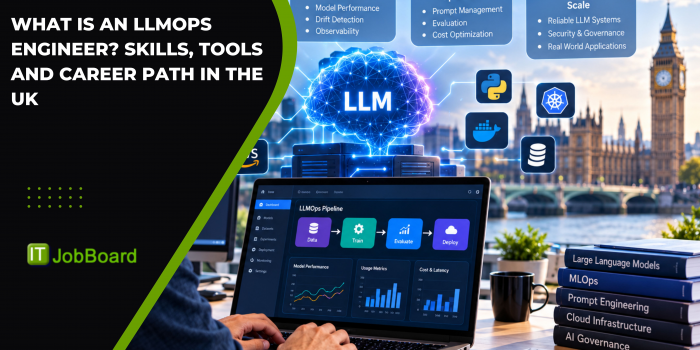
An LLMOps Engineer is a technology professional who helps organisations develop, deploy, operate, monitor and maintain applications powered by large language models (LLMs).
LLMOps, short for Large Language Model Operations, applies operational and engineering practices to AI applications that use models such as large language models. The work can cover model deployment, prompt management, evaluation, monitoring, data pipelines, security, performance and cost management.
LLMOps sits at the intersection of AI engineering, machine learning, DevOps, cloud engineering, software development and data engineering.
As organisations move generative AI applications from experimentation into production environments, technical teams need processes for monitoring and maintaining these systems. Skills England's 2026 digital and technology assessment highlights the changing technical skills required as AI becomes integrated into digital workflows.
What Does an LLMOps Engineer Do?
The responsibilities of an LLMOps Engineer can vary considerably between organisations.
Typical responsibilities may include:
- Deploying LLM-powered applications
- Managing AI application infrastructure
- Creating model evaluation processes
- Monitoring application performance
- Managing prompts and configurations
- Managing model versions
- Supporting retrieval-augmented generation systems
- Monitoring latency and reliability
- Managing APIs
- Automating deployment processes
- Supporting security controls
- Managing cloud infrastructure
- Monitoring AI application costs
- Troubleshooting production issues
- Working with developers and data scientists
The role is therefore broader than simply selecting an AI model.
What Is LLMOps?
LLMOps is a collection of engineering and operational practices for managing applications that use large language models.
A simplified LLM application lifecycle can look like:
Data → Model → Prompt/Application → Testing → Deployment → Monitoring → Evaluation → Improvement
Each stage can introduce technical challenges.
For example, changing a model can affect output quality.
Changing a prompt can alter application behaviour.
Increasing usage can increase infrastructure or API costs.
An LLMOps process helps teams manage these changes systematically.
Why Is LLMOps Different from Traditional DevOps?
There are similarities.
Both DevOps and LLMOps can involve:
- Automation
- CI/CD
- Monitoring
- Infrastructure
- Version control
- Testing
- Deployment
- Incident management
However, LLM applications introduce additional considerations.
Traditional applications generally have predictable software logic.
LLM applications can produce variable outputs based on prompts, context, model versions and retrieved information.
Teams therefore need additional methods for evaluating output quality and monitoring AI-specific behaviour.
What Skills Does an LLMOps Engineer Need?
1. Cloud Engineering
Knowledge of cloud platforms can be valuable because many AI applications operate using cloud infrastructure.
Relevant areas include:
- Compute
- Storage
- Networking
- Containers
- Serverless services
- Cloud security
- Infrastructure management
2. DevOps
LLMOps Engineers can benefit from experience with:
- CI/CD
- Infrastructure as code
- Automation
- Containers
- Version control
- Monitoring
- Deployment pipelines
3. AI and Machine Learning
An LLMOps Engineer should understand the basics of:
- Machine learning
- Generative AI
- Large language models
- Embeddings
- Vector databases
- Model inference
- Model evaluation
4. Python
Python is widely used throughout AI and machine-learning workflows.
It can be useful for:
- Automation
- Data processing
- API integrations
- Evaluation scripts
- AI application development
5. APIs
Many LLM applications interact with model providers through APIs.
Understanding authentication, requests, responses, rate limits and error handling can therefore be important.
6. Monitoring
LLMOps requires monitoring more than traditional infrastructure metrics.
Teams may monitor:
- Latency
- Errors
- Usage
- Token consumption
- Cost
- Output quality
- Application performance
- Model behaviour
What Tools Can LLMOps Engineers Use?
The technology stack depends on the organisation.
An LLMOps environment can include:
- Git
- Docker
- Kubernetes
- Cloud platforms
- Python
- CI/CD platforms
- API gateways
- Monitoring systems
- Vector databases
- Model evaluation tools
- Data pipelines
- Infrastructure-as-code tools
An employer may use only a subset of these technologies.
For job seekers, understanding the underlying concepts is more useful than memorising a long list of products.
What Is RAG and Why Does It Matter to LLMOps?
Retrieval-Augmented Generation (RAG) is an architecture where an AI application retrieves relevant information and provides that context to an LLM before generating an answer.
A simplified RAG workflow is:
User question → Search/retrieval → Relevant information → LLM → Generated response
An LLMOps Engineer may help manage the infrastructure and operational processes around this workflow.
This can involve:
- Data ingestion
- Document processing
- Embeddings
- Vector search
- Retrieval
- Application monitoring
- Evaluation
- Performance optimisation
Understanding RAG can therefore be useful for professionals working with production LLM applications.
LLMOps vs MLOps
LLMOps and MLOps overlap, but they are not identical.
|
LLMOps
|
MLOps
|
|
Focuses heavily on LLM applications
|
Covers machine-learning systems more broadly
|
|
Prompt management can be important
|
Feature engineering can be important
|
|
LLM output evaluation
|
Model performance evaluation
|
|
Token usage and latency
|
Model/infrastructure performance
|
|
RAG pipelines
|
ML data and feature pipelines
|
|
Generative AI applications
|
Wider ML applications
|
An organisation may use the term MLOps for both areas, while another may distinguish between MLOps and LLMOps.
How Can You Become an LLMOps Engineer?
There are several possible routes.
Route 1: DevOps to LLMOps
A DevOps professional can add:
Python + AI fundamentals + LLMs + RAG + AI evaluation
Route 2: Software Development to LLMOps
A developer can build:
Cloud + deployment + APIs + AI application development + monitoring
Route 3: Machine Learning to LLMOps
An ML professional can expand into:
LLM applications + production infrastructure + deployment + observability
Route 4: Cloud Engineering to LLMOps
A cloud professional can develop:
AI infrastructure + model APIs + data pipelines + monitoring
The best route depends on existing experience.
Do LLMOps Engineers Need a Degree?
Not every LLMOps position will have identical educational requirements.
Relevant backgrounds can include:
- Computer science
- Software engineering
- Information technology
- Cloud computing
- Data science
- Artificial intelligence
- Engineering
Practical experience can be particularly important because LLMOps involves connecting several technical disciplines.
Skills England's digital and technology assessment also recognises different routes into digital careers, including higher education, apprenticeships and work-based development.
What Is the Career Path for an LLMOps Engineer?
A possible career path could be:
Software Developer → Cloud/DevOps Engineer → AI Platform Engineer → LLMOps Engineer → AI Platform Lead
Another route could be:
Machine Learning Engineer → ML Platform Engineer → LLMOps Engineer
Job titles differ between employers, so candidates should look beyond the exact phrase “LLMOps Engineer”.
Related job titles may include:
- AI Platform Engineer
- ML Platform Engineer
- Machine Learning Operations Engineer
- Generative AI Engineer
- AI Infrastructure Engineer
- AI Solutions Engineer
- MLOps Engineer
What Should You Learn First?
For someone starting from a traditional IT background, a practical learning sequence is:
Linux → Git → Python → Cloud → Docker → CI/CD → APIs → Machine Learning Fundamentals → LLMs → RAG → AI Evaluation → Monitoring
This does not mean every professional needs to master every technology.
The required skills depend on the specific LLMOps role.
What Does an LLMOps Engineer Need to Understand About Security?
LLM applications can interact with sensitive data, APIs and enterprise systems.
Security considerations can include:
- Identity and access management
- API security
- Data protection
- Secrets management
- Prompt injection
- Data leakage
- Third-party model risks
- Logging and monitoring
- Secure deployment
Cybersecurity therefore overlaps with LLMOps, particularly for enterprise AI applications.
Key Takeaways
- LLMOps means applying operational and engineering practices to large-language-model applications.
- LLMOps combines AI, cloud, DevOps, software and data engineering.
- Python, APIs, cloud, containers and monitoring are useful skills.
- RAG knowledge can be valuable for production LLM applications.
- LLMOps and MLOps overlap but can have different areas of focus.
- DevOps, software, cloud and machine-learning professionals can potentially transition into LLMOps.
- Job titles vary, so related AI platform and MLOps roles should also be considered when searching for opportunities.
Frequently Asked Questions
What is an LLMOps Engineer?
An LLMOps Engineer helps deploy, operate, monitor and maintain applications powered by large language models.
What skills does an LLMOps Engineer need?
Useful skills include cloud computing, DevOps, Python, APIs, machine learning fundamentals, LLMs, RAG, monitoring and AI application deployment.
Is LLMOps the same as MLOps?
No. LLMOps focuses particularly on applications using large language models, while MLOps covers machine-learning operations more broadly. The responsibilities can overlap.
Can a DevOps Engineer become an LLMOps Engineer?
Yes. DevOps experience provides useful knowledge of deployment, automation, infrastructure and monitoring. Additional AI and LLM knowledge can help with the transition.
Does an LLMOps Engineer need Python?
Python is useful for AI application development, automation, data processing and evaluation, although the exact programming requirements vary between roles.