28/09/2026
London vs Cambridge IT Jobs: How Do the UK’s Two Technology Markets Differ?
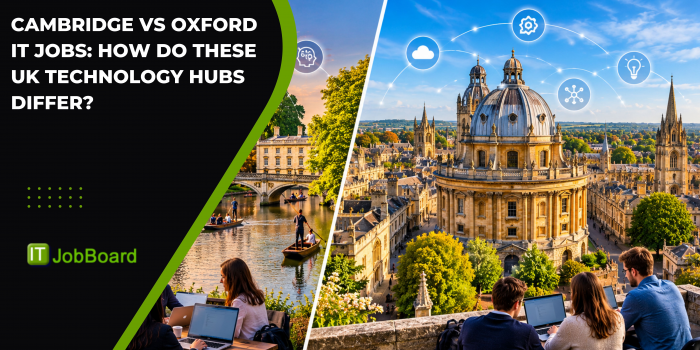
When comparing London vs Cambridge IT jobs, the biggest difference is not simply the number of vacancies. London has a broad technology market spanning financial services, consulting, software, telecommunications, retail and large enterprise technology, while Cambridge has a more concentrated technology ecosystem linked to software, AI, semiconductors, embedded systems, research, life sciences and advanced engineering.
For IT professionals, the right location can therefore depend on the type of technology work, skills and employer environment they want to pursue.
Direct Answer: How Do London and Cambridge IT Jobs Differ?
London offers a much larger and more diverse IT employment market, with roles ranging from software engineering and data analysis to cybersecurity, cloud infrastructure, business analysis and technology leadership.
Cambridge has a smaller but highly specialised technology ecosystem. Its employment market has strong links to research-intensive technology, AI, semiconductors, embedded software, telecommunications, robotics and life sciences.
Current IT Job Board listings illustrate this difference. The London jobs page currently contains hundreds of vacancies across a broad range of technology functions, while the Cambridge city page includes roles such as embedded software engineering, system integration, cybersecurity, machine learning, testing and infrastructure.
Key takeaway: London provides breadth and scale; Cambridge provides a concentrated environment for technology, engineering and research-led careers.
What Makes London Different for IT Professionals?
London is the UK's largest technology employment centre and has a highly diversified economy.
The UK government's technology-sector information describes Greater London as accounting for a substantial share of the UK's technology-sector value, with particular strengths in areas including AI, cybersecurity and investment.
This diversity is reflected in the types of roles advertised.
London technology professionals can find opportunities across:
- Software engineering
- Data analysis
- Business analysis
- Cybersecurity
- Cloud computing
- IT support
- Network engineering
- Telecommunications
- Enterprise applications
- Financial technology
- Technology consulting
- Product management
- IT project management
- Technical architecture
The city's financial-services sector also creates demand for technology professionals who understand regulated environments, data, security and enterprise systems.
Recent IT Job Board listings, for example, include London roles involving network engineering, AI-focused software architecture, SQL and commercial analytics.
This makes London particularly relevant to professionals whose skills can be applied across several industries.
Internal-link opportunity
Consider linking IT jobs in London to the relevant London city page and using category anchors such as:
- Software Engineer Jobs
- Data Analyst Jobs
- Business Analyst Jobs
- Cyber Security Jobs
- IT Support Jobs
- SQL Jobs
- Python Jobs
- Telecommunications Jobs
What Makes Cambridge Different for IT Professionals?
Cambridge has a different technology profile.
The Cambridge ecosystem is closely associated with research, innovation and high-technology businesses. Cambridge Enterprise reports more than 5,000 knowledge-intensive firms in and around Cambridge, employing more than 72,500 people.
The University of Cambridge also describes information technology and telecommunications as one of the region's largest business sectors, with nearly 3,000 companies identified in its Cambridge Cluster research.
The technology environment includes areas such as:
- Artificial intelligence
- Machine learning
- Semiconductor technology
- Embedded systems
- Software engineering
- Robotics
- Telecommunications
- Wireless technology
- Computer vision
- Data science
- Cybersecurity
- Life-science technology
- Research and development
The UK's 2026 semiconductor-sector study also identifies Cambridge as a globally significant semiconductor research and design ecosystem, with activity spanning chip architecture, embedded systems, photonics, wireless technology and AI-related processors.
This creates opportunities for professionals whose careers sit at the intersection of software, hardware, engineering and scientific research.
Which IT Roles Are Commonly Found in London?
London's scale means professionals can search across a wide range of technology categories.
Some commonly relevant career areas include:
Software Engineering
Software engineers can work for financial institutions, technology companies, retailers, consultancies, media organisations and startups.
Data and Analytics
London's large business and financial ecosystem supports demand for:
- Data Analysts
- Business Analysts
- Data Engineers
- Data Scientists
- Business Intelligence professionals
Cybersecurity
The concentration of financial, government and enterprise organisations creates demand for professionals working in security operations, governance, cloud security and risk.
Cloud and Infrastructure
London also supports roles involving Azure, AWS, networking, systems administration and enterprise infrastructure.
Technology Leadership
The size of London's technology organisations means there are opportunities for experienced:
- IT Managers
- Technology Managers
- Solutions Architects
- Project Managers
- Product Managers
- Technical Consultants
For candidates who want to move between industries or technology specialisms, this broad employer base can be an important consideration.
Which IT Roles Are Commonly Found in Cambridge?
Cambridge's technology ecosystem creates a different combination of opportunities.
Current IT Job Board listings include examples such as embedded Linux engineering, embedded software engineering, system integration, software testing, machine learning engineering, network engineering and cybersecurity.
This means Cambridge can be particularly relevant to professionals with skills in:
- C and C++
- C#
- Python
- Embedded Linux
- Machine Learning
- Computer Vision
- Wireless Communications
- Systems Integration
- Software Testing
- Networking
- Hardware-software integration
The semiconductor ecosystem adds another layer, with Cambridge supporting activity in chip architecture, photonics, wireless communications and energy-efficient AI computing.
Internal-link opportunity
Useful category anchors for a Cambridge-focused article include:
- Python Jobs
- Testing Jobs
- Software Engineer Jobs
- Data Scientist Jobs
- IT Support Jobs
- Telecommunications Jobs
- C# Jobs
- Developer Jobs
Is London or Cambridge More Suitable for Software Engineers?
There is no single answer because the two markets support different types of software engineering.
London provides access to software roles across many industries. A software engineer may work on financial platforms, enterprise applications, consumer products, SaaS products, cybersecurity systems or AI applications.
Cambridge has a stronger connection to technology products that combine software with advanced engineering and research.
For example, current Cambridge vacancies include embedded software and systems roles involving electronics, wireless communications, robotics and multidisciplinary engineering.
Therefore, a software engineer should look beyond the job title.
The more useful questions are:
- What industry is the employer in?
- Is the role product-focused or service-focused?
- Does the job involve hardware?
- Is research part of the role?
- Which programming languages are required?
- Is the position focused on enterprise software, embedded systems or AI?
How Do AI and Machine Learning Opportunities Compare?
Both locations are relevant to AI, but their ecosystems have different characteristics.
London has a very large AI ecosystem supported by startups, financial services, professional services, technology companies and investors. The UK government reported several AI-related technology investments and new roles connected with London during 2026.
Cambridge's AI opportunities are closely connected with research, engineering and sectors such as life sciences, healthcare, semiconductors and advanced technology.
The Greater Cambridge Growth Scenarios report identifies Cambridge as an important global technology and digital innovation hub and highlights connections between AI, life sciences and medtech.
For job seekers, this can translate into different types of AI career opportunities.
A candidate interested in AI product development, financial technology or large-scale enterprise AI may encounter a broad range of London roles.
A candidate interested in machine learning, computer vision, AI research, embedded AI or AI applied to scientific and engineering problems may find Cambridge particularly relevant.
What Skills Should Job Seekers Develop for Both Markets?
Several skills can be useful across both cities.
Programming
Python remains relevant across software development, data and AI roles. Other languages such as Java, C#, C++ and JavaScript may be important depending on the role.
Cloud Technology
Cloud platforms, infrastructure automation and cloud security are increasingly relevant across technology employers.
Data Skills
SQL, data analysis and data engineering skills can transfer across sectors.
Cybersecurity
Security knowledge is increasingly relevant to software, infrastructure and enterprise technology positions.
Communication
Technical professionals are often required to explain complex technology to non-technical stakeholders.
AI Literacy
Understanding how AI affects software development, data workflows and business processes can complement existing technical skills.
Does Company Size Matter When Choosing Between London and Cambridge?
Yes.
London has a large concentration of multinational companies, financial institutions, consultancies, technology firms and startups.
Cambridge has many smaller technology businesses, university spinouts, research-driven organisations and specialised technology companies alongside larger employers.
Cambridge Enterprise describes the local ecosystem as a connected network of universities, entrepreneurs, startups, spinouts and established companies.
This means candidates should consider employer type as well as location.
A large enterprise may offer highly structured technology teams and defined career paths, while a smaller technology company may provide exposure to several technical areas within the same role.
How Should You Search for London vs Cambridge IT Jobs?
Rather than searching only for a city, combine location + role + technology.
For example:
- London + Software Engineer
- London + SQL
- London + Business Analyst
- London + Cyber Security
- Cambridge + Python
- Cambridge + Embedded Software
- Cambridge + Machine Learning
- Cambridge + Testing
- Cambridge + Telecommunications
IT Job Board's current city pages allow candidates to browse vacancies by location, while category searches can help narrow opportunities according to technical specialism.
Candidates should also check whether each vacancy is:
- Permanent
- Contract
- Hybrid
- Remote
- Office-based
The location displayed in a job advert does not always mean that every working day is spent in the city.
What Should Candidates Consider Before Choosing Between the Two?
A useful comparison should include more than vacancy numbers.
Consider:
Technology specialism: Does the local market match your technical skills?
Industry: Do you want financial services, consulting, software, life sciences, telecommunications or advanced engineering?
Employer type: Are you targeting multinational companies, startups, scaleups or research organisations?
Working pattern: Does the employer offer hybrid, remote or office-based work?
Career direction: Will the role help you develop towards engineering, architecture, management, data or AI?
Commute: How practical is the location for your preferred working pattern?
Skills demand: Are employers asking for the programming languages, platforms and certifications you already have?
These factors can be more useful than comparing cities based solely on the number of vacancies.
Key Takeaways
- London vs Cambridge IT jobs represents two different technology-market models.
- London has a broader and more diversified technology employment base.
- Cambridge has a highly concentrated ecosystem around technology, research and advanced engineering.
- London offers technology opportunities across finance, consulting, retail, media, software and enterprise technology.
- Cambridge has notable strengths in AI, embedded systems, semiconductors, telecommunications, robotics and life-science technology.
- Software engineers should compare the actual responsibilities of roles rather than relying only on job titles.
- Python, SQL, software development, cloud, cybersecurity and AI skills can be relevant across both markets.
- Candidates should combine city, job role and technology keywords when searching for vacancies.
- Employer type and working pattern are important factors when comparing opportunities.
Frequently Asked Questions
1. What is the difference between London and Cambridge IT jobs?
London has a larger and more diverse IT market covering many industries, while Cambridge has a more specialised technology ecosystem with strong connections to research, AI, engineering, semiconductors and advanced technology.
2. Are there software engineering jobs in Cambridge?
Yes. Current Cambridge listings include software engineering, embedded software, systems integration and other engineering-focused technology positions.
3. What IT skills are useful for jobs in London?
Skills such as software development, Python, SQL, cloud technology, cybersecurity, data analysis, business analysis and networking can be relevant to London technology roles.
4. What technology sectors are important in Cambridge?
Cambridge has strong activity across information technology, telecommunications, AI, semiconductors, embedded systems, robotics, life sciences and research-led technology.
5. How can I find IT jobs in London and Cambridge?
Use location filters for London and Cambridge, then combine them with relevant technology categories such as Software Engineer, Python, SQL, Testing, Data Scientist, Telecommunications or IT Support.