18/09/2026
SAP vs Oracle Careers: Which Enterprise Technology Path Is Right for You?
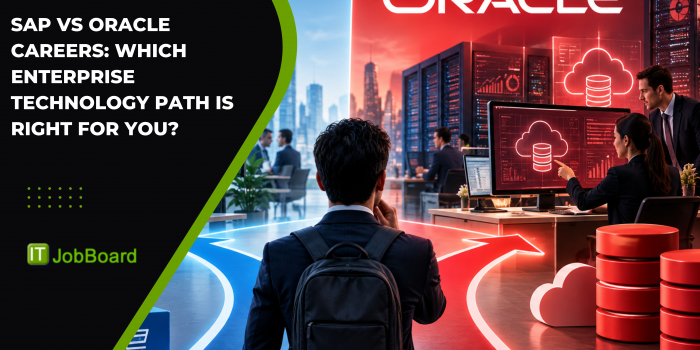
If you are comparing SAP vs Oracle careers, both can lead to strong opportunities in enterprise IT, but they involve different technologies, job responsibilities and career paths. SAP is strongly associated with enterprise resource planning, business processes and integrated organisational systems, while Oracle careers span databases, enterprise applications, cloud technology and data platforms. The right choice depends on whether you are more interested in business process technology, database systems, application platforms, data or enterprise architecture.
Direct answer: SAP may be a better fit if you want to work closely with business processes such as finance, supply chain, procurement and human resources. Oracle may be a better fit if you are interested in databases, cloud infrastructure, enterprise applications and data technology. However, both ecosystems offer multiple specialist career paths.
What Is the Difference Between SAP and Oracle Careers?
SAP and Oracle are both major enterprise technology ecosystems, but they are not simply interchangeable career options.
SAP is widely associated with ERP software that helps organisations manage interconnected business processes. SAP professionals can specialise in areas such as finance, supply chain, procurement, human resources, manufacturing and technology.
Oracle has a broader technology footprint that includes database technology, cloud infrastructure, enterprise applications and data management.
This means the typical career direction can be different.
An SAP professional might work as:
- SAP Consultant
- SAP Functional Consultant
- SAP Technical Consultant
- SAP Analyst
- SAP Developer
- SAP Basis Administrator
- SAP Security Specialist
- SAP Solution Architect
An Oracle professional might work as:
- Oracle Database Administrator
- Oracle Developer
- Oracle Consultant
- Oracle Cloud Engineer
- Oracle Applications Consultant
- Oracle Database Engineer
- Oracle Architect
- Oracle Cloud Specialist
There is also considerable overlap between the two ecosystems, particularly in large organisations that use multiple enterprise technologies.
What Does an SAP Professional Do?
SAP careers can be divided broadly into functional and technical roles.
A functional SAP professional focuses on how the technology supports business processes.
For example, an SAP professional working in finance may help configure systems around financial reporting, accounting or business transactions.
A technical professional may work with:
- SAP development
- System administration
- Integrations
- Security
- Data
- System performance
- Cloud environments
- Application architecture
SAP consultants often work directly with business stakeholders. They need to understand both the technology and the processes the organisation is trying to improve.
This makes business knowledge particularly valuable.
For example, someone working with SAP supply-chain technology may need to understand procurement, inventory, logistics and manufacturing processes rather than focusing purely on programming.
What Does an Oracle Professional Do?
Oracle careers cover a wider range of technical areas.
One of the best-known Oracle career paths is database administration.
An Oracle Database Administrator may be responsible for:
- Database performance
- Backup and recovery
- Security
- Availability
- User access
- Database configuration
- Troubleshooting
- Monitoring
- Capacity planning
Other Oracle professionals may work on enterprise applications, cloud services or development.
This makes Oracle particularly relevant to candidates interested in database careers, cloud computing and enterprise technology.
For example, someone with experience in SQL may move towards an Oracle database role, while a cloud professional could specialise in Oracle Cloud infrastructure.
Which Career Requires More Technical Skills?
There is no simple answer because both ecosystems contain technical and non-technical roles.
An SAP functional consultant may require strong business-process knowledge but relatively limited programming.
An SAP technical specialist may require considerably deeper technical skills.
Similarly, an Oracle functional consultant and an Oracle Database Administrator can have very different responsibilities.
Generally:
SAP functional roles: Business processes + configuration + stakeholder management
SAP technical roles: Development + integrations + systems + architecture
Oracle database roles: SQL + database administration + performance + security
Oracle cloud roles: Cloud + infrastructure + networking + automation
Therefore, candidates should compare specific job roles rather than simply comparing SAP and Oracle as technologies.
Is SAP or Oracle Better for Someone With SQL Skills?
SQL can provide a particularly useful foundation for Oracle-oriented careers.
Candidates interested in database work can build on SQL knowledge by learning:
- Relational database concepts
- Database administration
- Performance tuning
- Backup and recovery
- Database security
- Cloud databases
- Automation
SQL can also be useful in SAP environments, particularly for professionals working with data and technical systems.
However, SAP careers can place greater emphasis on understanding business processes depending on the role.
If you enjoy writing queries, analysing database structures and troubleshooting data systems, an Oracle database career may feel more natural.
If you enjoy understanding how technology supports finance, procurement, HR or supply-chain operations, an SAP functional career may be more suitable.
Which Career Is Better for Graduates?
Both can be viable options for graduates, although the entry routes are different.
A graduate interested in SAP could start by developing knowledge of:
- ERP fundamentals
- Business processes
- SAP modules
- Data concepts
- Business analysis
- Project delivery
- Enterprise systems
A graduate interested in Oracle could start with:
- SQL
- Database fundamentals
- Linux
- Cloud computing
- Programming
- Networking
- Data management
The important point is to avoid learning only product terminology.
Employers generally need professionals who understand how enterprise technology solves practical problems.
For example, knowing SAP terminology without understanding business processes may not be enough for a functional role.
Similarly, knowing SQL syntax without understanding database administration may not prepare someone for a DBA position.
Which Has More Career Specialisation?
Both have extensive specialisation opportunities.
SAP professionals can specialise in areas such as:
- SAP S/4HANA
- Finance
- Supply Chain
- Procurement
- Human Resources
- Manufacturing
- Business Intelligence
- Security
- Integration
- Development
- Architecture
Oracle professionals can specialise in:
- Oracle Database
- Oracle Cloud
- Database Administration
- Enterprise Applications
- Data Engineering
- Cloud Infrastructure
- Security
- Development
- Architecture
This means neither ecosystem should be viewed as a single job.
The choice becomes more useful when you identify the particular specialisation you want.
How Do SAP and Oracle Careers Compare With Software Development?
Both ecosystems can overlap with software development, but the work is usually more enterprise-focused.
A traditional Software Engineer may spend much of their time developing applications, APIs or services.
An SAP Developer may work on software and integrations connected to enterprise business systems.
An Oracle Developer may work with databases, applications, stored procedures and enterprise platforms.
Candidates who enjoy programming but also want to understand large organisational systems may therefore find enterprise technology particularly interesting.
Those interested primarily in application development may prefer a broader Software Engineer or Application Developer career.
How Important Are Cloud Skills?
Cloud knowledge is increasingly relevant to both career paths.
Enterprise organisations increasingly operate technology across cloud and hybrid environments.
This means professionals may need to understand:
- Cloud architecture
- Identity and access management
- Security
- Automation
- Monitoring
- Data migration
- Integration
- Infrastructure management
For Oracle professionals, cloud skills can complement database and enterprise application knowledge.
For SAP professionals, cloud knowledge can support modern enterprise application and ERP environments.
This creates opportunities for professionals who combine an established enterprise platform with modern cloud capabilities.
What Skills Should You Learn for an SAP Career?
If SAP interests you, consider developing a combination of technical and business skills.
Useful areas include:
- ERP fundamentals
- Business process analysis
- SAP modules
- Data management
- Enterprise integration
- Cloud computing
- Stakeholder communication
- Requirements gathering
- Problem-solving
- Project delivery
The most appropriate skills depend heavily on the SAP role.
A functional consultant may need stronger business and stakeholder skills, while a technical specialist may need deeper development, integration or infrastructure knowledge.
What Skills Should You Learn for an Oracle Career?
Oracle candidates should first establish strong database and technology fundamentals.
Useful skills include:
- SQL
- Relational databases
- Database administration
- Performance tuning
- Backup and recovery
- Database security
- Linux
- Cloud platforms
- Automation
- Data modelling
For development-focused roles, programming and application integration can also become important.
Candidates interested in Oracle Cloud should add cloud architecture, networking, security and infrastructure knowledge.
Which Career Offers Better Long-Term Progression?
Both can provide several routes into senior technology positions.
An SAP career could progress from:
Junior SAP Professional → SAP Consultant → Senior Consultant → SAP Lead → SAP Solution Architect
Another route could move towards:
SAP Specialist → Enterprise Architect → Technology Leadership
An Oracle database career might progress through:
Junior Database Professional → Oracle DBA → Senior DBA → Database Architect → Enterprise Architect
Cloud-focused professionals could move towards:
Oracle Cloud Engineer → Senior Cloud Engineer → Cloud Architect → Enterprise Architect
The best progression depends more on specialisation and experience than on choosing SAP or Oracle alone.
How Should You Choose Between SAP and Oracle?
Consider SAP if you enjoy:
- Business processes
- Enterprise systems
- Consulting
- Stakeholder interaction
- ERP
- Finance or supply-chain technology
- Process improvement
Consider Oracle if you enjoy:
- Databases
- SQL
- Data systems
- Cloud technology
- Infrastructure
- Performance optimisation
- Technical troubleshooting
There is no universal winner.
The better choice is the ecosystem that matches the type of technical and business problems you want to solve.
Final Thoughts
The SAP vs Oracle careers decision is less about choosing one technology as universally better and more about choosing the type of IT work that suits your interests.
SAP can be particularly attractive for professionals interested in ERP, business processes and enterprise transformation. Oracle can be a strong route for people interested in databases, cloud technology, data and enterprise platforms.
Both ecosystems also provide opportunities to develop specialist expertise and progress towards architecture, consulting and technology leadership.
For candidates starting out, the most useful approach is to choose a specific role first and then identify the technology skills required for that role. Building practical knowledge around SQL, enterprise systems, cloud platforms, data and business processes can keep multiple career options open.
FAQs
1. Is SAP or Oracle better for an IT career?
Neither is universally better. SAP may suit people interested in ERP and business processes, while Oracle may suit professionals interested in databases, cloud and data technology.
2. Can I move from SQL into an Oracle career?
Yes. Strong SQL and database knowledge can provide a useful foundation for Oracle database roles, although additional skills in administration, security, performance and cloud technology may be required.
3. Do SAP jobs require programming?
Not always. Many SAP functional roles focus more on business processes, configuration and stakeholder management, while technical SAP roles can require programming and integration skills.
4. Which is easier to learn, SAP or Oracle?
It depends on the role. SAP functional learning may be more accessible to candidates with business-process experience, while Oracle database roles can require strong technical and database fundamentals.
5. Can SAP or Oracle careers lead to senior IT roles?
Yes. Experienced professionals in both ecosystems can progress into senior consulting, architecture, enterprise technology and IT leadership positions.