18/08/2026
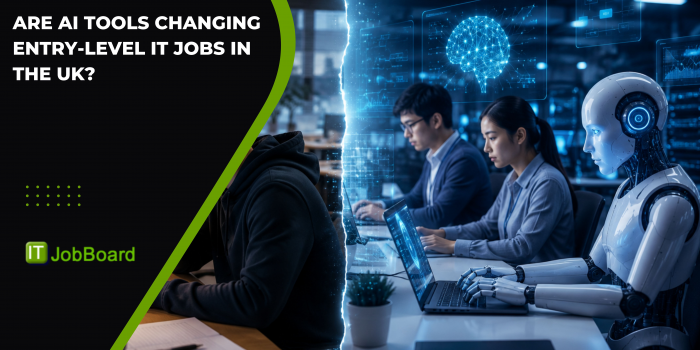
Are AI Tools Changing Entry-Level IT Jobs in the UK?
The traditional route into an IT career has often started with junior responsibilities: writing basic code, testing applications, resolving support tickets, preparing reports, documenting systems and learning from more experienced colleagues. Artificial intelligence is now changing how many of these tasks are performed.
This has created an important question for people searching for entry-level IT jobs UK: are AI tools reducing opportunities for junior technology professionals, or are they simply changing what employers expect from new candidates?
The evidence points towards a more complicated picture.
AI is increasingly capable of handling routine and repetitive tasks, but organisations still need people who can understand technology, verify AI-generated work, solve unfamiliar problems and take responsibility for outcomes. At the same time, the UK's graduate labour market has become more competitive. Recent reporting based on Indeed data found that UK graduate job postings reached their lowest level since 2020 during the first half of 2026, while demand for AI-related skills reached a record high.
For graduates and career starters, the implication is important: the entry-level IT career is not disappearing, but the definition of “entry-level” is changing.
Why are people concerned about AI and entry-level IT jobs?
The concern comes from the types of tasks that traditionally gave junior workers their first professional experience.
Many entry-level technology roles involve structured, repeatable activities. A junior developer might fix simple bugs. A junior analyst might clean data. An IT support technician might handle password resets and standard troubleshooting. A junior tester might execute predefined test cases.
AI can increasingly assist with, or automate, parts of these activities.
For example, coding assistants can generate routine code. AI systems can summarise documentation. Chatbots can answer common support questions. Data tools can automate parts of analysis. Testing tools can generate test cases.
This does not automatically mean that an entire job disappears.
Instead, the number of tasks a junior employee performs manually may decrease.
That creates a new challenge: if AI performs some of the basic work, how do new professionals gain the experience traditionally acquired through that work?
This question is becoming increasingly important because junior tasks are not only productive tasks. They are also learning opportunities.
Are entry-level IT jobs actually disappearing because of AI?
There is currently not enough evidence to conclude that AI is eliminating entry-level IT employment as a whole.
What is clearer is that AI is changing hiring requirements and the structure of junior work.
Recent research and reporting increasingly point towards task transformation rather than a simple replacement of entire occupations. A 2026 analysis of AI's labour-market effects reported limited evidence of broad employment destruction among highly AI-exposed workers so far, while highlighting changes in job tasks, hiring expectations and productivity.
The distinction matters.
Consider a junior software developer.
Before widespread AI coding tools, a junior developer might spend significant time writing straightforward functions. With AI assistance, that developer may produce the same functionality faster.
But someone still needs to:
- Understand the requirement
- Decide whether the generated code is appropriate
- Review the code
- Test it
- Identify security problems
- Integrate it with the wider application
- Explain technical decisions
- Fix unexpected behaviour
The work has changed, but software engineering has not become unnecessary.
The same principle applies across many IT disciplines.
Which junior IT tasks are most affected by AI?
AI tends to have the greatest immediate impact on tasks that are repetitive, predictable and relatively easy to verify.
These can include:
- Basic code generation
- Simple debugging
- Documentation
- Data formatting
- Routine report generation
- Standard customer responses
- Basic technical research
- Repetitive testing
- Simple SQL queries
- First-line troubleshooting
- Content summarisation
However, automation becomes more difficult when a task requires context, judgement, accountability or interaction with unpredictable systems.
That means junior professionals should understand an important career principle:
Do not build your entire employability around tasks that software can perform automatically.
Instead, develop capabilities around the tasks that require understanding and judgement.
How is AI changing junior software developer jobs?
Software development is one of the clearest examples of this transition.
Generative AI can now help developers write functions, explain code, generate tests, identify possible bugs and produce documentation.
This can make a technically capable developer significantly more productive.
However, it can also change the expectations placed on junior developers.
An employer may no longer be impressed simply because a candidate can produce basic code.
Instead, employers may want evidence that the candidate can:
- Understand software architecture
- Review AI-generated code
- Identify incorrect assumptions
- Debug complex problems
- Work with APIs
- Understand security
- Write tests
- Use version control
- Communicate with stakeholders
- Make sensible technical decisions
In other words, AI may raise the baseline expectation for junior developers.
The candidate who knows how to use AI responsibly and still understands the fundamentals can potentially be more valuable than a candidate who either refuses to use AI or relies on it without understanding the output.
What is happening to graduate IT jobs in the UK?
Graduate candidates are entering a labour market where employers are becoming more selective.
Recent UK reporting indicates that graduate job postings have faced significant pressure, while AI-related skills have become increasingly sought after.
This creates a difficult combination for graduates.
There may be fewer traditional entry-level opportunities at the same time as employers expect candidates to arrive with more practical skills.
That does not mean graduates need years of professional experience.
It means they need stronger evidence of what they can actually do.
A university qualification can demonstrate academic knowledge.
A portfolio can demonstrate application.
For example, instead of simply stating:
“Knowledge of Python and AI.”
A graduate could demonstrate:
“Built a Python application using an LLM API, implemented retrieval from a structured knowledge base, evaluated outputs and documented limitations.”
The second statement provides evidence of practical capability.
Do employers now expect AI skills from junior IT candidates?
Increasingly, yes.
The important distinction is between AI awareness and advanced AI engineering.
A graduate applying for an IT support role may not need to build a machine-learning model.
But understanding how AI-powered support tools work, how to verify generated information and how to use automation responsibly could be valuable.
Similarly, a junior software developer may not need advanced machine-learning mathematics, but understanding LLM APIs, AI-assisted coding workflows and model limitations can be useful.
Recent UK employer research reported that many organisations expect basic AI proficiency to become increasingly important even beyond specialist technical positions. One 2026 survey reported that 77% of UK organisations expected basic AI proficiency to become a baseline requirement across most non-technical roles within the following year.
This suggests that AI literacy is becoming broader than the specialist AI jobs market.
Which entry-level IT roles can benefit from AI?
AI is not only a threat to junior roles. It can also make early-career professionals more productive.
Junior software developers
AI can help with coding, testing and documentation, allowing junior developers to spend more time understanding systems and solving problems.
Junior data analysts
AI can assist with SQL, data exploration and report generation, while the analyst focuses on interpreting results and understanding business requirements.
IT support technicians
AI-powered support systems can handle common requests, allowing technicians to focus on complex incidents and escalations.
Cybersecurity analysts
AI can help prioritise alerts and identify unusual activity, although human validation remains essential.
QA testers
AI can assist with test generation and repetitive testing while junior testers learn more about quality strategy and software behaviour.
Cloud and DevOps professionals
AI can assist with monitoring, scripting and operational workflows, allowing junior professionals to gain exposure to larger infrastructure environments.
The common theme is that AI can become a productivity tool for junior professionals rather than simply a replacement mechanism.
What skills should graduates develop for AI-era IT jobs?
The strongest strategy is to combine foundational IT skills with practical AI literacy.
Technical fundamentals
Graduates should still understand programming, databases, operating systems, networking, cloud computing and cybersecurity fundamentals depending on their chosen career.
AI does not remove the need for fundamentals.
It makes them more important because professionals need enough technical knowledge to recognise when an AI-generated answer is wrong.
AI literacy
Candidates should understand:
- What generative AI can and cannot do
- How LLMs work at a practical level
- Prompt design
- AI APIs
- Model limitations
- Hallucinations
- Data privacy
- AI security
- Output evaluation
Critical thinking
AI can generate convincing but incorrect answers.
A professional who accepts every AI output without verification creates risk.
Critical evaluation is therefore an employability skill.
Recent research into GenAI and entry-level software engineering found strong agreement around the importance of critically evaluating AI-generated output, using GenAI effectively and responsibly, and being able to learn and adapt independently.
Communication
Technology professionals still need to explain problems to people.
Strong communication can distinguish candidates who merely operate tools from professionals who can contribute to business outcomes.
Should graduates learn AI instead of traditional IT skills?
No.
This is one of the biggest mistakes an aspiring IT professional can make.
AI should generally be added to a strong technology foundation rather than used as a replacement for it.
A graduate who understands Python, SQL, databases, APIs and software engineering principles can use AI more effectively than someone who only knows how to write prompts.
The same applies to cybersecurity.
Someone who understands networks, authentication, operating systems and security principles is better positioned to evaluate AI-generated security analysis.
The future skill combination is therefore not:
Traditional IT OR AI
It is:
Traditional IT + AI literacy + human judgement
How can graduates prove they can work with AI?
A portfolio is one of the most practical ways to demonstrate AI capability.
A graduate could create a small number of focused projects rather than dozens of unfinished experiments.
For example:
Software development: Build an AI-powered application and explain the architecture, testing and security decisions.
Data: Create a data-analysis project where AI assists with SQL generation but all outputs are independently validated.
Cybersecurity: Build a security-analysis project showing how AI can assist with threat detection while explaining false positives and limitations.
IT support: Create a knowledge-base assistant and document how it handles unknown questions.
Cloud: Deploy an AI-enabled application using a cloud platform and document its infrastructure.
The project does not need to be revolutionary.
Employers need evidence that the candidate can understand a problem, use technology appropriately and evaluate the result.
Could AI make it harder for young people to enter IT?
Potentially, particularly if organisations automate many of the repetitive tasks traditionally performed by junior employees.
This is one of the less-discussed risks of workplace AI.
Entry-level work performs two functions:
- It contributes to business output.
- It develops future professionals.
If organisations automate all beginner tasks without creating alternative learning pathways, they could eventually weaken their own talent pipeline.
This is especially important in software engineering and other technical disciplines where professional judgement develops through experience.
The issue is therefore not simply how many junior jobs AI removes.
It is also whether organisations redesign junior roles so that new workers continue to learn.
What can employers do to develop junior IT talent in an AI-driven workplace?
Employers can redesign entry-level positions around learning, supervision and higher-value tasks.
Instead of assigning junior employees only repetitive work, organisations can give them responsibility for:
- Reviewing AI-generated outputs
- Testing AI-enabled systems
- Documenting workflows
- Monitoring automated processes
- Investigating exceptions
- Supporting senior engineers
- Improving internal tools
- Analysing system performance
This allows AI to remove low-value repetition without removing the learning pathway.
The approach can benefit employers as well.
Recent UK reporting has highlighted growing concern around young people struggling to secure their first employment opportunities, while government initiatives are increasingly focusing on AI skills and job readiness.
A strong junior talent pipeline remains valuable even in an AI-enabled economy.
What should someone applying for entry-level IT jobs in the UK do now?
Candidates should avoid treating AI as a separate career category.
Instead, connect AI to the job they actually want.
A practical approach is:
Choose one IT pathway.
Software development, data, cybersecurity, cloud, IT support and testing are all possible routes.
Build the fundamentals.
Learn the technologies that form the foundation of the role.
Add relevant AI skills.
Do not attempt to learn every AI platform. Learn the AI capabilities relevant to your chosen discipline.
Create two or three practical projects.
Projects provide evidence that you can apply knowledge.
Learn to evaluate AI outputs.
Being able to identify errors is increasingly important.
Show outcomes on your CV.
Explain what you built, automated, improved or analysed rather than simply listing tools.
Prepare for practical interviews.
Employers may increasingly assess candidates through real-world tasks rather than relying exclusively on traditional interview questions.
What does the future of entry-level IT work look like?
The future of entry-level IT work is likely to be different from the traditional junior career model.
AI will continue to automate some routine activities.
But technology organisations will still need people who can learn systems, solve problems, communicate effectively and take responsibility for technical decisions.
The biggest change may therefore be the starting point.
A junior professional may be expected to arrive with greater digital fluency, some experience using AI tools and a stronger understanding of their chosen technical discipline.
At the same time, employers will need to rethink how junior professionals acquire experience.
The most successful organisations may not be those that simply automate the greatest number of entry-level tasks.
They may be the organisations that use AI to remove repetitive work while giving early-career professionals more opportunities to learn, analyse, experiment and contribute.
For candidates searching for entry-level IT jobs UK, the message is clear: AI is changing the doorway into technology careers, but it is not closing the door.
The strongest candidates will be those who understand both sides of the equation — what AI can automate and what still requires human judgement.
Frequently Asked Questions
Are AI tools replacing entry-level IT jobs in the UK?
AI is automating some repetitive tasks traditionally assigned to junior employees, but there is not enough evidence to conclude that entry-level IT employment as a whole is disappearing. Instead, many junior roles are changing and employers are increasingly looking for candidates with AI literacy and strong technical fundamentals.
Are graduate IT jobs becoming harder to find?
The UK graduate labour market has become more competitive. Recent reporting based on Indeed data found that graduate job postings reached their lowest level since 2020 during the first half of 2026, while demand for AI skills reached a record high.
What AI skills should IT graduates learn?
Useful skills include generative AI, LLM fundamentals, AI APIs, prompt design, output evaluation, AI security and responsible AI use. The depth required depends on the specific IT career.
Will AI replace junior software developers?
AI is likely to automate parts of software development rather than eliminate the entire profession. Junior developers who understand programming fundamentals and can effectively review, test and improve AI-generated code can remain valuable.
Should graduates learn AI instead of coding?
No. AI should complement coding and other IT fundamentals rather than replace them. Understanding programming makes it easier to evaluate AI-generated code and build reliable applications.
How can graduates get experience with AI?
Graduates can build practical portfolio projects involving AI APIs, data analysis, automation, software development, cybersecurity or cloud technologies. Projects should demonstrate problem-solving and evaluation rather than simply showing that an AI tool was used.
What skills will help graduates compete for IT jobs?
Technical fundamentals, AI literacy, analytical thinking, communication, problem-solving and adaptability are increasingly valuable. Employers need people who can use AI productively while also recognising its limitations.
Is AI literacy becoming important outside specialist AI jobs?
Yes. Recent UK employer research suggests that basic AI proficiency is increasingly being treated as a broader workplace capability rather than a skill limited to AI specialists.
Can AI actually help junior IT professionals?
Yes. AI can accelerate coding, research, documentation, data analysis, testing and troubleshooting. Used correctly, it can allow junior professionals to spend more time on learning, problem-solving and higher-value work.
What is the best strategy for finding entry-level IT jobs in the UK?
Choose a specific IT career path, develop strong fundamentals, learn relevant AI capabilities, build practical projects and demonstrate measurable skills on your CV. Candidates should focus on showing what they can accomplish rather than simply listing AI tools.