18/09/2026
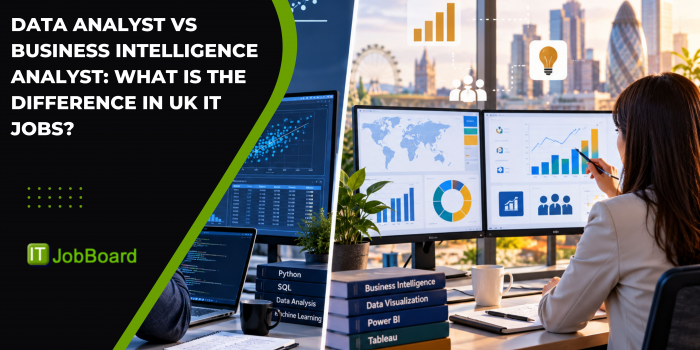
Data Analyst vs Business Intelligence Analyst: What Is the Difference in UK IT Jobs?
If you are comparing Data Analyst vs Business Intelligence Analyst careers, the two roles can look very similar because both involve analysing information, creating reports and helping organisations make better decisions. However, their day-to-day focus can be different. Data Analysts generally investigate data to answer specific business questions, identify trends and produce insights, while Business Intelligence Analysts often focus more heavily on reporting systems, dashboards, performance metrics and turning organisational data into decision-making tools.
Direct answer: A Data Analyst may be the better fit if you enjoy analysing datasets, identifying patterns and answering business questions. A Business Intelligence Analyst may suit you better if you enjoy dashboards, reporting, data visualisation and building systems that help organisations monitor performance. There is considerable overlap, and the exact responsibilities depend on the employer.
What Is the Difference Between a Data Analyst and a Business Intelligence Analyst?
The simplest distinction is the type of problem each professional tends to solve.
A Data Analyst typically asks:
What does the data tell us?
A Business Intelligence Analyst may ask:
How can we turn organisational data into useful information for decision-making?
For example, a Data Analyst might investigate why customer retention has declined.
A BI Analyst might build a dashboard that allows managers to monitor customer retention, sales performance and operational KPIs on an ongoing basis.
In practice, however, one person may perform both types of work.
UK job advertisements already show this overlap. Current IT Job Board listings include roles where Data Analysts work within BI functions, produce dashboards and reports, use Power BI and SQL, and work closely with stakeholders.
What Does a Data Analyst Do?
A Data Analyst works with data to identify information that can help an organisation understand problems and make decisions.
Typical responsibilities include:
- Collecting data
- Cleaning datasets
- Writing SQL queries
- Analysing trends
- Identifying patterns
- Producing reports
- Creating dashboards
- Investigating business questions
- Checking data quality
- Presenting findings
- Supporting decision-making
A Data Analyst might receive a question such as:
Why have sales fallen in a particular region?
They could collect the relevant data, clean it, analyse historical performance and identify patterns that help explain the change.
The role therefore combines technical analysis with business understanding.
What Does a Business Intelligence Analyst Do?
A Business Intelligence Analyst focuses on transforming organisational data into useful reporting and insight.
Typical responsibilities can include:
- Building dashboards
- Developing management reports
- Defining KPIs
- Data modelling
- Reporting automation
- Data visualisation
- SQL querying
- Power BI development
- Monitoring business performance
- Supporting decision-makers
- Improving reporting processes
For example, a BI Analyst might create a Power BI dashboard that allows senior managers to monitor:
- Revenue
- Customer numbers
- Operational performance
- Costs
- Employee metrics
- Sales targets
- Regional performance
The dashboard may then become part of the organisation's regular decision-making process.
Which Role Uses More SQL?
Both can use SQL extensively.
Data Analysts may use SQL to:
- Extract datasets
- Filter information
- Join tables
- Calculate metrics
- Investigate trends
- Validate data
- Answer business questions
BI Analysts may use SQL to:
- Prepare reporting datasets
- Connect data sources
- Build queries for dashboards
- Create reporting models
- Support automated reporting
- Validate business intelligence outputs
The difference is not necessarily how much SQL each role uses.
It is more about what the SQL is being used to achieve.
A Data Analyst may write a query to investigate a particular business question.
A BI Analyst may write queries that support a recurring reporting system.
Which Role Uses Power BI More?
Power BI is highly relevant to both roles.
However, Business Intelligence positions often place particularly strong emphasis on dashboard development and reporting environments.
A BI Analyst may work with:
- Power BI
- DAX
- Power Query
- Data models
- Dashboards
- Data visualisation
- Reporting automation
Data Analysts can also use these tools to communicate findings.
Current IT Job Board vacancies show this overlap, with Data Analyst and BI-oriented positions requesting combinations of Power BI, SQL, reporting, data modelling and stakeholder communication.
Therefore, learning Power BI can be useful whichever career direction you choose.
Which Career Requires More Data Analysis?
Data analysis is central to both careers.
A Data Analyst may spend more time investigating individual questions or datasets.
For example:
- Why did customer churn increase?
- Which products are performing best?
- Which region has the strongest growth?
- What factors are affecting costs?
A BI Analyst may spend more time building repeatable reporting systems that allow managers to answer these questions themselves.
For example:
- Executive dashboard
- Sales dashboard
- Financial performance dashboard
- Customer KPI dashboard
- Operational reporting system
There is no strict boundary.
Many organisations use the titles differently.
What Skills Do Data Analysts Need?
A strong Data Analyst should develop a combination of technical, analytical and communication skills.
SQL
SQL is one of the most useful technical skills for Data Analysts.
You should understand:
- SELECT
- WHERE
- JOIN
- GROUP BY
- Aggregations
- Subqueries
- Common Table Expressions
- Window functions
Excel
Excel remains useful for data analysis, particularly for smaller datasets, quick analysis and business reporting.
Data Visualisation
Useful tools include:
- Power BI
- Tableau
- Excel
- Other reporting platforms
Analytical Thinking
You need to understand what the numbers actually mean rather than simply producing calculations.
Communication
A Data Analyst often needs to explain complex findings to people who do not work with data every day.
What Skills Do Business Intelligence Analysts Need?
BI Analysts need many of the same skills but may require deeper knowledge of reporting environments.
Important areas include:
- SQL
- Power BI
- DAX
- Power Query
- Data modelling
- Data visualisation
- Dashboard development
- KPI development
- Reporting automation
- Business analysis
- Stakeholder management
Understanding how different data sources connect can also become important.
A BI professional may need to combine information from:
- CRM systems
- Finance systems
- HR platforms
- Sales systems
- Databases
- Cloud platforms
The goal is to turn those different sources into useful business information.
Which Career Is Better for Graduates?
Both can be accessible to graduates, particularly those with backgrounds in:
- Computer science
- Mathematics
- Statistics
- Economics
- Business
- Engineering
- Data science
A graduate does not necessarily need a specific degree for every role.
Practical evidence can also be valuable.
For example, an aspiring Data Analyst could create a project involving:
- A public dataset
- Data cleaning
- SQL analysis
- Statistical investigation
- Power BI visualisation
- Written business recommendations
Someone targeting BI roles could additionally create an interactive dashboard with multiple data sources and clearly defined KPIs.
This gives employers evidence of practical ability rather than simply a list of technologies.
Which Career Is More Business-Focused?
Both careers require business understanding, but Business Intelligence roles can be particularly focused on organisational reporting and performance.
BI professionals often work with senior stakeholders who need regular information about business performance.
A BI Analyst might therefore need to understand:
- Business objectives
- KPIs
- Revenue
- Costs
- Operational performance
- Customer behaviour
- Departmental targets
Data Analysts can also work closely with stakeholders, particularly when investigating specific business problems.
Communication is therefore important in both careers.
Which Career Is More Technical?
Neither role is automatically more technical.
A junior Data Analyst may mainly work with Excel and basic reporting.
A senior Data Analyst could use advanced SQL, Python, statistical methods and complex datasets.
Likewise, a BI Analyst could focus on basic dashboards or become highly specialised in:
- Data modelling
- DAX
- Power BI architecture
- ETL
- Data warehouses
- SQL
- Reporting platforms
The technology environment matters more than the job title.
Can a Data Analyst Become a Business Intelligence Analyst?
Yes.
The transition can be relatively natural because the skills overlap significantly.
A Data Analyst who already knows SQL, Excel and data visualisation can develop additional BI skills such as:
- Power BI
- DAX
- Power Query
- Data modelling
- Dashboard design
- Data warehousing
- Reporting automation
For example:
Data Analyst → BI Analyst → Senior BI Analyst → BI Lead
Another route could be:
Data Analyst → BI Developer → BI Architect
The exact progression depends on the organisation.
Can a Business Intelligence Analyst Become a Data Analyst?
Yes.
BI professionals already work with data, reporting and business questions.
To move towards a more analytical Data Analyst role, they may develop stronger skills in:
- Statistical analysis
- Advanced SQL
- Python
- Data exploration
- Predictive analysis
- Experimental analysis
- Data storytelling
This can broaden their career options beyond reporting and dashboards.
How Important Is Python?
Python is useful but is not necessarily mandatory for every Data Analyst or BI Analyst role.
A Data Analyst working with advanced analysis may use Python for:
- Data cleaning
- Automation
- Statistical analysis
- Data transformation
- Large datasets
A BI Analyst may not need Python if their work is primarily based around SQL, Power BI and reporting platforms.
Therefore, SQL and Power BI can be more immediately relevant for many entry-level roles.
Python becomes particularly useful when moving towards more advanced analytics, data engineering or data science.
How Is AI Changing These Careers?
AI is changing how analysts work with data.
AI-assisted tools can help with:
- Generating SQL
- Explaining queries
- Creating formulas
- Summarising datasets
- Identifying patterns
- Producing first drafts of reports
- Supporting dashboard analysis
However, this does not remove the need for analytical judgement.
An analyst still needs to determine:
- Whether the data is reliable
- Whether the question is correctly defined
- Whether the analysis is appropriate
- Whether a correlation is meaningful
- Whether an AI-generated query is correct
- What the findings actually mean for the business
The ability to validate and interpret information therefore remains important.
Which Career Has Better Progression?
Both can lead to senior data and technology positions.
A possible Data Analyst progression is:
Junior Data Analyst → Data Analyst → Senior Data Analyst → Lead Data Analyst → Analytics Manager
Other routes include:
- Data Scientist
- Data Engineer
- BI Analyst
- Analytics Consultant
- Data Product roles
A BI progression could look like:
Junior BI Analyst → BI Analyst → Senior BI Analyst → BI Lead → BI Manager
Experienced professionals can also move into:
- BI Developer
- Data Architect
- Analytics Manager
- Data Platform roles
- Technology leadership
The choice should therefore be based on the type of work you prefer rather than assuming one career automatically has better progression.
Which Career Should You Choose?
Choose Data Analyst if you enjoy:
- Investigating data
- Answering business questions
- Finding patterns
- Analytical problem-solving
- SQL
- Statistical thinking
- Explaining insights
Choose Business Intelligence Analyst if you enjoy:
- Dashboards
- Power BI
- Data visualisation
- KPI reporting
- Data modelling
- Reporting automation
- Business performance
If you enjoy both, there is no need to make the distinction too early.
Learning SQL + Excel + Power BI + data analysis can prepare you for a wide range of entry-level opportunities.
Final Thoughts
The Data Analyst vs Business Intelligence Analyst comparison is not a choice between two completely separate careers. The roles overlap considerably, and some employers may even use the titles interchangeably.
Data Analysts often focus more on investigating information and answering specific business questions, while BI Analysts frequently concentrate on reporting, dashboards, KPIs and business intelligence systems.
For someone starting an IT career, the most useful approach is to build transferable data skills first. SQL, Excel, Power BI, data visualisation and communication can provide a strong foundation. From there, you can specialise towards deeper analytics or business intelligence depending on the work you enjoy.
FAQs
1. What is the main difference between a Data Analyst and a Business Intelligence Analyst?
A Data Analyst generally focuses on analysing data to answer business questions, while a Business Intelligence Analyst often focuses more on dashboards, reporting, KPIs and business intelligence systems.
2. Do Data Analysts and BI Analysts both need SQL?
Yes. SQL is an important skill for many Data Analyst and Business Intelligence Analyst positions because both roles commonly work with organisational databases and datasets.
3. Is Power BI useful for Data Analysts?
Yes. Power BI can help Data Analysts create dashboards, visualise findings and communicate insights to stakeholders.
4. Can a Data Analyst become a BI Analyst?
Yes. Data Analysts can move into BI roles by developing additional skills in Power BI, DAX, data modelling, reporting and dashboard development.
5. Which career is better, Data Analyst or Business Intelligence Analyst?
Neither career is universally better. Data Analyst may suit people who enjoy investigation and analysis, while BI Analyst may be better for people interested in dashboards, reporting and business performance.