21/08/2026
What IT Skills Will UK Employers Value Most as AI Changes the Job Market?
The UK IT job market is moving into a new phase where AI skills and traditional technology expertise increasingly overlap. For job seekers, this raises a practical question: what skills should you actually develop if you want to remain competitive?
The answer is not simply “learn AI”.
Employers still need software engineers, cybersecurity professionals, cloud specialists, data engineers, IT support professionals, architects and technology managers. What is changing is the way these professionals are expected to work.
Skills England says AI is likely to automate or augment parts of many occupations rather than simply remove entire professions. Its 2026 analysis also notes that around 70% of UK workers are in occupations containing tasks that AI could potentially perform or enhance.
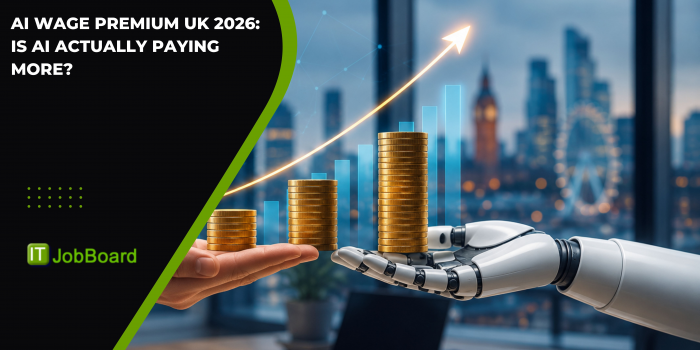
At the same time, demand for AI capability is rising rapidly. PwC's 2026 UK AI Jobs Barometer reports that UK job postings requiring specialist AI skills reached 180,000 in 2025, up from 112,000 in 2024, while workers with AI skills commanded an average 34.2% wage premium.
This creates a new question for IT professionals:
Which combination of skills will make someone valuable in an AI-enabled workplace?
Why are IT skills changing because of AI?
Artificial intelligence is changing the tasks people perform inside technology jobs.
A software developer can use AI to generate code.
A cybersecurity analyst can use AI to investigate alerts.
A data analyst can use AI to accelerate analysis.
A cloud engineer can use AI-assisted automation.
An IT support professional can use AI to diagnose common issues.
This does not necessarily make the underlying profession irrelevant.
Instead, the professional may spend less time on repetitive execution and more time on:
- Problem-solving
- Reviewing AI output
- Architecture
- Security
- Decision-making
- System integration
- Quality control
- Business requirements
- Strategic work
This is why the future of IT skills is likely to be about augmentation rather than simple replacement.
Which IT skills are most valuable in an AI-driven UK job market?
There is no single skill that guarantees career security.
However, several skill groups are becoming particularly important:
- AI literacy
- Software engineering
- Cybersecurity
- Cloud computing
- Data engineering
- Automation
- Systems architecture
- Critical thinking
- Communication
- Business and domain knowledge
The most valuable professionals may increasingly be those who combine several of these capabilities.
For example:
Cybersecurity + AI
can be more powerful than cybersecurity knowledge alone.
Cloud + AI infrastructure
can be more valuable than basic cloud administration.
Software engineering + AI-assisted development
can create a stronger profile than either skill in isolation.
What does AI literacy actually mean for an IT professional?
AI literacy is often misunderstood.
It does not necessarily mean becoming a machine-learning engineer.
For many IT professionals, AI literacy means understanding:
- What AI can and cannot do
- How generative AI works at a practical level
- How to write effective instructions
- How to evaluate AI-generated information
- How hallucinations occur
- How to protect sensitive data
- How AI can be integrated into workflows
- How to use AI responsibly
- When human judgement is still required
Skills England's research identifies foundational AI literacy as relevant across the workforce, alongside more advanced technical skills for specialist roles.
This creates an important distinction.
AI literacy is becoming a broad workplace capability.
AI engineering remains a specialist technical discipline.
IT professionals need to understand which level applies to their career.
Why is software engineering still important when AI can write code?
AI-generated code has changed software development, but software engineering involves considerably more than code production.
Developers still need to understand:
- Requirements
- Architecture
- Security
- Performance
- Scalability
- Testing
- APIs
- Integration
- Maintenance
- User experience
AI can generate a function.
It does not automatically know whether that function belongs in the architecture.
It can suggest an implementation.
It does not guarantee that the implementation is secure.
It can produce an application quickly.
It does not automatically understand the organisation's long-term technical strategy.
This means programming skills remain valuable, but developers increasingly need to become AI-enabled software engineers.
Will AI change what employers expect from junior developers?
It may.
One of the biggest changes could be that employers expect junior developers to be productive with AI tools much earlier.
Instead of spending most of the day writing simple code manually, a junior developer may be expected to:
- Use AI coding assistants
- Review generated code
- Identify errors
- Write tests
- Understand architecture
- Debug systems
- Explain technical decisions
This raises the importance of fundamentals.
A developer who understands programming deeply can evaluate AI output.
Someone who relies entirely on AI without understanding the underlying technology may struggle when the generated solution is wrong.
UK Government analysis has found weakening entry-level hiring in some occupations, including software engineering, but explicitly warns that this evidence should not be treated as proof that AI caused the decline.
That distinction should remain central when discussing AI and graduate IT careers.
Why is cybersecurity becoming an even more important IT skill?
AI creates new cybersecurity opportunities and new risks.
Organisations adopting AI need to protect:
- Models
- Data
- APIs
- User identities
- Cloud environments
- AI applications
- Internal knowledge systems
At the same time, attackers can use AI to improve phishing, automate reconnaissance and develop more convincing social-engineering campaigns.
This creates demand for professionals who understand both sides.
Cybersecurity specialists increasingly need to understand:
How can AI improve security?
and:
How can AI introduce security vulnerabilities?
That combination is creating new areas such as AI security, model security and AI governance.
Why will cloud skills remain important as AI adoption increases?
AI requires infrastructure.
Even an apparently simple AI application can involve:
- Cloud computing
- Databases
- Storage
- APIs
- Networking
- Identity
- Monitoring
- Security
- Scaling
As organisations deploy more AI applications, their infrastructure requirements can become more complicated.
Cloud professionals therefore have an opportunity to move from traditional infrastructure work towards AI infrastructure and platform engineering.
Important skills include:
- Cloud architecture
- Infrastructure as code
- Containers
- Kubernetes
- Cloud security
- Observability
- Cost optimisation
- AI workloads
The combination of cloud and AI is particularly relevant because AI adoption requires somewhere to run.
Why are data engineering skills becoming more valuable?
AI depends on data.
If an organisation has fragmented, inaccurate or poorly governed information, an advanced AI model cannot magically solve the underlying problem.
Data engineers build systems that make information usable.
Their work can include:
- Data pipelines
- ETL/ELT
- Data warehouses
- Data lakes
- APIs
- Data quality
- Data governance
- Cloud data platforms
As AI adoption grows, the quality and accessibility of data become increasingly important.
This means data engineering can act as a bridge between traditional IT infrastructure and modern AI systems.
Is automation becoming more important than manual IT work?
In many areas, yes.
Automation is not the same thing as AI, but the two technologies increasingly work together.
IT professionals can automate:
- Infrastructure deployment
- Testing
- Monitoring
- Ticket workflows
- Data processing
- Security responses
- Software delivery
AI can then add intelligence to those automated processes.
This creates a useful career direction:
Manual task → automation → AI-assisted automation → system optimisation
Professionals who understand this progression can become more valuable because they are not simply performing tasks; they are improving how the work gets done.
Why will systems thinking become an important IT skill?
AI can perform individual tasks extremely well.
But businesses operate systems.
A technology professional needs to understand how:
- Applications
- Infrastructure
- Data
- Security
- Users
- Processes
- Costs
interact.
This is called systems thinking.
For example, an AI application may work perfectly from a technical perspective but still fail because:
- It creates excessive cloud costs.
- It exposes sensitive data.
- Users do not trust it.
- It cannot integrate with existing software.
- Its output cannot be audited.
A systems thinker can identify these problems before they become major failures.
That makes systems thinking particularly valuable in complex IT environments.
Are communication skills becoming more important in IT?
Yes.
This may sound unrelated to AI, but it is increasingly important.
As AI automates more technical tasks, IT professionals may spend more time explaining decisions and managing stakeholders.
A technology professional may need to explain:
- Why AI should be adopted
- Why it should not be used in a particular process
- Why an AI output is unreliable
- How much an implementation will cost
- What security risks exist
- How a system affects employees
Technical knowledge alone does not guarantee that someone can communicate these issues effectively.
Skills England's 2026 analysis identifies communication, critical thinking and analytical skills among important capabilities for an AI-enabled workforce.
Why is critical thinking becoming an essential AI skill?
AI can produce confident answers that are incomplete or incorrect.
This creates a new professional responsibility:
Do not simply accept AI output. Evaluate it.
IT professionals need to ask:
- Is the information accurate?
- Does the solution meet the requirements?
- Is the code secure?
- Is the data reliable?
- Are there hidden assumptions?
- Could the output create a business risk?
This is why critical thinking becomes more important as AI becomes more capable.
The more convincing AI becomes, the more important verification becomes.
Is domain knowledge more valuable because of AI?
Potentially, yes.
AI tools are increasingly general-purpose.
What can differentiate a professional is understanding the specific environment in which the technology is being used.
For example:
A cybersecurity professional understands security operations.
A financial technology specialist understands financial systems.
A healthcare technology professional understands the requirements of healthcare environments.
A cloud engineer understands infrastructure.
A business analyst understands organisational processes.
This creates an important career principle:
AI knowledge + domain expertise can be more valuable than generic AI knowledge.
Why are AI user skills becoming important?
Not every AI-related professional builds models.
Many professionals are becoming AI users within their existing discipline.
PwC's 2026 UK analysis found that AI-user roles were driving much of the recent growth in AI-related hiring, with user roles increasing 65.8% in 2025 compared with 21.6% growth for AI developer roles.
This is highly relevant for IT job seekers.
You do not necessarily need to compete for a small number of pure AI engineering positions.
You can become the person who applies AI effectively within:
- Software development
- Cybersecurity
- Data
- Cloud
- IT operations
- Business analysis
- Technology management
That significantly expands the potential career market.
Can AI skills increase an IT professional's earning potential?
There is evidence that AI skills are attracting a wage premium.
PwC's 2026 UK AI Jobs Barometer reports an average 34.2% wage premium for workers with AI skills, compared with 11% in 2024.
However, this should not be interpreted as:
“Learn AI and automatically earn 34% more.”
The figure is an average across the analysed labour market, not a guaranteed salary increase for every individual.
Experience, location, role, industry and depth of expertise still matter.
The more useful conclusion is that employers are increasingly placing economic value on AI capability.
Which AI skills should an IT graduate learn first?
Graduates should avoid trying to learn everything.
A sensible progression is:
First: Learn a core IT discipline
Choose one:
- Software engineering
- Cybersecurity
- Cloud
- Data
- Networking
- IT support
Second: Learn AI fundamentals
Understand:
- Generative AI
- LLMs
- AI limitations
- Responsible AI
- Prompting
- AI evaluation
Third: Apply AI to your discipline
For example:
Software + AI
Cybersecurity + AI
Cloud + AI
Data + AI
Fourth: Build projects
Show employers what you can actually do.
This creates a stronger profile than simply collecting AI certificates.
Should experienced IT professionals completely change careers to AI?
Usually, that is not necessary.
An experienced professional already has something valuable: context.
A network engineer understands networks.
A database administrator understands data infrastructure.
A software engineer understands application development.
A security analyst understands threats.
Adding AI to that existing expertise can create a powerful hybrid profile.
For example:
Network Engineer → AI Infrastructure
Database Engineer → AI Data Platforms
Cybersecurity Analyst → AI Security
Software Developer → AI Application Engineering
Cloud Engineer → AI Cloud Infrastructure
This approach can be more realistic than starting a completely new career from zero.
What skills will distinguish senior IT professionals from AI tools?
Senior professionals increasingly provide value through:
- Judgement
- Architecture
- Leadership
- Risk management
- Strategy
- Mentoring
- Stakeholder management
- Complex problem-solving
AI can support these activities, but organisations still need people who take responsibility for decisions.
PwC's 2026 analysis found that AI-exposed entry-level roles are increasingly demanding traditionally senior skills such as leadership and strategic thinking.
That suggests an important shift:
AI may raise the skill expectations attached to some roles.
Does AI make soft skills more important for IT careers?
It can.
As routine technical work becomes easier to automate, capabilities such as:
- Communication
- Leadership
- Collaboration
- Creativity
- Empathy
- Negotiation
- Critical thinking
can become increasingly valuable.
PwC reports that the most AI-exposed jobs are adding human-intensive skills such as empathy, judgement and creativity faster than less-exposed roles.
This challenges the idea that an AI career is purely technical.
The future IT professional may need to be more human as well as more technical.
What should employers look for when hiring AI-enabled IT professionals?
Employers should look beyond the keyword “AI”.
A stronger recruitment process can assess whether candidates can:
- Apply AI to real problems
- Validate AI outputs
- Understand technical fundamentals
- Identify security risks
- Communicate clearly
- Work with existing systems
- Learn new tools
- Make decisions independently
A candidate who lists ten AI tools but cannot explain how they used them to solve a real problem may be less valuable than someone who demonstrates one successful implementation.
This is particularly relevant as AI skills become normalised.
What should IT job seekers put on their CV about AI?
Instead of writing:
“Knowledge of AI.”
Be specific.
For example:
“Used AI-assisted development tools to accelerate application prototyping and automated testing.”
Or:
“Implemented AI-assisted threat analysis to prioritise security alerts.”
Or:
“Built a data pipeline supporting an AI-powered analytics application.”
The stronger approach is:
Tool + action + technical context + outcome.
This gives recruiters evidence rather than a generic keyword.
Will AI skills become a basic requirement for IT jobs?
For some roles, possibly.
AI literacy could gradually become similar to cloud or cybersecurity awareness.
Not every employee needs to become a cloud architect.
Not every employee needs to become a cybersecurity specialist.
But many IT professionals need to understand both.
AI may follow a similar path.
Some people will specialise in AI.
Others will simply use AI as part of their existing profession.
What is the best IT career strategy for an AI-driven job market?
A strong strategy is to build a skill stack rather than chase a single fashionable technology.
For example:
Software Engineer
- Programming
- Cloud
- AI
- Security
- System design
Or:
Cybersecurity Professional
- Security fundamentals
- Cloud
- AI security
- Automation
- Threat intelligence
Or:
Data Professional
- SQL
- Python
- Data engineering
- Cloud
- AI
The advantage of a skill stack is flexibility.
If one technology changes, your entire career does not depend on it.
What mistakes should IT job seekers avoid when learning AI?
There are several common mistakes.
Learning tools without fundamentals
Knowing how to use an AI application is not the same as understanding technology.
Chasing every new AI trend
Tools change quickly.
Fundamentals last longer.
Ignoring cybersecurity
AI adoption creates security risks.
Ignoring data
AI systems depend on data.
Ignoring communication
Technology still needs people.
Collecting certificates without projects
Employers need evidence of capability.
Assuming AI will solve everything
AI requires evaluation and human judgement.
Avoiding these mistakes can make learning much more productive.
What will the UK's future IT workforce look like?
The UK technology workforce is likely to become increasingly hybrid.
There will still be:
- Software engineers
- Network engineers
- Cybersecurity professionals
- Cloud engineers
- Data engineers
- IT support professionals
- Architects
- Project managers
But many of these jobs will incorporate AI.
At the same time, specialist AI roles will continue to grow.
UK Government projections estimate that jobs directly involving AI activities could rise from 158,000 in 2024 to 3.9 million by 2035, while a broader 9.7 million people could be working in AI-related occupations.
These figures should be interpreted as projections rather than guarantees.
But they illustrate the scale of the potential transformation.
Should IT professionals focus on AI or traditional technology skills?
The strongest answer is:
Build traditional technical expertise and add AI capability.
Do not throw away your existing skills because AI is becoming popular.
Instead, ask:
How can AI make my existing expertise more valuable?
A software developer can become an AI-enabled developer.
A cybersecurity analyst can become an AI security specialist.
A cloud engineer can move into AI infrastructure.
A data engineer can work on AI data platforms.
An IT manager can specialise in AI transformation.
This creates a career strategy based on adaptation rather than replacement.
What is the single most valuable skill in the AI-era IT job market?
There may not be one technical skill that remains dominant for long.
But one capability is particularly transferable:
The ability to learn and adapt.
AI technology changes rapidly.
Tools change.
Models improve.
Job requirements evolve.
Organisations change how they work.
A professional who can learn new technology, understand its limitations and apply it to real business problems can remain useful even when individual tools become obsolete.
That is why adaptability should not be treated as a vague soft skill.
In an AI-driven technology market, it is a practical career capability.
What should IT professionals do next?
If you already work in IT, do not start by asking which AI certification you should buy.
Start with your current job.
Write down the tasks you perform each week.
Then divide them into three categories:
Tasks AI can automate.
Tasks AI can assist with.
Tasks requiring human judgement.
Learn how to use AI for the first two categories.
Strengthen your expertise in the third.
Then look for ways to combine them.
That approach can turn AI from a career threat into a productivity tool.
The UK evidence increasingly points towards a labour market where AI skills are becoming more valuable while traditional roles are being redesigned. PwC describes this as a two-track market, where roles that use AI to amplify expertise are seeing stronger growth and higher value, while roles where AI simplifies tasks can face slower growth.
For IT professionals, that distinction is crucial.
The future is unlikely to belong simply to people who know AI.
It is more likely to belong to people who know technology + AI + their specialist domain + how to solve real problems.
That is the skill combination worth building.
Frequently Asked Questions
What IT skills are most in demand because of AI?
AI literacy, software engineering, cybersecurity, cloud computing, data engineering, automation, AI integration, systems architecture and AI governance are increasingly relevant skills in an AI-enabled IT market.
Do traditional IT skills still matter?
Yes. Programming, networking, databases, cloud, cybersecurity and infrastructure remain foundational technologies for many AI systems.
Should IT professionals learn AI?
Yes, but the level of AI knowledge required depends on the role. Most IT professionals can benefit from practical AI literacy without becoming AI engineers.
Which AI skills should IT graduates learn?
IT graduates can start with AI fundamentals, generative AI, responsible AI, AI-assisted workflows and then apply those skills to a core discipline such as software engineering, cybersecurity, cloud or data.
Is AI literacy different from AI engineering?
Yes. AI literacy involves understanding and using AI effectively, while AI engineering involves building, integrating and deploying AI systems at a technical level.
Will AI replace software engineering skills?
AI can automate parts of software development, but software engineering also involves architecture, testing, security, requirements and complex problem-solving. These skills remain important.
Why are cybersecurity skills important for AI?
AI creates new security risks involving data, models, applications, APIs and identity. Cybersecurity professionals are needed to protect AI-enabled environments.
Why are cloud skills important for AI?
AI applications require computing, storage, networking, deployment, monitoring and security. Cloud skills help organisations build and operate this infrastructure.
Are AI skills associated with higher salaries in the UK?
PwC's 2026 UK AI Jobs Barometer reported an average 34.2% wage premium for workers with AI skills. This is an average across its analysis and should not be interpreted as a guaranteed salary increase for every worker.
Will entry-level IT jobs disappear because of AI?
There is evidence that some entry-level roles are under pressure, but UK Government analysis says current evidence should not be treated as causal proof that AI is responsible for those changes.
What is the best way to future-proof an IT career?
Build deep expertise in one technical discipline, develop AI literacy, learn automation, strengthen communication and critical-thinking skills, and continuously adapt as technology changes.
Is adaptability an important IT skill?
Yes. Rapid changes in AI tools and employer requirements mean IT professionals increasingly need the ability to learn, evaluate and apply new technologies.