20/08/2026
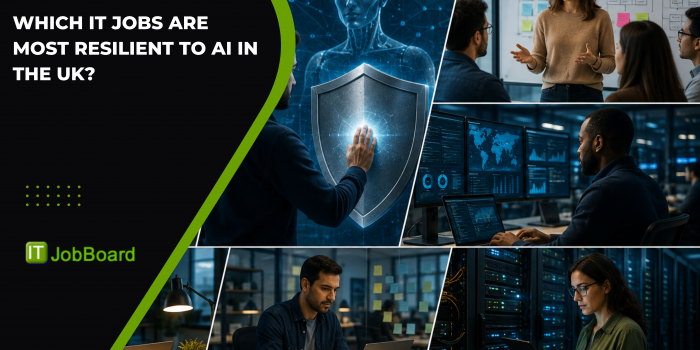
Which IT Jobs Are Most Resilient to AI in the UK?
One of the biggest questions facing technology professionals is no longer simply whether artificial intelligence will create new jobs. It is which existing IT jobs are likely to remain valuable as AI becomes more capable.
Searches for “AI-proof jobs” or “jobs safe from AI” often produce overly simplistic answers. No technology career can be guaranteed to remain unchanged. Artificial intelligence can affect individual tasks inside almost any occupation, including highly skilled professional roles.
A better way to think about career resilience is to ask which types of work are harder to automate completely.
The UK's latest skills research supports this task-based approach. Skills England says AI is reshaping skills across many occupations and that the UK has relatively high exposure to AI because many workers perform cognitive, analytical and data-driven tasks that AI can augment or automate. At the same time, the organisation stresses that AI is likely to automate or augment aspects of many occupations rather than simply eliminate whole professions.
For IT professionals, the most resilient careers are likely to be those where success depends on a combination of technical depth, complex problem-solving, system responsibility, human judgement, security, communication and continuous learning.
What makes an IT job resilient to AI?
An IT job is more resilient when it contains tasks that are difficult to automate reliably from beginning to end.
Several characteristics can increase resilience.
Complex problem-solving
Problems that do not have a predictable solution are harder for automation systems to handle.
Responsibility and accountability
Someone still needs to be responsible when a critical system fails or an important technical decision causes harm.
Human interaction
Technology professionals frequently need to communicate with customers, executives, developers, suppliers and other teams.
Complex systems
Large technology environments contain dependencies, legacy systems, security constraints and organisational requirements that cannot always be understood from isolated pieces of information.
Security and risk
Security decisions involve uncertainty, consequences and adversarial behaviour.
Physical-world interaction
Some technology careers involve hardware, infrastructure, devices or environments where digital systems interact with the physical world.
Continuous learning
The ability to adapt as technology changes can itself become a career advantage.
This does not mean AI will have no effect on these roles.
It means AI is more likely to change the way professionals perform the work than completely remove the need for the profession.
Are there really AI-proof IT jobs?
There are no genuinely AI-proof IT jobs.
Calling a profession “safe from AI” can create a false sense of security.
A better term is AI-resilient.
An AI-resilient role may still experience automation, but the core responsibilities remain valuable because they require skills that are difficult to replicate completely.
For example, cybersecurity analysts may use AI to investigate alerts more quickly.
That does not mean cybersecurity becomes unnecessary.
Instead, the professional may spend less time manually processing alerts and more time investigating complex incidents, understanding attack behaviour and making security decisions.
Similarly, software developers may use AI to produce routine code more quickly while spending more time on architecture, integration, testing and system design.
The job changes.
Its value does not necessarily disappear.
Which IT jobs are currently more resilient to AI?
Several technology careers have characteristics that can make them relatively resilient.
These include:
- Cybersecurity professionals
- Cloud architects
- Solutions architects
- Network architects
- IT project managers
- Technology consultants
- Systems architects
- DevOps and platform engineers
- Data engineers
- AI engineers
- AI security specialists
- Enterprise architects
- IT business analysts
- Technology risk professionals
However, resilience depends on the actual responsibilities of the role.
A highly repetitive cybersecurity monitoring position may be more exposed to automation than a senior security architect.
A developer responsible for simple, repetitive applications may experience more automation than an engineer designing complex distributed systems.
The job title is less important than the task profile.
Why are cybersecurity jobs relatively resilient to AI?
Cybersecurity is a particularly interesting example because AI creates both offensive and defensive capabilities.
Security teams can use AI to:
- Analyse security alerts
- Detect unusual behaviour
- Summarise incidents
- Identify suspicious activity
- Automate investigation steps
- Generate security reports
But attackers can also use AI.
This creates a continuing cycle of adaptation.
Security professionals need to understand:
- Attack techniques
- System architecture
- Identity
- Network behaviour
- Vulnerabilities
- Risk
- Threat intelligence
- Incident response
- Security controls
They also need to make decisions under uncertainty.
That makes cybersecurity difficult to reduce to a completely automated workflow.
AI may therefore change the cybersecurity professional's workload without eliminating the need for cybersecurity expertise.
For IT job seekers, this creates an important distinction:
AI can automate security tasks without automating the responsibility for security.
Why could cloud architecture remain valuable as AI improves?
AI applications require infrastructure.
Models need computing resources, storage, networking, security, monitoring and deployment environments.
As organisations adopt AI, they may actually create more complex infrastructure requirements.
Cloud professionals can be responsible for:
- Architecture
- Scalability
- Cost management
- Reliability
- Security
- Integration
- Monitoring
- Disaster recovery
- Performance
These responsibilities involve trade-offs.
For example, the technically fastest solution may not be the most cost-effective.
The most secure architecture may not be the easiest to deploy.
A cloud architect needs to understand the business context as well as the technology.
AI can help evaluate options and automate infrastructure tasks, but the final architecture still requires judgement.
This makes cloud architecture and platform engineering potentially resilient areas within the wider IT job market.
Why are data engineers important in an AI-driven economy?
AI depends on data.
Poor-quality data can produce poor-quality AI outcomes.
Data engineers are responsible for the systems that collect, transform, store and deliver data.
Their work can involve:
- Data pipelines
- Databases
- Data warehouses
- Data integration
- Data quality
- Data governance
- Data infrastructure
- APIs
- Cloud data platforms
AI can automate parts of coding and data processing, but organisations still need reliable data architectures.
In fact, increased AI adoption may make data quality more important.
An organisation cannot expect an AI system to produce reliable business insights if its underlying information is incomplete, inconsistent or poorly governed.
This makes data engineering an interesting example of a technology career where AI can increase productivity while simultaneously increasing demand for good technical foundations.
Could software engineering remain a strong career despite AI?
Yes, but software engineering is likely to change significantly.
Software developers are among the IT professionals most directly affected by generative AI.
AI tools can already help with:
- Code generation
- Debugging
- Testing
- Documentation
- Refactoring
- Code explanation
- Prototyping
This can reduce the time required for some development tasks.
But software engineering is not simply code production.
A professional developer must understand:
- Requirements
- Architecture
- Security
- Performance
- Scalability
- Testing
- User needs
- Integration
- Maintenance
AI-generated code still needs to be reviewed.
Someone needs to determine whether the code solves the correct problem.
That means the most resilient software engineering careers may increasingly be those involving architecture, complex systems, security, product understanding and technical leadership.
The UK Government's 2026 entry-level hiring research does show pressure in software engineering hiring: its analysis found software engineer entry-level hiring down 27% in the period studied. However, the report explicitly says further research is needed before concluding that AI is the cause, making it important not to confuse correlation with causation.
That is a useful lesson when analysing AI and employment.
Why could AI engineering itself be a resilient career?
It may seem obvious that AI engineering should be resilient because AI creates demand for AI specialists.
But the reason is more interesting.
AI engineers work on systems that other professionals use.
Their responsibilities can include:
- Model integration
- Machine learning
- AI application development
- Model evaluation
- Data pipelines
- AI infrastructure
- Deployment
- Monitoring
- Performance optimisation
- AI security
As AI platforms become easier to use, some basic AI development tasks may become automated.
However, sophisticated organisations still need people who understand how AI systems work and how to integrate them into real production environments.
The UK Government's AI Labour Market Survey identifies skills gaps and evolving skills needs within the UK's AI sector, showing that specialist AI capability remains an important part of the national technology ecosystem.
The lesson is not that AI engineers are protected from AI.
It is that people who understand the technology deeply are often better positioned to adapt as the technology changes.
Why are IT architects difficult to replace completely?
Architecture requires decisions across multiple systems.
An enterprise architect or solutions architect may need to consider:
- Existing infrastructure
- Security requirements
- Data
- Applications
- Integration
- Costs
- Compliance
- Business strategy
- Scalability
- Future technology changes
AI can help compare options or produce architectural suggestions.
But organisations still need someone to decide which option is appropriate.
The difficulty is that architecture is not simply a technical problem.
It is an organisational problem.
The best technical solution may not be practical because of budget, existing contracts, legacy infrastructure or internal capabilities.
That combination of technology and business judgement makes architecture relatively difficult to automate completely.
Could IT project management survive AI automation?
Yes, although project management is likely to change.
AI can help project managers with:
- Meeting summaries
- Documentation
- Risk tracking
- Status reports
- Scheduling
- Task management
- Information retrieval
This can reduce administrative work.
But successful technology projects also require:
- Stakeholder management
- Negotiation
- Conflict resolution
- Prioritisation
- Leadership
- Decision-making
- Communication
These responsibilities involve human relationships and organisational context.
A project manager who spends most of their time preparing status reports may see significant automation.
A technology leader who manages complex stakeholders and strategic decisions may remain highly valuable.
Again, task exposure matters more than the job title.
Why is IT consulting likely to remain valuable?
Technology consultants help organisations understand what technology should be used and how it should be implemented.
AI can generate recommendations.
But a consultant still needs to understand the client's:
- Business model
- Processes
- Existing systems
- Budget
- Risks
- Workforce
- Customers
- Strategic priorities
The value of consulting often comes from connecting technology to business outcomes.
That is difficult to automate completely because every organisation is different.
As AI adoption grows, consulting may actually become more complex.
Businesses may need help deciding:
“Where should we use AI?”
“Where should we not use AI?”
“What data can we safely use?”
“How should we redesign this workflow?”
“What should we automate?”
“How do we measure whether AI has delivered value?”
These questions create opportunities for professionals who can combine technical knowledge with business understanding.
Are jobs involving human interaction more resilient to AI?
Generally, roles that depend heavily on human interaction can be harder to automate completely.
Skills England's 2026 analysis notes that AI exposure is higher in professional, analytical and data-driven work, while sectors centred on physical activity or human interaction are less exposed.
Within IT, human interaction can also matter.
Consider an IT consultant working directly with senior management.
The consultant may need to understand an ambiguous business problem, ask the right questions and build agreement among stakeholders.
An AI system can assist with research.
It cannot automatically create trust between people.
This is why communication should not be treated as a secondary skill in an AI-driven technology career.
Does physical infrastructure make some technology jobs more resilient?
Yes.
Technology is not purely digital.
Data centres, networking infrastructure, telecommunications equipment, industrial systems and physical devices require real-world installation, maintenance and troubleshooting.
These environments can be difficult to automate completely because they involve physical conditions, safety requirements and unpredictable situations.
This does not mean AI has no impact.
AI can assist with monitoring, predictive maintenance and diagnostics.
But humans may still need to work with physical systems.
This creates a useful career principle:
The closer a technology role is to complex physical systems, the harder complete automation can become.
Which IT skills are most valuable for AI-resilient careers?
Rather than focusing only on specific job titles, professionals can build a combination of skills.
Technical depth
Strong knowledge of a technical discipline creates a foundation for adaptation.
Systems thinking
Understanding how different technologies interact becomes increasingly important as AI automates individual components.
Cybersecurity
Security remains important because automation also creates new attack surfaces and risks.
Data literacy
AI depends on data, making data quality and interpretation increasingly important.
Critical thinking
Professionals need to evaluate AI-generated recommendations.
Communication
Technology decisions often involve people who have different priorities and levels of technical knowledge.
Business understanding
Knowing why a technology should be used can be as valuable as knowing how it works.
Adaptability
Technology changes continuously.
Skills England's 2026 report specifically identifies communication, critical thinking and analytical skills as important cross-cutting capabilities for an AI-enabled workforce.
Is specialising better than being a generalist in the AI era?
There is no universal answer.
Deep specialisation can make someone highly valuable in a specific technical area.
But excessive specialisation can create risk if the underlying technology changes dramatically.
A stronger approach may be T-shaped expertise.
This means:
Deep knowledge in one area + broad knowledge of related technologies.
For example:
Cybersecurity + AI + cloud
Software engineering + AI + security
Data engineering + AI + cloud
Cloud architecture + security + automation
IT consulting + AI + business strategy
This combination can provide both depth and adaptability.
Can AI actually make some IT professionals more valuable?
Yes.
AI can increase productivity, which can increase the value of professionals who know how to use it effectively.
Imagine two software engineers.
Engineer A spends the majority of their time manually completing routine tasks.
Engineer B uses AI to accelerate those tasks and spends more time on architecture, testing, performance and problem-solving.
If both engineers have similar technical ability, Engineer B may produce more value.
This is why AI should not always be viewed as a competitor.
For many professionals, it can become a force multiplier.
Skills England's research similarly emphasises that the UK needs to equip the broader workforce with practical AI capability rather than focusing only on producing AI specialists.
What should IT professionals do if their current job is highly exposed to AI?
The answer is not necessarily to abandon the career.
Instead, identify which parts of the job are becoming automated and move towards higher-value responsibilities.
For example:
IT support → automation + systems administration + cloud
Junior developer → software engineering + architecture + AI-assisted development
Data analyst → analytics + data engineering + AI evaluation
Manual tester → test automation + quality engineering
SOC analyst → threat hunting + security engineering + AI-assisted detection
The objective is to move from performing repetitive tasks to designing, supervising, improving and securing the systems that perform those tasks.
That is a much more sustainable career strategy than trying to avoid AI completely.
What does the UK job market suggest about AI-resilient careers?
Current UK evidence points towards a labour market undergoing transition rather than one experiencing simple mass replacement.
The June 2026 UK Government entry-level hiring analysis found that 30 of 38 tracked entry-level occupations were declining, with software engineering among the faster-declining information-processing roles. But the same report states that the evidence is not sufficient to attribute these changes directly to AI.
At the same time, the UK's information and communications sector has recently shown strong growth. In August 2026, ONS data reported that computer programming, consultancy and related activities rose 3.7% quarter-on-quarter, following a 3.8% rise in the previous quarter.
These findings illustrate why simplistic statements such as “AI is killing IT jobs” are misleading.
Some roles and tasks are under pressure.
Other technology activities are expanding.
The skills required inside existing jobs are changing.
What is the best way to future-proof an IT career?
There is no guaranteed formula for future-proofing a career.
But professionals can improve their resilience by developing capabilities that remain useful across different technologies.
A strong strategy is:
Build technical depth.
Become genuinely good at something.
Learn AI.
Understand how AI can support your work.
Learn automation.
Identify repetitive processes and understand how they can be improved.
Develop systems thinking.
Understand the wider environment rather than only individual tasks.
Improve communication.
Technology needs to be explained to people.
Develop business awareness.
Understand the outcomes your work is supposed to produce.
Keep learning.
Treat career development as continuous rather than occasional.
Skills England's AI foundation benchmark identifies basic technical, non-technical, responsible and ethical capabilities needed to use AI effectively at work.
This reinforces an important point: AI readiness is not simply about learning how to operate a chatbot.
It includes understanding how to use AI responsibly and how to evaluate the information it produces.
Which IT careers could become stronger because of AI?
Some technology careers may benefit from AI adoption because organisations need people to build and manage the systems.
Potential growth areas include:
- AI engineering
- AI security
- Data engineering
- Cloud infrastructure
- AI infrastructure
- MLOps
- Platform engineering
- Technology architecture
- Automation engineering
- AI governance
- Technology risk
- Data governance
However, growth should not be interpreted as a guarantee of employment.
Technology markets change quickly.
The more reliable strategy is to build skills that can transfer between technologies.
What is the biggest mistake IT professionals can make about AI?
The biggest mistake may be treating AI as either a threat or a trend that can simply be ignored.
Both approaches can create problems.
If you treat AI only as a threat, you may miss opportunities to become more productive.
If you ignore it, your skills may gradually become less relevant as workflows change.
A better approach is to ask:
Which parts of my job can AI perform?
Which parts can AI assist with?
Which parts still require my expertise?
What new responsibilities will appear because of AI?
Those questions create a practical career strategy.
What will AI-resilient IT careers look like in the future?
The most resilient IT careers are unlikely to be completely untouched by AI.
They will be AI-enabled.
Professionals may spend less time writing repetitive code, manually analysing information, monitoring routine events or preparing documentation.
Instead, they may spend more time designing systems, reviewing AI outputs, managing risks, solving complex problems, communicating decisions and improving automated workflows.
That is a significant change.
But it does not necessarily represent the end of IT careers.
It represents a transition from doing every task manually to managing technology that can perform many tasks automatically.
The UK's own skills strategy reflects this direction. Skills England says the challenge is not only increasing the number of AI specialists but ensuring the wider workforce can adapt to rapid technological change.
For IT professionals, that may be the most important career lesson of the AI era.
Do not search for a job that AI can never touch.
Instead, build a career where your value comes from understanding technology deeply, solving problems AI cannot solve reliably, evaluating what AI produces and taking responsibility for the outcome.
That is a much more realistic definition of an AI-resilient IT career.
Frequently Asked Questions
Which IT jobs are most resilient to AI in the UK?
IT roles involving complex systems, security, architecture, business judgement, human interaction and accountability may be relatively more resilient. Examples include cybersecurity, cloud architecture, solutions architecture, data engineering, technology consulting and AI engineering.
Are any IT jobs completely safe from AI?
No. There are no IT jobs that can be guaranteed to remain completely unaffected by AI. Even relatively resilient roles are likely to change as AI becomes integrated into technology workflows.
Will AI replace software developers?
AI is likely to automate some software development tasks, but software engineering also involves architecture, requirements, testing, security, integration and system-level decision-making. These responsibilities are harder to automate completely.
Is cybersecurity a good career in the AI era?
Cybersecurity remains important because AI can create new security capabilities and new risks. Security professionals can use AI for detection and investigation while continuing to handle complex incidents, risk and security decisions.
Are cloud jobs resilient to AI?
Cloud roles involving architecture, security, reliability, scalability and cost management can be relatively resilient because they require system-level decisions and trade-offs. AI can automate some cloud tasks while increasing demand for AI infrastructure.
Is data engineering a future-proof IT career?
Data engineering can be a resilient career because AI systems depend on reliable data. Data pipelines, data quality, governance and infrastructure remain important even as AI tools become more capable.
Are IT architects likely to be replaced by AI?
AI can assist architects with research and design suggestions, but architecture involves business requirements, system dependencies, security, cost and organisational constraints. Human judgement remains important.
Will AI reduce entry-level IT jobs?
Some entry-level IT tasks and roles are under pressure, but current evidence does not establish that AI is the sole cause. UK Government research found significant declines in some entry-level occupations, including software engineering, while noting that further research is needed to determine the role of AI.
What skills make an IT professional more resilient to AI?
Technical depth, systems thinking, cybersecurity, data literacy, critical thinking, communication, business understanding, automation and continuous learning can all improve career resilience.
Should IT professionals become AI engineers?
Not necessarily. Professionals can add AI skills to their existing specialisation. A software developer, cybersecurity analyst, data engineer or cloud professional can become more valuable by understanding how AI affects their own discipline.
What does AI-resilient mean?
AI-resilient means that a role or skill set is relatively difficult to automate completely because it involves complex judgement, human interaction, accountability, system-level thinking or other capabilities that remain difficult for AI to perform reliably end-to-end.
How can I future-proof my IT career?
Develop deep expertise in one technical area, learn how AI affects that area, build automation skills, strengthen communication and analytical abilities, understand business requirements and continuously update your knowledge as technology changes.