18/08/2026
How Is AI Changing the UK Job Market and What Does It Mean for IT Professionals?
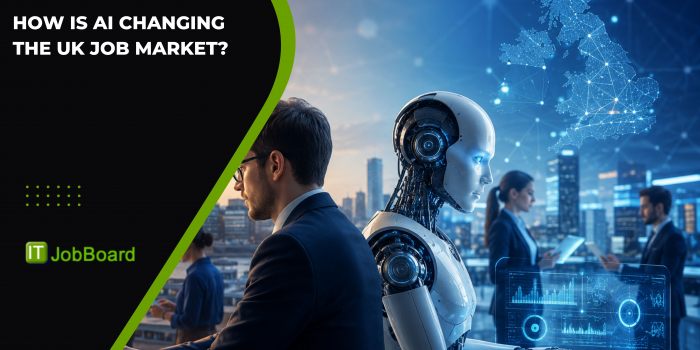
Artificial intelligence is no longer simply a specialist technology used by research teams. It is becoming part of how UK organisations develop software, analyse information, manage operations, support customers, detect security threats and make business decisions. As a result, AI jobs UK searches are increasingly connected to a much broader question: how is artificial intelligence changing the jobs that already exist?
The answer is more complicated than “AI will replace people”. AI is creating specialist roles, changing the responsibilities of existing IT professionals and increasing demand for people who can combine technical knowledge with AI capabilities. The World Economic Forum expects AI and information-processing technologies to be among the major forces transforming employment through 2030, while AI and big data are among the fastest-growing skill areas.
For UK technology professionals, the important shift is therefore not simply whether AI creates or removes jobs. It is which tasks are being automated, which new responsibilities are emerging, and which skills are becoming more valuable.
Why is AI changing the UK job market?
AI is changing the UK job market because organisations are moving from experimenting with artificial intelligence to integrating it into everyday business processes.
Software development teams can use AI-assisted coding tools. Data teams can automate parts of data preparation and analysis. Customer service teams can use conversational AI. Cybersecurity teams can apply machine learning to identify unusual behaviour. IT support teams can automate routine requests and troubleshooting.
This creates two simultaneous effects.
First, some repetitive tasks can be completed faster or with less human intervention. Second, organisations need professionals who can design, integrate, monitor, secure and govern those AI-enabled systems.
The UK labour market is also operating in a more cautious hiring environment. The Office for National Statistics reported 712,000 estimated vacancies for April to June 2026, down 0.9% from the previous quarter and 2.5% from a year earlier. That means employers are becoming more selective about the skills they hire for, making specialist technology capabilities increasingly important.
Is AI creating more jobs or replacing existing jobs?
AI is doing both, but the impact depends heavily on the occupation and the tasks within it.
A job is rarely made up entirely of tasks that can be automated. Most technology roles contain a mixture of technical, analytical, creative, interpersonal and decision-making responsibilities.
For example, an AI coding assistant may generate part of a software application's code. It does not automatically remove the need for a software engineer to understand the requirements, design the architecture, review the generated code, test it, secure it and take responsibility for the final product.
This distinction between jobs and tasks is critical when evaluating the impact of AI.
The World Economic Forum's Future of Jobs Report 2025 projects significant labour-market disruption by 2030, with 170 million jobs expected to be created and 92 million displaced globally as different macrotrends reshape employment. AI and machine learning specialists are among the fastest-growing roles.
For UK IT professionals, this suggests that adaptability may become more important than protecting a single traditional job description.
Which IT jobs are being transformed by AI?
Almost every major technology discipline can be affected by AI, but the nature of the change differs between roles.
Software developers may increasingly use AI for code generation, debugging, documentation, testing and software maintenance. The developer's role can consequently move towards architecture, quality assurance, system design and complex problem-solving.
Data analysts can use AI to accelerate data exploration, generate queries and identify patterns. Human judgement remains important for validating results, understanding business context and communicating insights.
Cybersecurity professionals can use AI to detect anomalies, prioritise alerts and analyse large volumes of security information. At the same time, AI creates new security risks that require specialist knowledge.
IT support professionals may see routine questions increasingly handled by AI-powered assistants. Human specialists remain important for complex incidents, infrastructure problems, escalations and situations requiring judgement.
Cloud and DevOps professionals are also affected as AI becomes integrated into infrastructure monitoring, deployment automation and operational workflows.
The result is not necessarily fewer technology careers. Instead, many existing roles are becoming AI-enabled roles.
Which new AI jobs are emerging in the UK?
The growth of AI is creating demand for specialised positions across development, data, infrastructure, governance and security.
Examples include:
- AI Engineer
- Machine Learning Engineer
- Generative AI Engineer
- MLOps Engineer
- AI Solutions Architect
- AI Product Manager
- AI Governance Specialist
- AI Security Engineer
- LLM Engineer
- AI Automation Engineer
- Data Engineer
- Machine Learning Operations Specialist
The broader employment trend supports this direction. The World Economic Forum identifies AI and Machine Learning Specialists among the fastest-growing jobs and expects demand for AI and machine-learning capabilities to continue increasing as organisations adopt advanced technologies.
Importantly, not every new AI opportunity will contain “AI” in the job title. A Software Engineer, Data Engineer, Cloud Engineer or Cybersecurity Analyst may increasingly be expected to work with AI technologies without changing their formal job title.
That is why searching only for AI jobs UK may provide an incomplete picture of the emerging market.
Why are AI skills becoming important even outside AI jobs?
One of the biggest changes in the UK technology market is that AI knowledge is becoming a supporting skill rather than something limited to dedicated AI specialists.
A software developer may need to understand how to integrate an LLM into an application. A data analyst may need to use AI-assisted analytics. A cybersecurity professional may need to understand attacks against AI systems. A product manager may need to evaluate whether an AI feature is commercially and technically viable.
The World Economic Forum ranks AI and big data among the fastest-growing skills, alongside networks and cybersecurity and technological literacy. It also identifies analytical thinking, creative thinking, resilience, flexibility and lifelong learning as important skills for the evolving workforce.
This creates a useful concept for job seekers:
The future is not necessarily about becoming an AI specialist. It is increasingly about becoming an IT specialist who knows how to work effectively with AI.
What AI skills are UK employers likely to value?
The answer depends on the role, but several skill groups are becoming increasingly relevant.
Technical AI skills
These can include:
- Machine learning
- Generative AI
- Large language models
- Prompt engineering
- Retrieval-augmented generation
- AI APIs
- Model evaluation
- Data engineering
- MLOps
- AI deployment
- AI security
Software and infrastructure skills
AI applications still need reliable technical foundations. Python, SQL, APIs, cloud platforms, databases, DevOps, containerisation and software engineering remain highly relevant.
Analytical skills
AI can produce outputs, but professionals still need to determine whether those outputs are accurate, useful and appropriate.
Analytical thinking therefore remains important even as AI capabilities improve.
Human skills
Communication, collaboration, creativity, leadership, adaptability and critical thinking are not becoming irrelevant.
In fact, they may become more valuable because organisations need people who can interpret AI outputs, challenge incorrect recommendations and make decisions where technology cannot provide sufficient context.
The World Economic Forum reports that analytical thinking remains the most sought-after core skill, while creative thinking, resilience, flexibility and agility are also expected to grow in importance.
Will AI make software developers less important?
AI is likely to change software development more than it eliminates the need for software developers.
AI coding tools can generate functions, suggest improvements, explain unfamiliar code and assist with testing. This can reduce the time required for some development tasks.
However, production software involves considerably more than writing code.
Developers still need to understand:
- Business requirements
- System architecture
- Security
- Scalability
- Data protection
- Testing
- Integration
- Performance
- Reliability
- Technical debt
The developer's value can therefore move higher up the technology stack.
Instead of measuring productivity purely by lines of code written, organisations may increasingly value engineers who can use AI tools to deliver reliable systems more efficiently.
How is AI changing the way UK companies hire IT professionals?
AI is also changing recruitment itself.
Employers are increasingly interested in candidates who can demonstrate practical experience rather than simply list technologies on a CV.
For example, a candidate who writes “Generative AI” on a CV provides limited evidence of capability.
A stronger profile might explain how the candidate built an internal AI assistant, created a RAG application, integrated an LLM API, evaluated model outputs or deployed an AI workflow into production.
This supports a broader movement towards skills-based hiring.
The World Economic Forum reports that 69% of surveyed employers expect to recruit talent skilled in AI tool design and enhancement, while 62% anticipate hiring people with skills to work with AI. It also reports that 77% of employers plan to upskill existing workers in response to AI disruption.
For candidates, this means practical evidence can become increasingly important.
Does someone need to become an AI engineer to benefit from the AI jobs market?
No.
This is one of the most important points for existing IT professionals.
A network engineer does not necessarily need to become a machine learning engineer. A software developer does not necessarily need to become a research scientist. A cybersecurity analyst does not need to build foundation models.
Instead, professionals can develop AI literacy relevant to their existing career.
For example:
Software Engineer + Generative AI
Data Analyst + AI-assisted analytics
Cybersecurity Analyst + AI security
Cloud Engineer + AI infrastructure
DevOps Engineer + AI automation
Business Analyst + AI-enabled business processes
This approach can allow professionals to benefit from AI adoption without completely restarting their careers.
What does AI mean for graduates and people starting IT careers?
AI changes the entry-level technology career path, but it does not make technology careers inaccessible.
The challenge is that some basic tasks that previously provided junior employees with learning opportunities may increasingly be automated.
That means graduates need to demonstrate more than theoretical knowledge.
A strong early-career portfolio could include:
- A small AI application
- An automated data-analysis project
- A chatbot connected to a knowledge base
- A machine-learning project
- An AI-powered software feature
- An AI security experiment
- A cloud deployment using an AI service
The objective is not to build the world's most sophisticated AI model.
It is to demonstrate that you understand how technology solves a real problem.
Will human skills become more important as AI becomes more capable?
Yes, particularly in roles requiring judgement, communication and accountability.
AI can generate an answer, recommendation or piece of code. Someone still needs to determine whether the result is appropriate.
That creates demand for professionals who can combine technical capability with human judgement.
The World Economic Forum expects nearly 40% of workers' existing skill sets to change or become outdated between 2025 and 2030. It also highlights curiosity, lifelong learning, creative thinking, resilience and adaptability alongside technical skills.
For IT professionals, continuous learning is therefore becoming part of the job rather than an optional career-development activity.
What should UK IT professionals do to prepare for an AI-driven job market?
The best strategy is not to learn every new AI tool that appears.
Instead, professionals should build depth in their existing discipline and add AI capabilities that complement it.
A practical approach is:
- Identify where AI intersects with your current role.
Understand which tasks in your job are likely to be automated, assisted or enhanced.
- Learn the fundamentals.
Understand how machine learning, generative AI, LLMs, data and AI evaluation work at a practical level.
- Build something.
A small working project is often more useful than a long list of AI courses.
- Strengthen your core technical skills.
AI does not remove the importance of programming, databases, networking, cloud, cybersecurity or data engineering.
- Develop human skills.
Communication, analytical thinking, problem-solving and adaptability remain valuable.
- Show measurable outcomes.
When updating your CV, explain what you achieved with AI rather than simply listing the tool you used.
This approach aligns with the direction identified by the World Economic Forum, where employers increasingly expect a combination of technological and human capabilities.
What does the future of AI jobs in the UK look like?
The UK AI jobs market is likely to become broader rather than being limited to a small group of specialist AI professionals.
Some new roles will emerge. Existing IT roles will absorb AI responsibilities. Certain repetitive tasks will become automated. New areas such as AI governance, AI security, model evaluation, AI infrastructure and agentic systems will create additional specialist opportunities.
At the same time, the wider UK labour market remains competitive. ONS data shows that vacancy levels have been falling compared with the previous year, which makes specialist and demonstrable skills increasingly important for technology professionals.
The most useful way to understand the AI jobs market, therefore, is not to ask whether AI will replace IT professionals.
The better question is:
Which IT professionals will become more valuable because they know how to use, build, manage and govern AI?
For many UK technology workers, that distinction could define the next stage of their careers.
Frequently Asked Questions
What are AI jobs in the UK?
AI jobs in the UK include roles that develop, deploy, manage, secure or apply artificial intelligence. Examples include AI Engineers, Machine Learning Engineers, Generative AI Engineers, MLOps Engineers, AI Architects and AI Governance Specialists.
Is AI creating jobs in the UK?
Yes. AI is creating specialist technology roles while also changing responsibilities within existing jobs. Global employer research identifies AI and Machine Learning Specialists among the fastest-growing roles and AI and big data among the fastest-growing skills.
Will AI replace IT jobs?
AI is more likely to automate particular tasks within many IT jobs than eliminate entire occupations. Roles are changing as professionals increasingly use AI for coding, analytics, automation, support and other activities.
What AI skills should IT professionals learn?
Useful skills include generative AI, machine learning fundamentals, LLMs, AI APIs, data engineering, MLOps, AI security and AI evaluation. Core skills such as programming, cloud computing, cybersecurity and data analysis remain important.
Do software developers need AI skills?
Increasingly, AI literacy can give software developers an advantage because AI is becoming integrated into software development, application features, testing and automation.
Are AI jobs only available to experienced professionals?
No. Graduates and career changers can enter the field through software development, data, cloud, cybersecurity or other technical pathways and gradually specialise in AI-related work.
What is the most important skill for the future AI job market?
There is no single skill that guarantees employability. A combination of technical literacy, analytical thinking, adaptability and continuous learning is increasingly valuable. The World Economic Forum identifies analytical thinking as the leading core skill while AI and big data are among the fastest-growing skills.
How can I find AI jobs in the UK?
Candidates can search for roles such as AI Engineer, Machine Learning Engineer, MLOps Engineer, AI Architect, Data Scientist, AI Product Manager and AI Security Engineer, while also looking for existing IT roles that include AI-related responsibilities.
Is AI a good career option in the UK?
AI is a strong career area because organisations across industries are adopting artificial intelligence and requiring people who can build, integrate and manage AI systems. However, candidates should develop strong foundational technology skills rather than relying only on knowledge of individual AI tools.
Will AI skills become necessary for all IT jobs?
Not every IT role will require advanced AI engineering skills, but basic AI literacy is likely to become increasingly useful across many technology disciplines. The depth of AI knowledge required will depend on the specific role.