28/08/2026
What Cybersecurity Certifications Do UK Employers Look For?
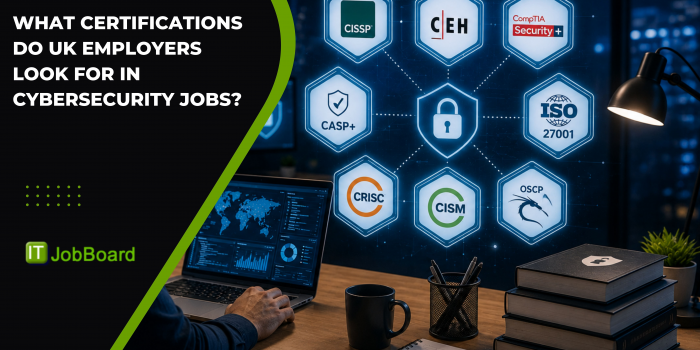
Cybersecurity certifications UK can help candidates demonstrate technical knowledge when applying for security roles, particularly when they are changing careers or do not have extensive professional experience. However, the most useful certification depends on the type of cybersecurity job you want, your existing technical background and your level of experience.
A certification is not a substitute for practical skills. UK employers may also assess networking knowledge, operating systems, cloud technologies, security tools, analytical ability and hands-on experience. Government research into the UK cyber labour market highlights continuing skills gaps and the importance of developing relevant technical and professional capabilities.
For job seekers, the best approach is therefore not to collect as many certifications as possible. Instead, choose qualifications that support the specific cybersecurity career you want to build.
Are Cybersecurity Certifications Necessary?
Not every cybersecurity job requires a certification.
Some employers prioritise:
- Previous IT experience
- Practical cybersecurity knowledge
- Networking skills
- Cloud experience
- Security operations experience
- Problem-solving
- Communication
- Hands-on projects
However, certifications can be particularly useful for candidates who:
- Are moving into cybersecurity
- Have limited professional experience
- Do not have a relevant degree
- Want to demonstrate foundational knowledge
- Are changing cybersecurity specialisms
- Need structured learning
For example, an IT Support professional applying for a Junior SOC Analyst position may use a security certification to demonstrate that they have developed knowledge beyond traditional IT support.
Which Cybersecurity Certification Should Beginners Consider?
For people starting cybersecurity, the priority should be establishing strong foundations.
CompTIA Security+
CompTIA Security+ is one of the commonly recognised entry-level cybersecurity certifications.
It covers areas including:
- Threats and vulnerabilities
- Security architecture
- Security operations
- Network security
- Identity and access management
- Risk management
- Cryptography
- Incident response
Security+ can be useful for candidates targeting roles such as:
- Junior SOC Analyst
- Security Analyst
- IT Security Analyst
- Security Operations Analyst
- Junior Cybersecurity Professional
However, candidates should combine certification study with practical learning.
Knowing security terminology is different from being able to investigate an actual security event.
Is CompTIA Network+ Useful for Cybersecurity?
Networking is one of the most important foundations of cybersecurity.
CompTIA Network+ focuses on networking concepts such as:
- Network infrastructure
- IP addressing
- Network protocols
- Network troubleshooting
- Wireless networking
- Network security
- Network operations
Although Network+ is not specifically a cybersecurity certification, it can be valuable for people who lack networking experience.
This is particularly relevant to future:
- SOC Analysts
- Network Security Engineers
- Security Engineers
- Cloud Security Engineers
- Incident Responders
If you already have strong networking knowledge, you may not need a networking certification before moving into cybersecurity.
What Certification Is Useful for SOC Analyst Jobs?
SOC Analysts monitor security environments and investigate potential incidents.
For this career path, useful certification areas include:
- Security fundamentals
- Security analytics
- Incident response
- SIEM
- Threat detection
- Network security
CompTIA CySA+
CompTIA CySA+ is focused more specifically on cybersecurity analytics and defensive security.
Relevant areas include:
- Threat detection
- Vulnerability management
- Security monitoring
- Incident response
- Security analytics
This can make it relevant for professionals targeting SOC and security analyst roles.
However, it is generally more useful after establishing foundational cybersecurity knowledge rather than treating it as the first step for someone completely new to IT.
Which Certifications Are Useful for Cyber Security Analysts?
Cyber Security Analysts may work across a broader range of security activities than SOC Analysts.
Depending on the job description, useful areas can include:
- Security operations
- Threat intelligence
- Incident response
- Vulnerability management
- Network security
- Cloud security
Potential certification paths include:
Security+ → CySA+ → Specialist Certification
The exact progression should depend on the job you want rather than following a fixed certification ladder.
Which Certifications Are Useful for Penetration Testers?
Penetration testing requires a different skill set from defensive security.
Potential certifications include:
- CompTIA PenTest+
- Certified Ethical Hacker (CEH)
- GIAC penetration testing certifications
- Offensive Security certifications
However, penetration testing is particularly practical.
A candidate can have several certifications but still struggle to demonstrate real-world testing ability.
For this career path, candidates should combine certifications with:
- Capture-the-Flag challenges
- Vulnerability labs
- Web application security practice
- Network security labs
- Linux experience
- Security testing projects
Is CEH Worth Considering?
Certified Ethical Hacker (CEH) is associated with ethical hacking and penetration testing.
It can help candidates demonstrate familiarity with concepts such as:
- Reconnaissance
- Vulnerability assessment
- Network security
- Web security
- Malware
- Social engineering
- Ethical hacking methodologies
However, candidates should examine individual UK job descriptions before choosing a certification.
If your target roles consistently request a particular qualification, that may make it more valuable for your career than simply choosing a certification because it is widely known.
Which Certifications Are Useful for Security Engineers?
Security Engineers generally need stronger infrastructure and technical skills.
Depending on the role, relevant certification areas can include:
- Network security
- Cloud security
- Identity and access management
- Infrastructure security
- Security architecture
- Microsoft security
- AWS security
- Azure security
For example, someone targeting a Cloud Security Engineer position should prioritise cloud knowledge rather than collecting unrelated entry-level cybersecurity qualifications.
A possible progression could be:
Networking + Security Fundamentals → Cloud Fundamentals → Cloud Security Specialisation
What About Cloud Security Certifications?
Cloud security is becoming increasingly important as organisations move workloads and services into cloud environments.
Professionals interested in cloud security can consider certification pathways associated with:
- AWS
- Microsoft Azure
- Google Cloud
The most appropriate certification depends on the cloud platform used by the employers you want to work for.
Before choosing a certification, search UK job vacancies for terms such as:
- AWS Security
- Azure Security
- Cloud Security Engineer
- Cloud Security
- Identity and Access Management
- Cloud Infrastructure Security
This gives you a better indication of which platform skills are relevant to your target market.
What Certifications Are Useful for Microsoft Security Roles?
Many UK organisations use Microsoft technologies across their infrastructure.
Candidates interested in Microsoft-focused security positions can explore certifications covering:
- Security operations
- Identity
- Azure security
- Microsoft Defender
- Microsoft Entra
- Cloud security
These can be particularly relevant for professionals working with Microsoft enterprise environments.
The important point is to match the certification with the technology stack mentioned in the vacancy.
What About CISSP?
CISSP is an advanced cybersecurity certification and is generally more appropriate for experienced professionals than beginners.
It covers a broad range of security domains, including:
- Security and risk management
- Asset security
- Security architecture
- Network security
- Identity and access management
- Security assessment
- Security operations
- Software development security
CISSP can be relevant to experienced cybersecurity professionals moving towards senior technical, consulting, architecture or management positions.
It should not normally be treated as the first cybersecurity certification for someone with no IT or security experience.
Do Certifications Matter More Than Experience?
Usually, candidates should aim for a combination of both.
Consider two CVs.
Candidate A
- Five cybersecurity certifications
- No practical projects
- No IT experience
- Cannot explain how a security incident would be investigated
Candidate B
- One relevant certification
- IT support experience
- Home SOC lab
- SIEM project
- Documented incident investigation
- Strong networking knowledge
Depending on the vacancy, Candidate B may have a stronger practical profile.
The lesson is simple:
Certification demonstrates knowledge. Practical experience demonstrates application.
The strongest candidates aim to develop both.
How to Choose a Cybersecurity Certification
Before paying for a certification, follow these steps.
Step 1: Choose Your Target Job
Decide whether you want to become a:
- SOC Analyst
- Cyber Security Analyst
- Penetration Tester
- Security Engineer
- Cloud Security Engineer
- Security Consultant
- GRC Analyst
Step 2: Analyse Job Descriptions
Look at multiple UK vacancies.
Record recurring requirements.
For example:
|
Target Role
|
Skills to Look For
|
|
SOC Analyst
|
SIEM, networking, incident response
|
|
Cyber Security Analyst
|
Monitoring, vulnerabilities, threat detection
|
|
Penetration Tester
|
Linux, web security, vulnerability testing
|
|
Security Engineer
|
Networking, infrastructure, cloud
|
|
Cloud Security Engineer
|
AWS/Azure, IAM, cloud security
|
|
GRC Analyst
|
Risk, compliance, governance
|
Step 3: Identify Your Skill Gaps
Compare the requirements with your current abilities.
Do not automatically choose the most advanced certification.
Choose the qualification that addresses a genuine skill gap.
Step 4: Build Practical Experience
Create projects around what you are learning.
For example:
Security+ → Security Lab → SOC Project → Junior SOC Applications
This creates a much stronger career story than:
Security+ → CySA+ → CEH → Another Certification
without practical application.
Can Certifications Help You Get a Cybersecurity Job Without a Degree?
Yes, certifications can strengthen the profile of candidates who do not have a relevant degree.
However, they work best when combined with demonstrable skills.
A candidate without a computer science degree could build a profile around:
IT Experience + Cybersecurity Certification + Practical Projects + Technical Skills
For example:
IT Support experience + Security+ + SIEM home lab + networking knowledge
can provide a more compelling narrative for a Junior SOC application than simply listing a certification.
How Should You Put Cybersecurity Certifications on Your CV?
Create a dedicated certification section.
For example:
Certifications
CompTIA Security+
Relevant areas: security operations, network security, risk and incident response.
CompTIA CySA+
Relevant areas: security analytics, threat detection and vulnerability management.
You should also mention certifications within your professional summary when they are particularly relevant to the vacancy.
Avoid listing every certificate you have ever completed if it is unrelated to the role.
What Skills Should You Learn Alongside Certifications?
Certification study should be combined with technical skills.
Networking
Learn:
- TCP/IP
- DNS
- HTTP
- VPNs
- Firewalls
Operating Systems
Develop practical Windows and Linux knowledge.
Security Tools
Understand concepts behind:
- SIEM
- EDR
- Firewalls
- Vulnerability scanners
- Endpoint protection
Scripting
Learn basic:
Cloud
Develop foundational knowledge of AWS, Azure or another major cloud platform.
Communication
Cybersecurity professionals must explain technical risks clearly.
This is particularly important when writing incident reports or communicating security issues to non-technical stakeholders.
Should You Get Multiple Cybersecurity Certifications?
Not necessarily.
More certifications do not automatically mean better employment prospects.
A better approach is to build a logical certification roadmap.
For example:
Beginner
Networking Fundamentals → Security+
SOC Career
Security+ → CySA+ → SIEM/Incident Response Experience
Penetration Testing
Security Fundamentals → Ethical Hacking → Practical Penetration Testing
Cloud Security
Cloud Fundamentals → Cloud Platform Certification → Cloud Security
Senior Cybersecurity
Professional Experience → Advanced Certification such as CISSP
The right sequence depends on your career goal.
How AI Is Changing Cybersecurity Skills
Artificial intelligence is increasingly being integrated into security monitoring, threat detection and security operations.
This means cybersecurity professionals should not only learn traditional security concepts but also understand how AI-assisted security tools work.
Useful future-facing skills include:
- AI security tools
- Security automation
- Prompting for security workflows
- Automated threat detection
- AI-assisted investigation
- Validating AI-generated findings
However, fundamental cybersecurity knowledge remains essential.
An AI tool may identify suspicious activity, but a security professional still needs to determine whether the finding is accurate, what it means for the organisation and what action should be taken.
A Practical Cybersecurity Certification Roadmap
If you are starting from scratch, a simple roadmap could be:
Stage 1: IT Fundamentals
Learn networking, operating systems and basic troubleshooting.
Stage 2: Security Fundamentals
Learn threats, vulnerabilities, identity, encryption, risk and security controls.
Stage 3: Entry-Level Certification
Consider Security+ or another suitable foundation-level qualification.
Stage 4: Practical Experience
Build a home lab and practise security monitoring.
Stage 5: Choose a Specialism
Choose between:
- SOC
- Incident Response
- Penetration Testing
- Cloud Security
- Security Engineering
- GRC
Stage 6: Specialised Certification
Choose a certification aligned with your target role.
Stage 7: Apply for Jobs
Target roles that match your current skills rather than waiting until you meet every possible requirement.
Final Thoughts
The best cybersecurity certifications UK candidates can choose are not necessarily the most advanced or the most numerous. The right certification is the one that supports your target role and fills a genuine skills gap.
For beginners, establishing networking and security fundamentals should come first. Certifications such as Security+ can provide a structured foundation, while more specialised qualifications can support careers in SOC operations, penetration testing, cloud security or security engineering.
Experienced professionals may benefit from advanced certifications such as CISSP, but these should be considered in the context of professional experience and career objectives.
Most importantly, combine certification with practical skills.
Build security labs, analyse logs, practise incident investigations, develop networking knowledge and learn how security tools operate.
For someone applying for cyber security jobs UK, the strongest profile is often not the person with the longest certification list. It is the candidate who can clearly demonstrate:
“I understand cybersecurity, I have applied what I learned, and I can use those skills to solve security problems.”
Frequently Asked Questions
1. What are the best cybersecurity certifications in the UK?
The best certification depends on your target role. Security+ can provide foundational knowledge, while CySA+, ethical hacking, cloud security and advanced certifications may be more appropriate for specific career paths.
2. Is Security+ useful for UK cybersecurity jobs?
Security+ can help demonstrate foundational cybersecurity knowledge and may be useful for candidates targeting entry-level security positions.
3. Is a cybersecurity certification enough to get a job?
No. Certifications can demonstrate knowledge, but employers may also look for practical experience, technical skills and problem-solving ability.
4. Which certification is best for a SOC Analyst?
Security+ can provide a foundation, while CySA+ and practical SIEM, incident response and security monitoring experience can support progression into SOC roles.
5. Which certification is best for penetration testing?
Potential options include PenTest+, CEH and specialist penetration-testing certifications. Practical security testing experience is particularly important.
6. Do I need a degree if I have cybersecurity certifications?
Not necessarily. Some cybersecurity roles may accept candidates without a relevant degree, particularly where they can demonstrate certifications, technical skills and practical experience.
7. Is CISSP suitable for beginners?
CISSP is generally designed for experienced cybersecurity professionals and is not usually the first certification someone should pursue when entering the industry.
8. Should I get Security+ or Network+ first?
It depends on your current knowledge. If you have limited networking experience, Network+ or equivalent networking study can provide a useful foundation before or alongside security training.
9. Are cloud security certifications worth it?
They can be valuable for candidates targeting cloud security roles, particularly when the certification matches the cloud platform used by prospective employers.
10. How many cybersecurity certifications should I have?
There is no ideal number. A small number of relevant certifications combined with strong practical experience is generally more useful than collecting unrelated qualifications.