19/08/2026
How Is AI Changing IT Recruitment in the UK?
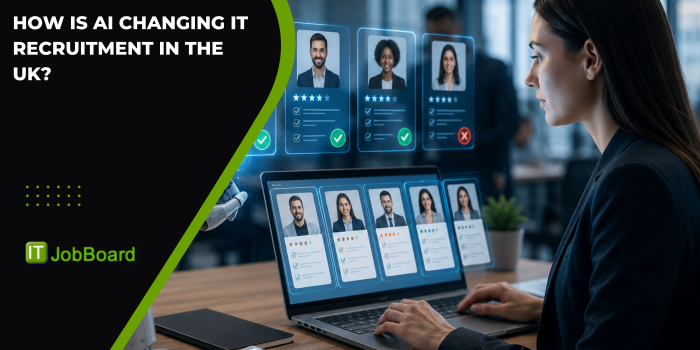
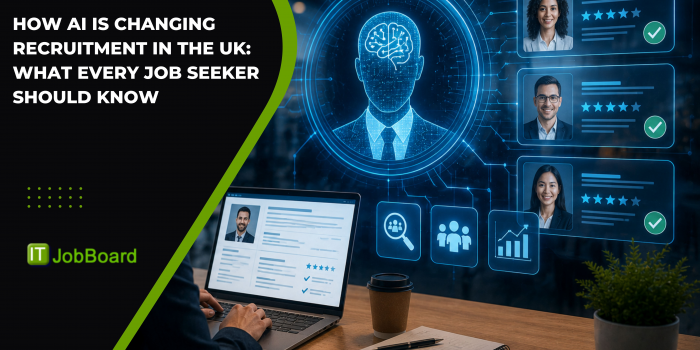
Artificial intelligence is changing more than the jobs people apply for. It is also changing how people are hired.
For candidates searching for IT jobs in the UK, the recruitment process increasingly involves automated CV screening, skills matching, online assessments, AI-assisted interview processes and digital talent platforms. At the same time, employers are using AI to process applications faster and identify candidates with particular technical capabilities.
This creates a new situation for both sides of the hiring process.
Candidates need to understand how their applications are evaluated, while employers need to make sure automation does not remove the human judgement required to identify the right person.
The shift is particularly relevant to the technology sector because IT recruitment already depends heavily on structured information such as technical skills, programming languages, certifications, job titles, experience and qualifications.
AI can analyse these signals at scale.
But can AI identify the best IT candidate?
Not always.
The future of IT recruitment is likely to involve a combination of automation, skills-based assessment and human decision-making.
Why is AI becoming important in UK IT recruitment?
Recruiters often deal with large numbers of applications for technology positions.
A single IT vacancy can attract candidates with different combinations of programming languages, certifications, experience levels and industry backgrounds.
Manually reviewing every CV can be time-consuming.
AI and recruitment software can help employers:
- Identify relevant skills
- Match candidates with vacancies
- Search CV databases
- Categorise applications
- Extract qualifications
- Identify experience
- Schedule interviews
- Generate candidate summaries
- Analyse recruitment data
This can reduce administrative work.
The UK's current AI skills research also shows that AI is becoming embedded in everyday work, while Skills England is encouraging employers to build workforce capability so AI can be used effectively and responsibly.
For recruitment teams, AI therefore becomes another productivity technology.
However, recruitment is not simply a data-processing problem.
A candidate's suitability can depend on communication, motivation, learning ability, teamwork and judgement — qualities that are much harder to evaluate from a CV alone.
How does AI screen IT CVs?
AI-powered recruitment systems can analyse CVs and application information against predefined requirements.
For an IT role, the system may identify terms associated with:
- Python
- Java
- SQL
- AWS
- Azure
- Cybersecurity
- Cloud computing
- Data analysis
- Machine learning
- DevOps
- Software development
- IT support
It can then help recruiters identify candidates whose profiles appear relevant.
This is useful when an employer receives hundreds of applications.
But candidates should understand an important limitation.
Matching keywords does not necessarily mean matching capability.
A CV may contain the phrase “Python” without demonstrating meaningful Python experience.
Another candidate may have strong transferable experience but use different terminology from the job description.
This is one reason skills-based recruitment is becoming increasingly important.
Is AI making IT recruitment more skills-based?
Potentially, yes.
One of the most significant changes associated with AI is the movement towards identifying specific skills rather than relying entirely on traditional career signals.
Instead of asking only:
“Does this candidate have five years of experience?”
Recruiters can increasingly ask:
“Can this candidate perform the skills required for this position?”
For technology jobs, that can involve evaluating:
- Programming ability
- Cloud skills
- Data skills
- AI literacy
- Cybersecurity knowledge
- Problem-solving
- Technical communication
- System design
- Automation
This approach can benefit candidates who have developed strong skills through alternative routes.
For example, someone who learned cloud computing through practical projects may have useful capabilities even without following a traditional career path.
However, skills-based hiring only works effectively when employers clearly define what “skill” means and assess it consistently.
Can AI accurately identify the best IT candidate?
AI can help identify potentially suitable candidates, but it should not automatically be treated as the final decision-maker.
A recruitment system can compare CV information with job requirements.
It cannot necessarily determine:
- How well someone communicates
- How they respond to uncertainty
- Whether they work effectively in a team
- How they approach unfamiliar problems
- Whether they can explain technical decisions
- How they respond to feedback
- Whether their experience is genuinely relevant
These factors matter particularly in IT.
A technically strong developer who cannot communicate effectively with product teams may not be the right hire.
Likewise, a candidate with fewer years of experience may outperform a more experienced candidate because they learn faster and adapt better.
AI can support the search.
Human judgement still matters.
How is AI changing IT interviews?
AI is also changing what happens after CV screening.
Online assessments can already test coding, data analysis, logical reasoning and technical knowledge.
AI can potentially assist with evaluating structured responses and identifying areas for further assessment.
At the same time, employers are becoming more aware that candidates can use generative AI during recruitment.
This creates a new problem.
If an applicant uses AI to generate every answer, how does an employer determine what the candidate actually knows?
Recent research into GenAI and entry-level software engineering found movement towards assessments that rely more heavily on observable, real-time interaction and higher-order tasks. The research also identified critical evaluation of AI output, responsible use of GenAI and independent learning as important capabilities.
This suggests that technical recruitment may become less dependent on simple take-home questions.
Candidates may increasingly need to explain their reasoning while solving a problem.
Will AI interviews replace human interviews?
It is unlikely that AI will completely replace human interviews for most important IT positions.
AI can help structure recruitment and automate parts of candidate assessment.
But human interviews provide information that automated systems may struggle to capture.
A hiring manager can ask:
“Why did you choose that architecture?”
“What would you change if the system had to support ten times the traffic?”
“What happened when your previous implementation failed?”
“How did you resolve disagreement with another developer?”
These questions test judgement and experience.
The answer is not simply whether the candidate knows a technology.
It is whether they can think like a professional who uses that technology.
That is difficult to reduce to a CV score.
How should IT candidates write CVs for AI-assisted recruitment?
Candidates should make their CVs easier for both software and humans to understand.
A strong IT CV should clearly communicate:
What you know
Programming languages, platforms, frameworks and technical skills.
What you have done
Projects, responsibilities and professional experience.
What you achieved
Performance improvements, automation, cost reduction, successful deployments or other measurable outcomes.
Where you used the skill
For example, instead of simply writing:
“Python”
A stronger entry might be:
“Used Python to automate data-processing workflows and introduce validation checks.”
The second version provides context.
Candidates should also avoid adding technologies they cannot discuss.
AI-assisted CV generation makes it easier to produce keyword-rich applications, but that can create problems later if the candidate cannot demonstrate the claimed skills during assessment.
Should candidates use AI to write their CVs?
AI can be useful for improving clarity, structure and grammar.
It can also help candidates identify missing information or tailor a CV to a particular vacancy.
But candidates should remain responsible for the final content.
A good process is:
Write your real experience first.
Then use AI to improve structure and presentation.
Check every technical claim.
Remove exaggerated language.
Make sure every skill can be explained in an interview.
Avoid inventing achievements.
This distinction is important because AI can make a weak CV look polished without making the underlying candidate stronger.
Employers are increasingly interested in genuine capability, not simply well-written application documents.
How can candidates make their IT CV more AI-friendly?
There is no need to fill a CV with keywords.
Instead, candidates should use clear terminology that accurately reflects their experience.
For example, if a job requires cloud computing, a candidate with genuine AWS experience should state the specific services or responsibilities they worked with.
Instead of:
“Experienced in cloud.”
Use:
“Deployed containerised applications on AWS using ECS and integrated CloudWatch monitoring.”
This gives both automated systems and recruiters more useful information.
The same principle applies to AI.
Instead of:
“AI expert.”
A candidate might say:
“Built an internal knowledge assistant using an LLM API and retrieval-based search, with validation checks for generated responses.”
Specificity is more useful than buzzwords.
Is skills-based hiring better for IT candidates?
It can be.
Traditional hiring often places significant weight on qualifications, job titles and years of experience.
Skills-based hiring can create opportunities for people who have developed capabilities through:
- Self-learning
- Bootcamps
- Apprenticeships
- Freelance projects
- Open-source contributions
- Personal projects
- Certifications
- Career transitions
This can be particularly useful in fast-changing areas such as AI, cloud and cybersecurity.
However, skills-based hiring still needs reliable assessment.
If an employer claims to hire based on skills but uses only CV keywords, the process has not truly become skills-based.
A genuine skills-first process needs evidence.
That could include technical assessments, portfolio reviews, practical tasks, structured interviews or work samples.
How is AI changing recruitment for junior IT professionals?
This is one of the most important areas of change.
Junior recruitment has traditionally involved identifying candidates with potential and developing them over time.
But AI can automate some of the routine tasks that previously provided junior employees with experience.
At the same time, employers may expect graduates to arrive with stronger digital and AI skills.
Hays identifies automation as one of the factors redefining early-career recruitment in the UK in 2026.
This creates a difficult balance.
Employers want productive employees.
Graduates need opportunities to develop experience.
The solution may be to redesign junior roles rather than remove them.
AI can handle repetitive tasks while junior professionals focus more on monitoring, evaluation, problem-solving and learning.
Could AI make recruitment unfair?
Yes, if it is designed or used poorly.
AI systems learn from data.
If historical recruitment decisions contain biases, automated systems can potentially reproduce or reinforce those patterns.
There is also a risk that candidates with non-traditional career paths may be overlooked if an algorithm relies too heavily on conventional signals.
For example, a career changer may have excellent technical skills but lack the exact job title used in the recruitment database.
Similarly, a candidate may have relevant experience described using different terminology.
This is why automated recruitment needs governance, monitoring and human oversight.
The goal should not be:
“Let AI choose the candidate.”
It should be:
“Use AI to help recruiters make better-informed decisions.”
What are the benefits of AI recruitment for employers?
When implemented properly, AI can provide several benefits.
Faster screening
Recruiters can process large volumes of applications more efficiently.
Better search
AI can identify relationships between skills, experience and job requirements.
Reduced administrative work
Scheduling, communication and candidate management can be partially automated.
More consistent processes
Structured assessment can reduce some forms of inconsistency between recruiters.
Better talent matching
AI can potentially identify candidates whose skills are relevant even when their job titles differ.
Recruitment analytics
Employers can analyse hiring pipelines and identify bottlenecks.
However, these benefits depend heavily on data quality, system design and human oversight.
What are the risks of AI recruitment?
The risks are equally important.
Over-reliance on keywords
Strong candidates can be missed if their experience is described differently.
Bias
Poorly designed systems can reproduce historical patterns.
Lack of transparency
Candidates may not understand how their applications were evaluated.
False confidence
A high algorithmic score does not necessarily mean the candidate is suitable.
Privacy concerns
Recruitment systems process sensitive personal and professional information.
AI-generated applications
Employers increasingly need to distinguish genuine candidate capability from AI-generated application content.
These risks mean that AI recruitment should be treated as an assistance system, not an infallible judge.
What does AI mean for recruiters in the UK?
Recruiters themselves are also being affected.
Rather than spending most of their time manually searching CVs and performing administrative tasks, recruiters can increasingly focus on:
- Candidate relationships
- Workforce planning
- Skills analysis
- Employer branding
- Interview design
- Candidate experience
- Talent-market intelligence
- Hiring strategy
This could make recruitment more strategic.
However, recruiters also need AI literacy.
Skills England's recent AI upskilling research found that organisations often struggle to translate AI availability into effective workforce capability. It recommends structured approaches to training so employees can use AI effectively, safely and responsibly.
Recruitment professionals therefore need to understand both the opportunities and limitations of AI.
Will AI make IT recruitment faster?
In many parts of the process, yes.
Searching, filtering, scheduling and summarising can all potentially be accelerated.
But faster recruitment is not automatically better recruitment.
If an organisation moves candidates through the process quickly but fails to evaluate technical ability accurately, the result may be poor hiring decisions.
The real objective should be:
Faster where automation adds value, human-led where judgement matters.
This hybrid model is likely to become increasingly common.
How should IT candidates prepare for AI-powered recruitment?
Candidates should prepare for two different evaluations.
The first is digital discoverability.
Recruitment systems need to understand what skills and experience the candidate has.
The second is human verification.
A recruiter or hiring manager needs to see evidence that the candidate genuinely possesses those skills.
A strong candidate should therefore:
- Use accurate technical terminology
- Show practical achievements
- Include relevant projects
- Quantify results where possible
- Keep skills consistent with experience
- Prepare to explain every major technology listed
- Practise technical problem-solving
- Be prepared to discuss AI use responsibly
The objective is not to “beat the algorithm”.
It is to make your genuine capabilities easy to identify.
Is AI changing what employers consider a good IT candidate?
Yes.
The traditional definition of a strong technology candidate often centred on technical knowledge and experience.
Increasingly, employers may also value the ability to work effectively with AI.
That includes:
Technical capability
Can you do the work?
AI literacy
Can you use AI appropriately?
Critical thinking
Can you identify when AI is wrong?
Adaptability
Can you learn when tools and workflows change?
Communication
Can you explain your decisions?
Professional judgement
Can you understand when technology should — and should not — be used?
This combination is likely to become increasingly important as AI becomes embedded into ordinary IT workflows.
What does the future of AI recruitment in the UK look like?
The future is unlikely to be completely automated.
Instead, recruitment is likely to become a hybrid process.
AI will increasingly help with:
- Search
- Matching
- Screening
- Scheduling
- Skills analysis
- Recruitment administration
- Candidate communication
Humans will remain important for:
- Complex interviews
- Technical judgement
- Cultural context
- Candidate relationships
- Final hiring decisions
- Assessing potential
- Understanding unusual career paths
The UK Government's current AI skills work shows that AI adoption is expanding while organisations still need to build workforce capability around effective and responsible use.
That principle applies to recruitment too.
The future of IT hiring will not simply be about finding people who know AI.
It will be about finding people who can work effectively with AI while retaining the technical and human skills needed to make good decisions.
For IT professionals, that means the recruitment process itself is becoming another reason to develop AI literacy.
For employers, it means AI should be used to improve hiring — not to remove the human judgement that makes good hiring possible.
Frequently Asked Questions
How is AI changing IT recruitment in the UK?
AI is changing IT recruitment through automated CV screening, candidate matching, skills analysis, interview support, scheduling and recruitment analytics. Human judgement remains important for technical assessment and final hiring decisions.
Can AI screen IT CVs?
Yes. AI-powered recruitment systems can analyse CVs for skills, qualifications, experience and other information relevant to a vacancy. However, keyword matching does not guarantee that a candidate has genuine practical capability.
Should I use AI to write my IT CV?
AI can help improve CV structure, grammar and clarity, but candidates should ensure every statement is accurate and based on genuine experience. Candidates should also be able to explain all technical skills listed on their CV.
What is skills-based hiring?
Skills-based hiring focuses more heavily on the capabilities required to perform a job rather than relying only on qualifications, job titles or years of experience. For IT roles, this can include programming, cloud, data, cybersecurity and AI skills.
Will AI replace IT recruiters?
AI is more likely to automate parts of recruitment administration and candidate search than eliminate the need for recruiters entirely. Recruiters can increasingly focus on candidate relationships, assessment, workforce planning and hiring strategy.
Can AI recruitment systems be biased?
Yes. Poorly designed or trained systems can reproduce biases present in historical data or recruitment processes. Human oversight, monitoring and appropriate governance are therefore important.
Will AI interviews replace human interviews?
AI can support assessments and interviews, but human interviews remain valuable for evaluating communication, judgement, reasoning, motivation and other qualities that are difficult to measure from automated data alone.
What should IT candidates do to prepare for AI recruitment?
Candidates should use clear technical terminology, demonstrate practical skills, include relevant projects and be prepared to explain their experience in interviews and technical assessments.
Are AI skills becoming important for recruiters?
Yes. Recruiters increasingly need enough AI literacy to understand recruitment automation, candidate assessment, data, responsible AI use and the limitations of automated decision-making.
What skills will employers value in AI-enabled IT candidates?
Employers can increasingly value a combination of technical expertise, AI literacy, critical thinking, problem-solving, adaptability, communication and the ability to evaluate AI-generated outputs.
Does AI make IT recruitment faster?
AI can accelerate tasks such as CV searching, candidate matching, scheduling and summarisation. However, faster recruitment does not automatically mean better recruitment, so human assessment remains important.
What is the future of IT recruitment?
The most likely direction is a hybrid model where AI handles repetitive recruitment tasks while humans remain responsible for complex assessment, relationships, judgement and final hiring decisions.