30/07/2026
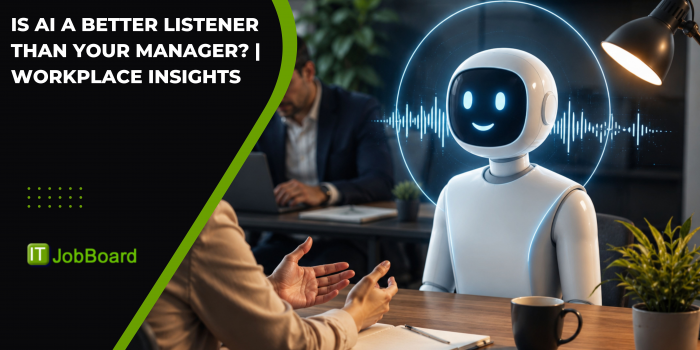
Is AI a Better Listener Than Your Manager? Lessons for the Modern Workplace
Ask Alexa a question at 2 a.m. and she answers instantly, no yawning, no impatience, no scrolling her phone while you talk. Ask a chatbot to walk you through a tricky HR policy and it will patiently repeat itself as many times as you need. AI never gets distracted, never interrupts, never checks the clock.
And yet, something is missing. We know, on some level, that the voice on the other end doesn't actually care. It processes. It doesn't feel.
That gap — between hearing and caring — is exactly what makes AI such an unexpected teacher. By watching what AI does well, and noticing precisely where it falls short, we can learn a lot about what real listening requires.
What AI Gets Right
It never multitasks on you. Every input gets full attention, every time. No half-formed thoughts while it waits for its turn to speak.
It doesn't interrupt. It lets you finish. In a workplace where meetings are a scramble of talking over each other, that alone is a lesson.
It remembers what you told it. Ask a well-built assistant something you mentioned earlier, and it recalls it. Compare that to a manager who forgets your update from last Tuesday's stand-up.
It responds to what you actually said. AI doesn't listen through the filter of what it wants to say next. It processes your exact words before generating a reply.
These are behaviors, not feelings — but behaviors are trainable. And that's the useful part.
Where AI Falls Short — and Why It Matters
AI can process your words without understanding your situation. It can recognize the word "overwhelmed" in a sentence without grasping what overwhelm feels like at 6 p.m. after a ten-hour shift. It offers the statistically likely response, not the emotionally right one.
This is the core difference: AI listens to respond correctly. Humans listen to connect.
That distinction matters most in workplaces — especially in industries like IT, where technical problem-solving can quietly crowd out the human side of a conversation. A developer describing a burnout-level workload doesn't need a solution generated in 0.3 seconds. They need someone who pauses, reflects, and asks a real follow-up question.
Five Listening Habits Borrowed From AI (and Made Human)
- Give full attention, not partial attention. Close the second tab. Put the phone face-down. AI doesn't multitask — and neither should you, for the two minutes someone is talking to you.
- Let people finish their sentence. Resist the urge to jump in with your own story or your own solution. Processing fully before responding is a discipline, not an accident.
- Reflect back before reacting. A good chatbot often paraphrases your question before answering. Try it in real conversation: "So what I'm hearing is..." It confirms understanding and it shows the other person they were actually heard.
- Remember the details. Following up on something someone mentioned weeks ago — a sick parent, a tough sprint, a job interview — signals that they mattered to you beyond the moment.
- Then go further than AI can. Ask how they're feeling about it, not just what happened. That's the step no algorithm can fully take, and it's the step that turns hearing into caring.
The Takeaway for Hiring and Workplace Culture
As AI tools take over more of the transactional listening — intake forms, FAQs, initial screening calls — the human parts of the job become more valuable, not less. Recruiters, managers, and team leads who can genuinely listen will stand out precisely because so much "listening" has quietly become automated.
AI can hear every word. It takes a human to notice what's underneath them.
FAQs
Can AI really "listen" the way humans do?
Not exactly. AI can process language accurately, respond consistently, and never get distracted — but it doesn't understand emotion or context the way a human does. It hears words; it doesn't feel meaning.
Why compare AI listening to workplace communication?
Because AI's strengths — full attention, no interrupting, consistent follow-through — highlight habits many managers and teams have let slip. It's a useful mirror, not a replacement.
Is AI replacing human listening skills in the workplace?
No — if anything, it raises the bar. As AI takes over routine, transactional exchanges (FAQs, screening calls, intake forms), the ability to listen with genuine empathy becomes a more valuable human skill, not a less important one.
What are practical ways to "listen like AI" without losing the human touch?
Give full attention without multitasking, let people finish speaking, reflect back what you heard before responding, and remember details from past conversations. Then go a step further AI can't: ask how the person feels, not just what happened.
How does this apply specifically to IT and tech workplaces?
Tech environments often prioritize fast problem-solving over emotional check-ins. Recognizing burnout, frustration, or disengagement requires the kind of patient, reflective listening AI does mechanically — but that leaders need to do genuinely.
Can better listening actually improve retention or hiring outcomes?
Yes. Employees who feel heard are more engaged and less likely to leave. For recruiters and managers, genuine listening during interviews and 1:1s builds trust that generic, automated interactions can't replicate.