07/07/2026
AI Engineer Jobs UK: Mastering Skills in Machine Learning and Deep Learning
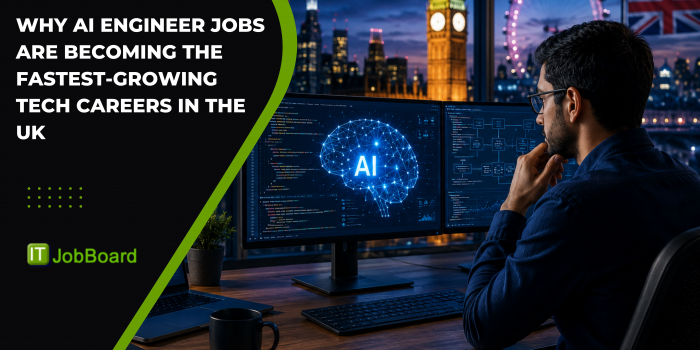
Artificial Intelligence is no longer a niche technology used only by research teams. UK businesses across finance, healthcare, retail, cybersecurity, manufacturing, and government are investing heavily in AI to automate processes, improve decision-making, and create new digital products. As a result, AI Engineer jobs in the UK are becoming some of the most sought-after roles in the technology sector.
Whether you're a software developer looking to move into AI, a graduate exploring career options, or a data professional wanting to specialise in machine learning, this guide explains the skills, tools, salaries, and career paths that employers are looking for in 2026.
What Does an AI Engineer Do?
An AI Engineer designs, builds, and deploys machine learning and deep learning systems that can learn from data and make predictions or decisions.
Typical responsibilities include:
- Building machine learning models
- Training and evaluating algorithms
- Working with large datasets
- Deploying AI applications into production
- Monitoring model performance
- Collaborating with software, data, and cloud teams
- Improving accuracy, scalability, and reliability of AI systems
Many employers advertise these positions under titles such as Machine Learning Engineer, AI Developer, Applied AI Engineer, or Deep Learning Engineer.
Why AI Engineering Is Growing in the UK
Demand for AI talent is increasing because organisations want to:
- Automate repetitive tasks
- Improve customer experiences
- Detect fraud and security threats
- Analyse large volumes of data
- Build intelligent products and services
- Reduce operational costs
Financial services, healthcare providers, e-commerce companies, and technology firms are among the biggest recruiters. Candidates searching AI Jobs UK are increasingly finding opportunities in both established enterprises and fast-growing startups.
For professionals already working with data, transitioning from Data Scientist Jobs into AI engineering is becoming a common career path as employers seek candidates who can not only analyse data but also deploy production-ready AI systems.
Essential Skills Every AI Engineer Needs
1. Python Programming
Python is the dominant language for AI and machine learning.
Employers expect experience with:
- NumPy
- Pandas
- Scikit-learn
- Jupyter Notebook
- FastAPI or Flask
Strong Python skills are often the first requirement listed in Machine Learning Engineer Jobs.
2. Machine Learning Fundamentals
AI Engineers should understand:
- Supervised learning
- Unsupervised learning
- Classification and regression
- Feature engineering
- Model evaluation
- Cross-validation
- Bias and variance
Understanding why a model works is just as important as knowing how to code it.
3. Deep Learning
Deep learning is increasingly important for:
- Computer vision
- Natural language processing
- Speech recognition
- Recommendation systems
- Generative AI applications
Popular frameworks include:
Experience with these frameworks is highly valued in modern AI recruitment.
4. Data Engineering & SQL
AI systems depend on clean, reliable data. Employers increasingly prefer candidates who can work with databases, data pipelines, and cloud storage systems.
Useful skills include:
- SQL
- ETL processes
- Data warehousing
- Apache Spark
- Cloud data platforms
5. Cloud & MLOps
Modern AI applications are often deployed in the cloud. Familiarity with AWS, Azure, or Google Cloud can significantly improve employability.
Many AI teams work closely with professionals in Cloud Engineer Jobs and DevOps Engineer Jobs to automate deployment and monitoring.
Useful MLOps tools include:
- Docker
- Kubernetes
- MLflow
- GitHub Actions
- CI/CD pipelines
Qualifications and Certifications
Many AI Engineers have degrees in:
- Computer Science
- Data Science
- Mathematics
- Statistics
- Engineering
However, employers increasingly value practical project experience and certifications alongside formal education.
Useful certifications include:
- AWS Certified Machine Learning – Specialty
- Microsoft Azure AI Engineer Associate
- Google Professional Machine Learning Engineer
- DeepLearning.AI Specializations
- TensorFlow Developer Certificate
A strong portfolio demonstrating real machine learning projects can often be as important as academic qualifications.
Career Path for AI Engineers
A typical progression looks like this:
Graduate Software Developer
Junior Machine Learning Engineer
AI Engineer
Senior AI Engineer
Lead AI Engineer
AI Architect / Head of AI
Many professionals also move into specialised areas such as:
- Computer Vision
- NLP Engineering
- AI Infrastructure
- MLOps
- AI Research
- Generative AI
For developers currently working in Software Developer Jobs, AI engineering can offer a natural progression into higher-paying, specialist technology roles.
AI Engineer Salary Guide UK
AI engineering is one of the highest-paying technology careers in the UK. Salaries vary depending on experience, location, industry, technical expertise, and the complexity of the AI solutions being developed.
Professionals working in London, Cambridge, Manchester, and Edinburgh often receive higher salaries due to the concentration of technology companies, financial institutions, and AI startups.
|
Job Role
|
Typical UK Salary
|
|
Junior AI Engineer
|
£40,000–£55,000
|
|
AI Engineer
|
£55,000–£75,000
|
|
Senior AI Engineer
|
£75,000–£95,000
|
|
Lead AI Engineer
|
£95,000–£120,000
|
|
AI Architect
|
£110,000–£140,000+
|
|
Head of AI
|
£130,000–£170,000+
|
Professionals with expertise in cloud platforms, MLOps, large language models (LLMs), and production AI systems are often among the highest earners in the technology sector.
AI Tools and Technologies Employers Want
Recruiters are increasingly looking for candidates who can work with modern AI tools beyond traditional machine learning libraries.
Popular technologies include:
Machine Learning Frameworks
- TensorFlow
- PyTorch
- Scikit-learn
- XGBoost
- Hugging Face Transformers
Programming Languages
- Python
- SQL
- Java
- Scala
- R (for some analytics roles)
Cloud Platforms
- Amazon Web Services (AWS)
- Microsoft Azure
- Google Cloud Platform (GCP)
Cloud deployment has become a standard requirement for many AI roles. If you're interested in cloud technologies, read our guide to Cloud Engineer Careers: Skills Employers Expect From Candidates, which explains how cloud expertise complements AI engineering.
MLOps Tools
Modern AI models require continuous deployment, monitoring, and optimisation.
Common tools include:
- Docker
- Kubernetes
- MLflow
- Kubeflow
- Git
- Jenkins
- GitHub Actions
Employers increasingly seek engineers who can build production-ready AI systems rather than experimental models.
Emerging Trends in AI Engineering
Artificial intelligence continues to evolve rapidly. Keeping your skills current is essential for long-term career success.
Generative AI
Generative AI has transformed how businesses create content, write code, analyse documents, and automate customer support.
Experience with Large Language Models (LLMs), prompt engineering, Retrieval-Augmented Generation (RAG), and AI agents is becoming highly desirable.
AI Governance
As AI adoption grows, organisations must ensure models are ethical, secure, and compliant with regulations.
Professionals who understand responsible AI practices and governance frameworks are increasingly valuable. Our article on AI Governance Jobs: Why Every Company Will Need AI Governance Specialists explores this growing career path.
MLOps
Machine learning operations (MLOps) focuses on deploying, monitoring, and maintaining AI models in production.
Companies are investing heavily in MLOps engineers who can automate model deployment and improve reliability.
AI and Cybersecurity
AI is now widely used for threat detection, fraud prevention, and security automation.
Professionals combining AI expertise with Cyber Security Jobs experience are becoming increasingly sought after.
How to Stand Out When Applying for AI Engineer Jobs
Competition for AI roles is increasing, but employers consistently value practical experience alongside technical knowledge.
To strengthen your CV:
- Build real-world machine learning projects.
- Publish code on GitHub.
- Participate in Kaggle competitions.
- Create AI applications using APIs and open-source models.
- Learn cloud deployment with AWS, Azure, or GCP.
- Gain experience with Docker and Kubernetes.
- Contribute to open-source AI projects.
Employers also appreciate candidates who can explain technical concepts clearly and collaborate effectively with software developers, data scientists, and business stakeholders.
Career Progression Beyond AI Engineering
AI engineering opens the door to several specialist and leadership careers.
Possible progression includes:
- Senior AI Engineer
- Machine Learning Architect
- AI Solutions Architect
- Head of AI Engineering
- Chief AI Officer
- AI Research Scientist
- MLOps Lead
- AI Product Manager
Many professionals also transition into cloud architecture or platform engineering. If you're comparing infrastructure-focused careers, our guide Platform Engineer vs DevOps Engineer: Which Career Pays More? explains how these roles differ and where they overlap with AI engineering.
Why AI Engineering Is a Future-Proof Career
Artificial intelligence is becoming a core capability across almost every industry. Organisations are investing heavily in AI-powered automation, predictive analytics, robotics, healthcare diagnostics, financial modelling, and intelligent customer experiences.
At the same time, demand for professionals capable of designing, deploying, and maintaining production AI systems continues to outpace supply.
By developing strong programming skills, understanding machine learning fundamentals, learning cloud platforms, and staying up to date with emerging AI technologies, you can build a highly rewarding career with excellent long-term prospects.
Conclusion
AI engineering has quickly become one of the UK's most exciting and rewarding technology careers. Businesses across finance, healthcare, retail, manufacturing, and the public sector are looking for professionals who can turn data into intelligent solutions that improve efficiency and drive innovation.
Whether you're starting your career or transitioning from software development or data science, investing in machine learning, deep learning, cloud computing, and MLOps skills will significantly improve your career opportunities.
Ready to take the next step? Explore the latest AI Engineer Jobs UK on ITJobBoard.co.uk and discover opportunities with employers shaping the future of artificial intelligence.
Frequently Asked Questions
1. What does an AI Engineer do?
An AI Engineer designs, develops, deploys, and maintains machine learning and deep learning systems that help organisations automate tasks, analyse data, and make intelligent decisions.
2. Which programming language is best for AI?
Python is the most widely used programming language for AI because of its extensive ecosystem of machine learning and deep learning libraries.
3. Do I need a degree to become an AI Engineer?
While many employers prefer a degree in Computer Science, Data Science, Mathematics, or Engineering, practical experience, certifications, and a strong project portfolio are increasingly important.
4. How much do AI Engineers earn in the UK?
AI Engineers typically earn between £40,000 and £75,000, while senior professionals and AI architects can earn well over £100,000 annually.
5. Which AI frameworks should I learn?
TensorFlow, PyTorch, Scikit-learn, and Hugging Face are among the most widely used AI frameworks in the industry.
6. Is cloud computing important for AI Engineers?
Yes. Many AI applications are deployed using cloud platforms such as AWS, Microsoft Azure, and Google Cloud, making cloud skills highly valuable.
7. What industries hire AI Engineers?
AI Engineers work across finance, healthcare, retail, manufacturing, cybersecurity, telecommunications, automotive, and government sectors.
8. Is AI Engineering a good career in the UK?
Yes. AI engineering offers excellent salaries, strong demand, continuous innovation, and outstanding long-term career prospects across multiple industries.